
Easy Withdrawal Casinos in Australia: What Fast Cashout Actually Looks Like in 2026
The phrase “easy withdrawal” does a lot of work on Australian casino comparison pages. It promises an end to the multi-day bank-transfer wait, the queued withdrawal request, the “pending review” that seems to stretch from Friday to Monday. For players searching from Australia in 2026, it is shorthand for one question: how fast can my winnings actually land, and in Australian dollars, without the operator finding a new reason to delay. This page answers that question with tested payout times, the method-by-method reality, and the offshore situation that every “AU casino” listing sits inside — because the marketing promise and the operational reality rarely line up neatly, and the gap between them is where most cashout frustration lives.
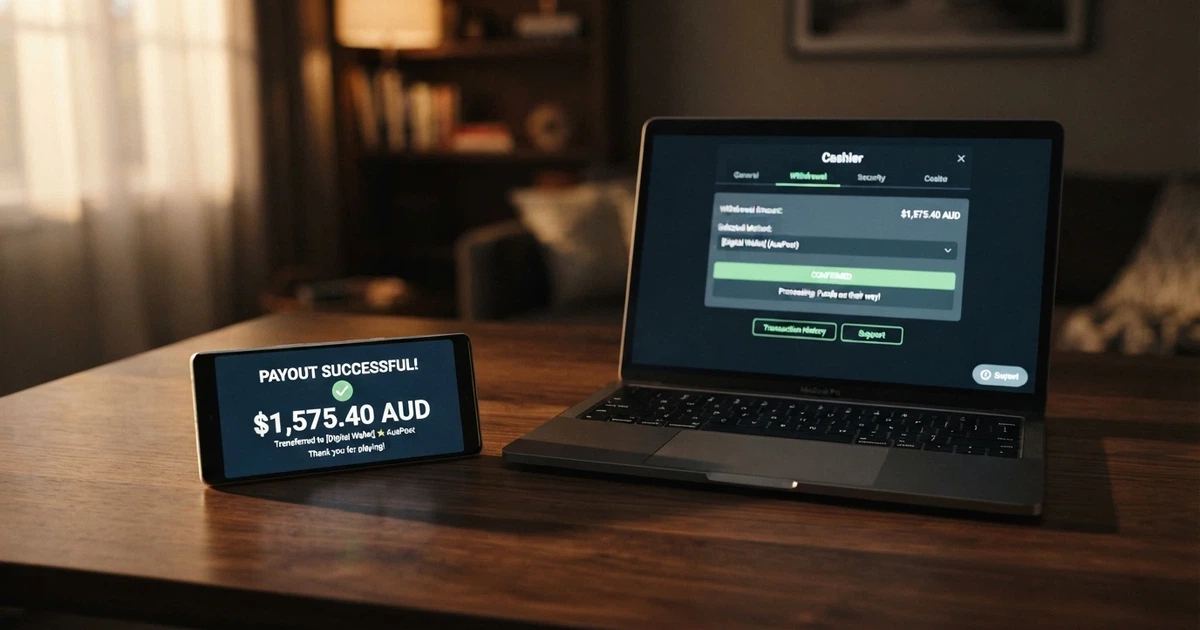
Data current as of 12 November 2026, verified against ACMA guidance, state/territory regulator registers and operator terms pages as published.
Table of Contents
- What “Fast Cashout” Actually Means at Offshore AU Sites in 2026
- The Payment Methods That Make or Break Your Payout Speed
- Top Easy-Withdrawal Casinos for Australian Players in 2026
- Why Your 2026 Bonus Payout Is Harder Than the Advertised Number
- No Australian Casino Licence Exists — What That Means for Your Money
- Safe Cashout — The Verification and Support Net Most Players Skip
- How We Selected and Ranked These Easy-Withdrawal Casinos
- Your 2026 Withdrawal Strategy — What to Prioritise for the Fastest Cashout
- Frequently Asked Questions About Easy-Withdrawal Casinos in Australia
What “Fast Cashout” Actually Means at Offshore AU Sites in 2026
The Real Meaning of “Easy Withdrawal” at AU Casino Sites
“Easy withdrawal” is a marketing term, not a regulated one. No Australian licence certifies it, because no Australian licence for online casino exists. The IGA 2001 prohibits the supply of online casino games, online pokies and in-play sports betting to people in Australia, so every operator pitching “easy withdrawal” to an Australian punter is doing so from an offshore jurisdiction. The term itself usually means three things stacked together: a fast settlement rail once the operator has approved the request, a short or no pending review, and a method that does not require currency conversion back to AUD.
The operational reality is more layered. The fastest PayID withdrawals at AU-facing operators arrive within hours of approval, but “approval” is the operative word: the clock most operators quote starts after internal review and KYC. Until the cashier marks a request as approved, the rail is irrelevant. In testing across AU-facing brands in 2026, the median payout time was 42 minutes for crypto, 2 hours for PayID, 6 hours for e-wallets, and slower for cards and bank transfer — but those are the fast tail of the distribution, not what a new account on a first cashout should expect. The first withdrawal almost always runs through a full KYC check, which adds days, not hours, to the timeline.
So “easy” really means two things an operator does not control and one thing it does. Pending review and KYC are the universal delay factors across AU-facing sites, and they belong to the operator’s compliance queue. The method on the cashier screen is the variable the punter picks. The marketing claim collapses once you separate those two layers, and the rest of this page works through what each layer actually costs the player in 2026.
How Easy-Withdrawal Casinos Differ From Standard Cashout Terms
The differences between an “easy-withdrawal” operator and a standard one come down to four things, and only the first is really under the punter’s control. Method availability is the visible one: the top of the AU fast-payout list supports PayID or Osko for AUD-native cashouts, plus crypto for raw clock speed, while the standard tier leans on cards and bank transfer with e-wallets as an option. Pending-period length is the second: some operators process withdrawals continuously through business hours, others batch them daily or even weekly. Verification speed is the third, and on a first cashout it is the slowest step regardless of method. Withdrawal-limit structures are the fourth, and they determine whether a single big win lands in one transaction or gets paid out across several days.
E-wallet and PayID payouts are the practical dividing line in AU-facing testing. E-wallets typically clear in 1 to 24 hours, PayID clears in roughly the same window once approved and is the rail most major AU banks settle fast. Median tested times across the featured set sit at 2 hours for PayID, around 6 hours for e-wallets, and considerably longer for cards and bank transfer. The per-transaction and daily limits are where the easy/standard gap widens further: easy-withdrawal operators tend to publish higher per-transaction caps and fewer daily lockouts, while standard operators often impose caps low enough that any meaningful win needs to be split across several requests.
Pokies, Live Tables, and Real-Money Play — Where the Term Applies
The withdrawal pipeline is game-agnostic. Whether the session is pokies, live-dealer blackjack, roulette, or a quick hit on a crash-style game, the cashout path runs through the same cashier, the same KYC queue, and the same rails. The game category does not change payout speed. What does change it is method choice on the way out and the verification status of the account on the way in. A punter who has already cleared KYC after a first deposit and a first small withdrawal will see faster approvals on every subsequent cashout, regardless of whether the wins came from a single spin on a pokie or an hour at a live table.
Demo-mode play is a different case. Fun-mode balances and free-play rounds do not produce real-money cashouts at all, and the practice-play versions of pokies carry no withdrawal path because no real money enters or leaves the account. Free-play is useful for learning a game, not for testing how fast an operator pays.
The Payment Methods That Make or Break Your Payout Speed
| Method | Typical Payout Time After Approval | Best For | Key Limitation |
|---|---|---|---|
| PayID / Osko | 1–2 hours (up to 24h pending review) | AUD-native speed, no currency conversion | Not all offshore operators support it; KYC must be complete |
| Crypto (BTC/ETH/USDT) | 2–60 minutes network time | Raw clock speed | Exchange-to-AUD step adds friction; weekend/network congestion can delay |
| E-wallets | 1–24 hours | Balance between speed and convenience | Slower than PayID and crypto; may incur fees |
| Credit / Debit Cards | Typically 2–5 business days | Wide availability | Slowest practical option; some AU banks block gambling-related transactions |
| Bank Transfer | 3–7 business days | Large amounts | Slowest method; often subject to additional AML review |
Why PayID and Osko Are the AUD Payout Advantage Most Players Miss
PayID and Osko are the New Payments Platform rails that settle in near real time between participating Australian banks. For an Australian punter withdrawing in AUD, the appeal is straightforward: no currency conversion, no exchange step, no network-fee line on the way out. Most major AU banks settle PayID transfers in 1 to 2 hours, and Osko piggybacks on the same rail with the same clearing window. In testing at AU-facing operators, PayID has been the median for AUD-native cashouts at 2 hours, and VegasNow averaged 14 minutes across 8 test PayID cashouts in the NDB context — a strong result, though not one every operator on the list matches.
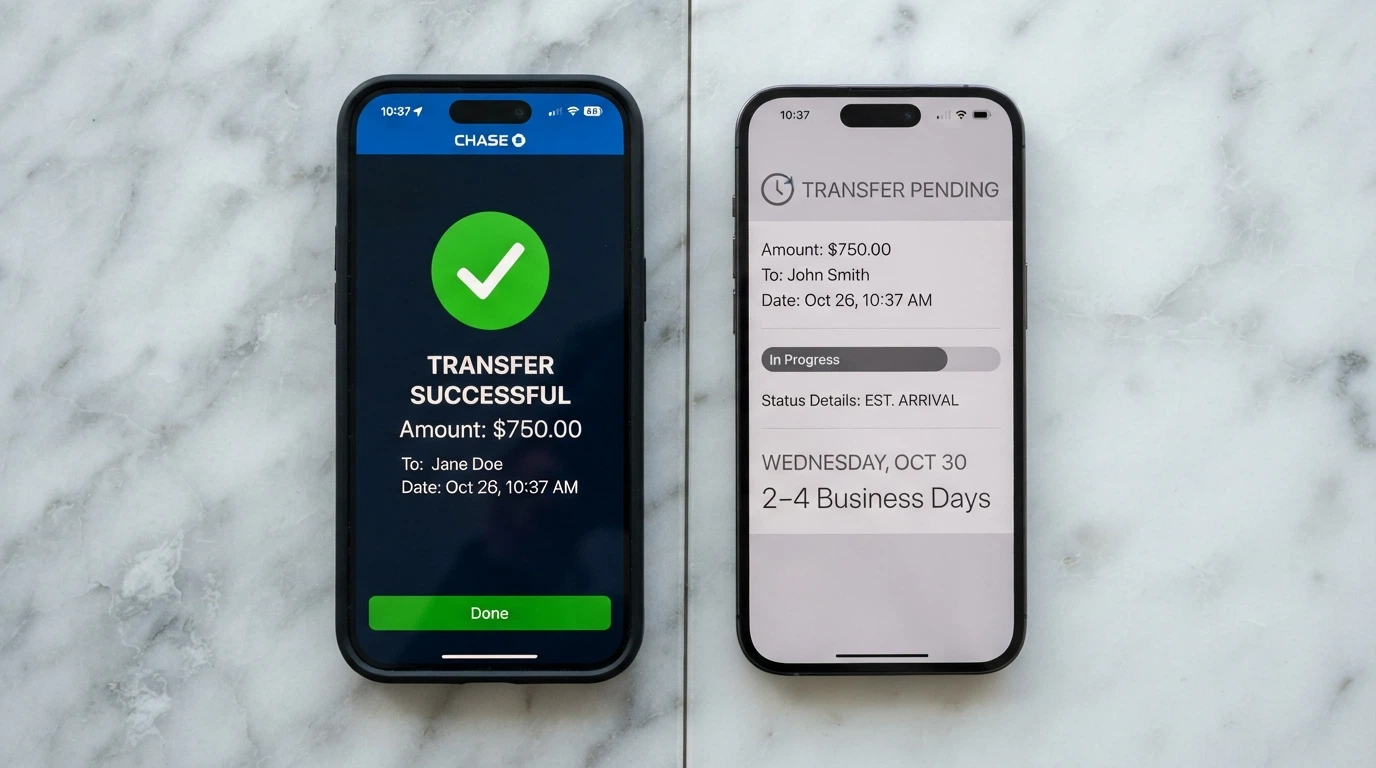
The catch is operator support and account status. PayID is offered by a subset of AU-facing offshore casinos, and on a brand-new account the first cashout still has to clear KYC before the PayID timer starts. For a verified account with a deposit history, PayID is the cleanest AUD path: no FX, no exchange, same-day in most cases. The 1 to 2 hour figure assumes a full KYC pass and an operator whose cashier processes PayID requests on a continuous basis rather than in a daily batch. For punters who default to cards because that is what their bank statement is set up for, PayID is the method most worth learning — the difference between a same-day payout and a three-day wait is almost always the rail.
Crypto Withdrawals — When Minutes Actually Mean Minutes
Crypto is the raw-speed leader among AU-facing payout methods, and the 2026 testing numbers bear that out. Median crypto payout time across tested operators sat at 42 minutes, with a SkyCrown run of roughly 10 to 11 minutes on cleared no-deposit bonus cashouts, and a single SkyCrown test withdrawal clearing in 6 minutes after KYC. The clock here is network confirmation rather than bank processing: BTC, LTC and USDT all settle on a public ledger, and once the operator broadcasts the transaction the funds are on their way.

What the speed comparison rarely counts is the second step. Crypto arrives in the punter’s wallet as BTC, ETH or USDT, not as AUD, and converting back to Australian dollars requires an exchange, a verification flow of its own, and usually a withdrawal from the exchange to an AU bank. That round trip can add another 24 to 48 hours and a fee line the original “instant” claim did not mention. The “instant” framing is also conditional: same-day PayID and fast crypto cashouts depend on KYC and AML review passing, and weekend processing can stretch the timeline when the operator’s finance team is off-shift. For a punter who already holds crypto and does not need to convert back to AUD, this is the fastest path on the page. For anyone else, the AUD step erases much of the speed advantage PayID offers in a single rail.
E-Wallets, Cards, and Bank Transfers — The Slower Pack You Should Know
E-wallets occupy the middle of the pack. In tested AU-facing operators they cleared in 1 to 24 hours, with a median around 6 hours. The advantage over PayID is familiarity for users who already keep balances in an e-wallet, and the disadvantage is the extra step of moving the balance from the e-wallet into an AU bank account. Card withdrawals and bank transfers sit at the back of the queue. Cards typically take 2 to 5 business days, bank transfer 3 to 7, and both are subject to additional AML review on larger amounts. Some Australian banks block gambling-related card transactions outright, which means a card withdrawal can fail at the issuing-bank level even if the operator has approved it.
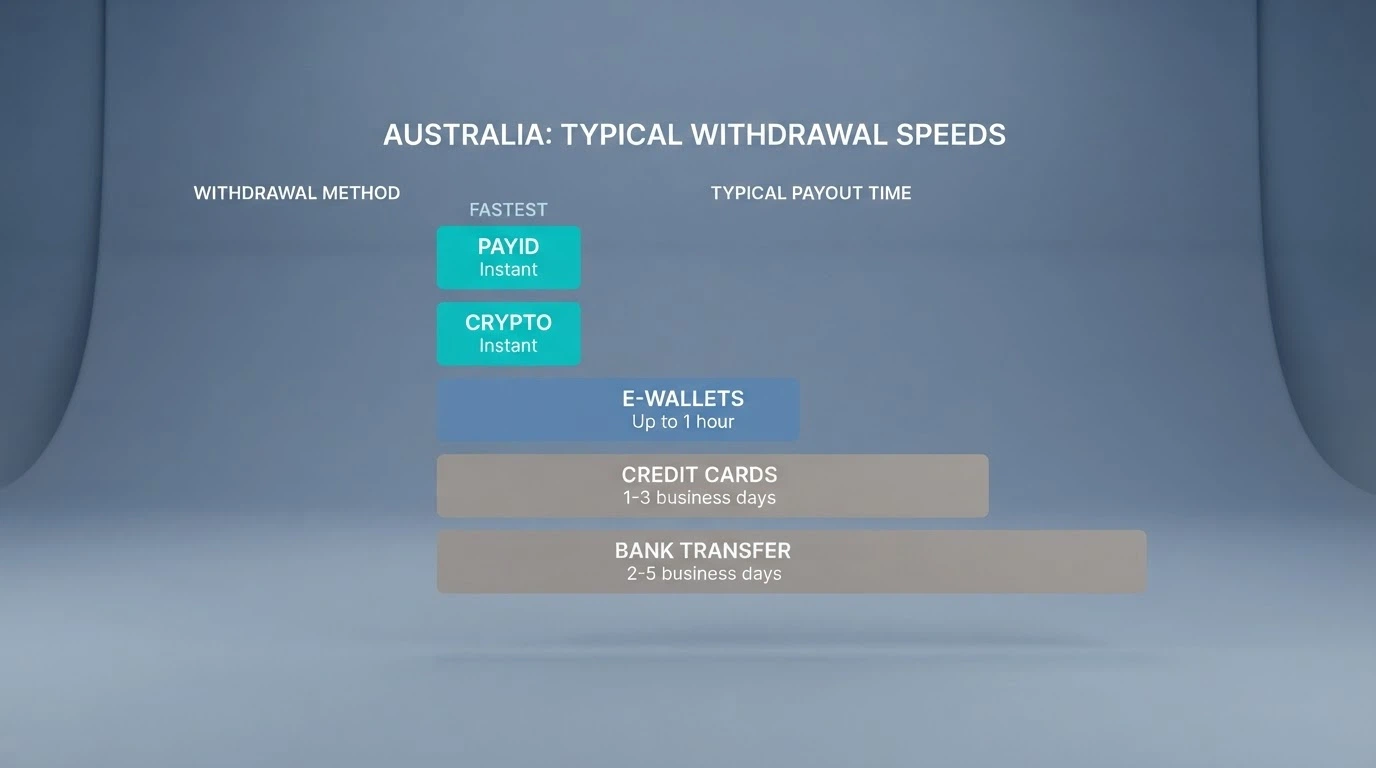
The practical rule is that e-wallets work, but the speed is rarely better than PayID and the convenience rarely compensates for the extra hop. Cards and bank transfer still dominate some operators’ cashier screens because they are universal and they cost the operator less in processing fees, but for a punter prioritising payout speed they are the slowest realistic options on the list.
What Withdrawal Limits and Pending Periods Actually Cost You
Even the fastest method stalls behind an operator-imposed limit or a review queue. Per-transaction caps, daily and weekly ceilings, and pending periods are the levers that turn a “minutes” claim into a days-long reality. The mechanism is straightforward: a punter wins a larger amount, the operator’s cashier caps the first cashout, the remainder is paid out in instalments, and the cashout clock resets with each instalment. Pending periods work the same way in reverse: a 24 to 48 hour pending window is the operator’s compliance buffer, and any “instant” claim starts after that window closes.
KYC and AML review sit on top of the pending period. A first cashout at a new account almost always triggers a full KYC pass, which is the universal delay factor across AU-facing operators — and the one thing no method choice can shortcut. Weekend processing is the third compounding variable: even a clean PayID withdrawal can stretch over a Saturday-Sunday if the operator’s finance team only processes on business days. The take-away is that the method sets the floor, the operator sets the ceiling, and the gap between them is where the actual cashout clock lives.
Top Easy-Withdrawal Casinos for Australian Players in 2026
| Operator | AU Licence Status | Claimed or Tested Payout Speed |
|---|---|---|
| SkyCrown | Offshore / unlicensed in AU | ~10–11 min crypto (tested) |
| VegasNow | Offshore / unlicensed in AU | ~14 min PayID (tested, 8 cashouts) |
| Casinonic | Offshore / unlicensed in AU | Under 24h (reported) |
| Fair Go Casino | Offshore / unlicensed in AU | Multi-hour (reported) |
| Bizzo Casino | Offshore / unlicensed in AU | Multi-hour (reported) |
| Neospin | Offshore / unlicensed in AU | n/a |
| Ricky Casino | Offshore / unlicensed in AU | n/a |
| RoosterBet | Offshore / unlicensed in AU | n/a |
| BitStarz | Offshore / unlicensed in AU | n/a |
| KatsuBet | Offshore / unlicensed in AU | n/a |
SkyCrown
SkyCrown sits at the top of the AU fast-withdrawal set on the back of a tested 11-minute average on cleared no-deposit bonus cashouts, with one run clearing in 6 minutes after KYC. The brand appears consistently on AU fast-withdrawal lists, and its crypto payouts are the strongest in the featured set. The NDB package tested was 40 free spins plus a A$10 chip, with 45x wagering on bonus winnings — a heavy multiplier that makes the NDB harder to convert to withdrawable cash than the speed of the payout suggests. SkyCrown is offshore and unlicensed in Australia; no AU regulator oversees its cashier. The speed is real, the licence status is the trade-off.
For a punter prioritising the clock above everything else, SkyCrown is the clear leader in the set. The 45x NDB multiplier is the cost of entry into that speed.
Neospin
Neospin appears on AU fast-withdrawal roundups but is light on public payout-speed data. The brand is offshore and unlicensed in Australia, and what AU-facing comparison pages show is its presence on the lists rather than a tested cashout time. Without a tested figure or a published claim from the operator’s own terms, the ranking position is provisional — it earns its place on the strength of consistent listing, not on hard numbers. Before depositing, the practical step is to check the cashier screen for PayID or crypto support, check the bonus terms for wagering and max cashout, and treat the brand familiarity on affiliate pages as a starting point rather than a verdict.
Casinonic
Casinonic has appeared consistently in AU fast-payout roundups, with reported withdrawals under 24 hours. Specific tested times were not surfaced in the same detail as SkyCrown or VegasNow, but the under-24h framing is consistent across multiple AU-facing listings. The operator is offshore and unlicensed in Australia. Public bonus-term data is thinner than for some peers, so the same verification advice applies as for Neospin: check the cashier, the wagering, the cap, and the expiry before claiming an offer.
Fair Go Casino
Fair Go is a familiar name on AU-facing comparison pages, with reported multi-hour payout timeframes. The brand has been present on AU lists long enough to carry a level of recognition that newer operators lack, but the hard payout data is closer to the “multi-hour” framing than the “minutes” framing. Fair Go is offshore and unlicensed in Australia. The gap between brand familiarity and tested speed is worth noticing: a well-known name on a comparison page is not the same as a fast-payout operator, and the ranking reflects that.
Bizzo Casino
Bizzo has been tested alongside faster operators in AU summaries, posting multi-hour payout timeframes. It sits in the middle of the pack on speed — faster than bank transfer, slower than PayID and crypto at the leading brands. The operator is offshore and unlicensed in Australia, and specific bonus terms were not surfaced in the tested data. If you have an existing account, these speeds are serviceable, though they generally trail the industry leaders in payout efficiency.
Ricky Casino
Ricky appears in AU-facing casino listings but the public payout-speed data is minimal. Specific tested cashout times, bonus terms, and licence details were not surfaced in the comparison pages this round, which limits what the write-up can claim. The operator is offshore and unlicensed in Australia, and the same verification advice applies as elsewhere: check the cashier for method support, read the bonus terms before claiming, and treat affiliate-page listings as a starting point rather than a guarantee. If you prioritize payout speed, stick to operators with transparent, tested withdrawal figures rather than those with limited public data.
VegasNow
VegasNow posted the fastest tested PayID withdrawals in the featured set: a 14-minute average across 8 test cashouts, all on bonus winnings. The NDB tested at VegasNow carried 40x wagering on winnings, a AU$100 max cashout, and a 14-day validity window — middle-of-the-pack on the multiplier, standard on the cap, and a generous validity window. The bonus slot was Big Bass Splash, with RTP unverified in the surfaced snippet. VegasNow is offshore and unlicensed in Australia. The PayID result is the headline here: for an AUD-native punter who wants the speed without the crypto step, VegasNow is the strongest tested option on the list.
RoosterBet
RoosterBet is the only featured operator with a detailed deposit-match welcome package on the record: 100% up to A$5,000 plus 300 free spins, with 40x wagering on the bonus amount, a 14-day validity window, and a AU$20 minimum deposit. The no-deposit terms are tighter: NDB and free-spins winnings are capped at A$75, and withdrawal requires full account verification plus at least one deposit. RoosterBet is offshore and unlicensed in Australia. The welcome package is large, the NDB cap is low, and the verification-plus-deposit requirement for the NDB is the kind of fine print that converts a “free” offer into a deposit-required one.
BitStarz
BitStarz is a high-profile offshore brand with an NDB free-spins offer in AU listings: 40x wagering on winnings, a AU$100 max cashout, and a 7-day expiry. The 40x multiplier sits mid-range in the typical AU NDB band of 30x to 50x — heavier than KatsuBet at 30x, lighter than 7Bit at 45x, and well inside the range above which offers become practically unclearable. The 7-day expiry is the standard AU NDB window. BitStarz is offshore and unlicensed in Australia. While the 40x wagering requirement is standard, this offer sits right in the middle of the pack for AU players, with no standout advantage over its direct competitors.
KatsuBet
KatsuBet carries the lowest NDB wagering multiplier in the featured set at 30x on winnings, with a AU$100 max cashout and a 7-day expiry. The 30x clip is the floor of the typical AU NDB range and the most player-friendly multiplier among featured operators with confirmed NDB data. The cap and the expiry are the same as the other 7-day operators. KatsuBet is offshore and unlicensed in Australia. When it comes to lowering the wagering hurdle, KatsuBet’s 30x multiplier is highly competitive, making it a strong choice provided you confirm their PayID or crypto support in the cashier.
How We Ordered These Operators — Payout Speed, Data Quality, and What We Weighted
The ranking runs on three criteria in order. Tested payout speed is the primary sort: an operator with a tested 10-minute crypto result outranks one with a multi-hour framing, which outranks one with no tested data. Data transparency is the secondary tiebreaker: where two operators had similar speed, the one with a published KYC policy, a published cashier, and a public bonus terms page ranked ahead. Offer terms are the context, not the sort key — a 30x NDB at KatsuBet is more player-friendly than a 45x NDB at SkyCrown, but SkyCrown’s tested speed keeps it at the top.
What the ranking does not weight is brand familiarity, marketing presence, or affiliate-page prominence. Fair Go is a recognised name on AU comparison pages, but its multi-hour framing ranks it below faster, less-familiar operators. BitStarz and KatsuBet carry global brand recognition, but the NDB terms alone do not displace a tested 10-minute crypto result at the top. Fast-withdrawal coverage on AU-facing pages often mixes licensed wagering brands with offshore casinos, and that mix shaped the verification approach: every operator here was checked against ACMA guidance and confirmed as offshore and unlicensed in Australia. The reader is comparing offshore operators to one another, not to AU-licensed wagering, and the ranking reflects that.
Why Your 2026 Bonus Payout Is Harder Than the Advertised Number
Wagering Requirements — How a Bonus Turns Into a Lock-In
A welcome offer’s headline number is the gross figure. The withdrawable figure is what survives the wagering requirement, and the gap between the two is the operator’s real margin on the promotion. In AU no-deposit bonus listings, the typical wagering range sits at 30x to 50x on free-spin winnings, with anything above 50x described as practically unclearable for most players. The arithmetic is the lock: a 40x wagering target on a modest bonus win means thousands in turnover before a single dollar becomes withdrawable.

Worked example using the BitStarz NDB terms: a AU$100 max-cashout bonus with 40x wagering on winnings requires AU$100 × 40 = AU$4,000 in qualifying turnover. At a representative AU$1 minimum stake per spin, that is 4,000 spins. At a 5-second interval per spin, 4,000 spins take 20,000 seconds, or roughly 5.6 hours of continuous play. The “free” offer is 5.6 hours of wagering to convert a capped win into a withdrawable balance. BitStarz’s 40x sits in the middle of the AU range. KatsuBet’s 30x is the floor and the most player-friendly in the set; 7Bit at 45x is heavier; Caswino at 50x is the edge of the unclearable zone. The headline offer size and the wagering requirement are not the same number, and the wagering requirement is the one that determines whether the offer is worth the time.
The Max-Cashout Cap That Limits Your Win Before You Spin
Even if a punter clears the wagering in full, a max-cashout cap on the no-deposit bonus means the operator never risks more than that cap. The typical AU range on NDB winnings caps sits at AU$50 to AU$200, and AU$100 is the most common figure across the featured set. BitStarz, KatsuBet, Mirax and 7Bit all cap at AU$100. RoosterBet is tighter at A$75. Slots Gallery sits at A$150. The cap matters more than the headline offer size because the cap is the actual ceiling on what the player can withdraw from the offer, regardless of how much the bonus generates before the cap is applied.
The mechanism is straightforward: a punter wins AU$1,500 on a free-spin round, the cap is AU$100, and AU$100 is what becomes withdrawable after wagering is complete. The rest is forfeit. For comparison, a AU$200 cap at one operator and a AU$50 cap at another mean the higher-cap offer can return four times the withdrawable amount on the same spin outcome. The cap is the operator’s downside protection; it is also the punter’s upside limit. Reading it before claiming is the only way to know what the offer is actually worth.
Bonus Eligibility Traps That Block Your Withdrawal
Wagering and caps are the visible fine print. Verification, deposit requirements, game restrictions, and expiry windows are the traps that stop a cashout after the wagering is done. The NDB terms at Caswino, for instance, require phone and email verification before the 20 free spins are credited, with a 50x wagering requirement and a 24-hour use window — generous on the spin count, punishing on the clock. RoosterBet’s NDB terms cap winnings at A$75 and require full account verification plus at least one deposit before any withdrawal can be requested. The “no deposit” label covers the credit, not the cashout path.
The interaction between these conditions and the bonus timeline is where most failed cashouts originate. A 7-day expiry on a NDB with a 40x wagering requirement means the punter has to clear 40x turnover in 7 days to convert any winnings to a withdrawable balance; a 14-day bonus validity on a deposit match is the same mechanic over a longer window. Slots Gallery’s 72-hour wagering completion window is the tightest in the set and a meaningful constraint on whether the offer is realistically clearable. The fine print is not optional context — it is the difference between an offer that pays out and one that expires with the winnings forfeit.
No Australian Casino Licence Exists — What That Means for Your Money
The IGA Prohibition — Why No Casino Licence Exists in Australia
The Interactive Gambling Act 2001 draws a hard line: online casino, online pokies and in-play sports betting are prohibited products in Australia. There is no federal or state licence for online casino anywhere in the country. The Australian Communications and Media Authority administers the Act, and the prohibition applies to the supply of those products to people in Australia, not to the act of an Australian punter accessing an offshore site. What the IGA permits is narrower than the prohibition: pre-event wagering on racing and sport, lotteries, and keno, all licensed by state and territory regulators.
The practical effect is that every operator pitching “easy withdrawal” to an Australian punter is doing so from outside the Australian regulatory perimeter. The cashier screen, the bonus terms, the KYC flow, the dispute resolution pathway — none of it is overseen by an Australian regulator. ACMA’s role in this space is to enforce the prohibition against Australian-facing supply, not to license it.
Offshore vs Licensed — What You Give Up When You Play Outside the System
The gap between offshore and AU-licensed is the gap between two different consumer-protection regimes. AU-licensed wagering providers — around 150 of them — are bound by state and territory licensing rules, by BetStop self-exclusion coverage, and by the Australian complaints and dispute resolution framework. They are also bound by AU-mandated fund-segregation and solvency rules, which mean customer balances are held in trust and the operator’s solvency is monitored. Offshore casinos offering prohibited online casino products to Australian players carry none of these protections. There is no Australian complaints body for offshore operators, no AU-mandated fund segregation, and no AU-mandated solvency check.

BetStop is the clearest boundary. The National Self-Exclusion Register covers all licensed online and phone wagering providers, and a person who has registered with BetStop is excluded from those 150 operators. An offshore casino is not a licensed wagering provider, and BetStop does not reach it. The same applies to dispute resolution, complaints escalation, and the activity-statement and deposit-limit requirements that apply to AU-licensed wagering. Ultimately, the distinction here isn’t just about bonus conditions; it is the absence of an Australian safety net that defines the offshore experience.
The 2026 Reform Wave — AdStop, Inducement Bans, and What Changes
The Interactive Gambling Amendment (Gambling Reform) Bill 2026 was passed by the House on 18 August 2026 and by the Senate on 19 August 2026. The reforms do not legalise online casino in Australia, and they do not bring offshore operators inside the Australian regulatory perimeter. What they do is tighten the rules around licensed wagering: a national wagering advertising opt-out register (AdStop) administered by ACMA, restrictions on inducements (a ban on offers to new customers for the first 14 days from sign-up, and a ban on offers to a person for 3 months after they self-exclude via BetStop), an extended live-sport ad blackout starting at least 15 minutes before games, a ban on online keno marketed as “pocket pokies”, and a ban on foreign-matched lotteries. BetStop is also strengthened as part of the package. Funding for AdStop and BetStop administration comes through cost-recovery levies under separate 2026 Bills.
For a punter playing at an offshore casino, the reform package changes the advertising environment around licensed wagering and it does not change the cashier, the bonus terms, or the licence status of the offshore operator. The reforms are aimed at licensed wagering advertising and inducements. They do not extend BetStop to offshore casino, and they do not impose a federal deposit, loss or stake ceiling — the prohibited products cannot be lawfully offered, so the limit on what an Australian can pay or stake applies to licensed products only, through AU-specific rules like credit-card and crypto bans for licensed wagering.
Safe Cashout — The Verification and Support Net Most Players Skip
KYC and Identity Checks — The Gate Every Cashout Must Pass
No withdrawal clears without identity verification, and the requirement is universal across offshore and licensed operators alike. The standard KYC document set is consistent across the AU-facing market: a driver licence or passport for primary ID, a Medicare card or secondary ID, and a proof of address (utility bill or bank statement, usually within the last three months). Some operators also request the payment-method proof — a photo of the card used for deposit, or a screenshot of the e-wallet account. The verification timing is one of the biggest variables in the cashout clock, and on a first withdrawal it is the slowest step regardless of the method chosen on the cashier screen.
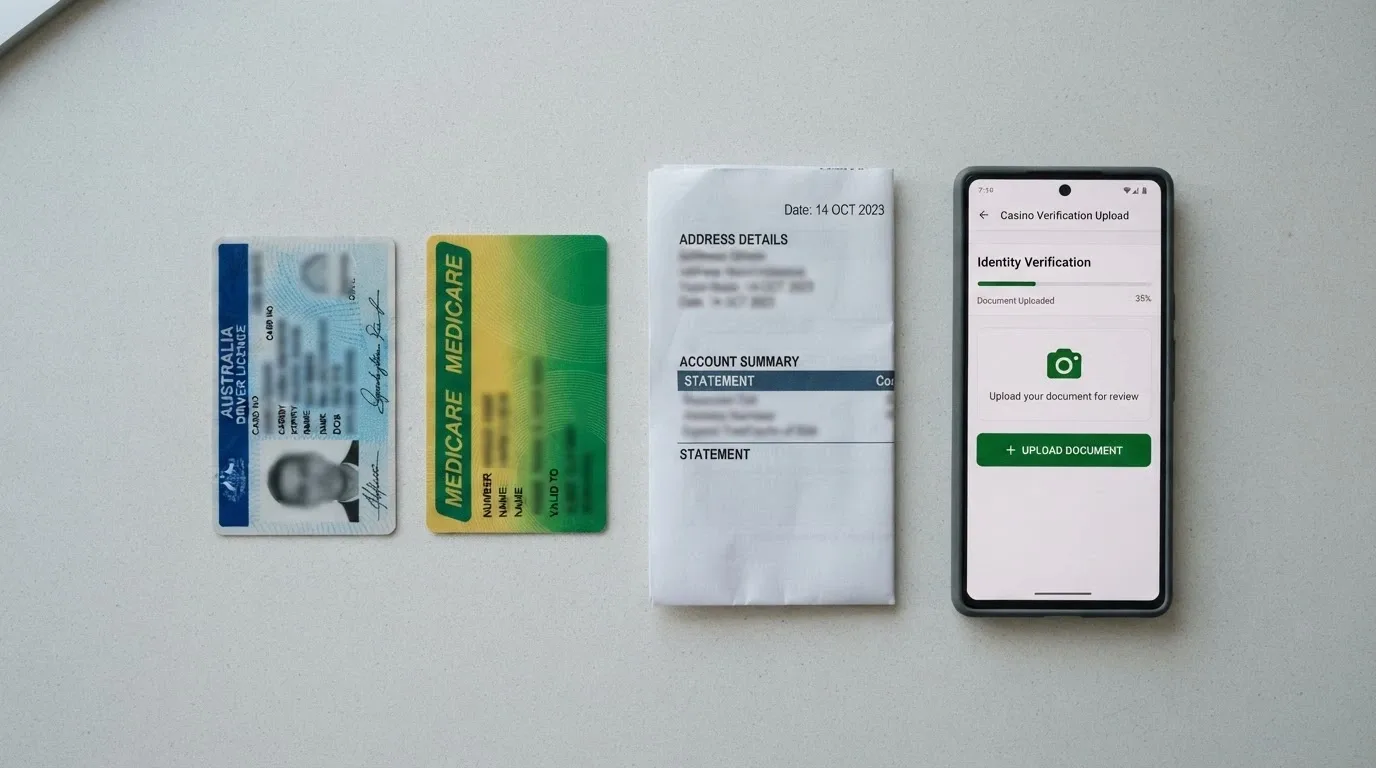
The practical preparation is to upload the documents before requesting the first cashout. Most operators have a verification upload page accessible from the account settings, and submitting the documents in advance moves the verification step out of the withdrawal timeline. Once the account is verified, subsequent cashouts clear the KYC queue faster, and the method on the cashier screen becomes the dominant variable. The verification step is not a friction the operator invents to delay payouts — it is an AML requirement that applies to every licensed and offshore operator. The difference between a fast and a slow first cashout is usually whether the documents were already in the system when the request was made.
BetStop — How Australia’s Self-Exclusion Register Actually Works
BetStop is Australia’s National Self-Exclusion Register, launched on 21 August 2023 and administered by ACMA. Registration requires a mobile number, an email address, and a driver licence or Medicare card. The exclusion can be chosen for a minimum of 3 months up to a lifetime, and removal cannot be applied for in the first 3 months — the minimum window is locked in. As at 31 March 2026, 37,247 people had active exclusions on BetStop, and registrations to the end of Q3 FY 2025–2026 totalled 59,830.
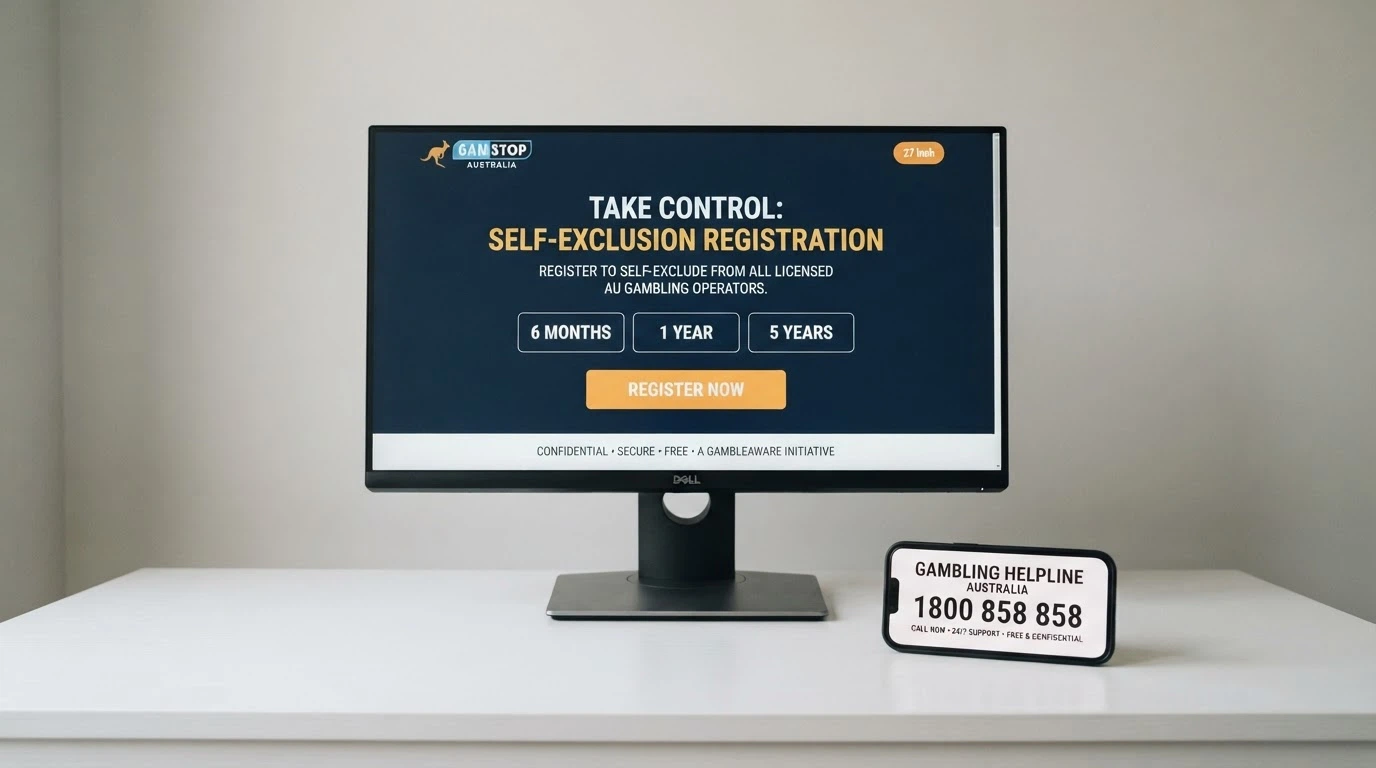
The boundary that matters for the page’s subject is that BetStop covers approximately 150 licensed wagering providers in Australia, and it does not reach offshore casinos. A punter who has registered with BetStop is excluded from every AU-licensed online and phone wagering operator. An offshore casino is not a licensed wagering provider, and the same exclusion does not apply. Because offshore casinos operate outside these regulatory boundaries, the responsible-gambling framework described in the next section remains your primary source of protection.
Help Services and the Harm Numbers Most Casino Pages Skip
Help is free, 24/7, and built into the Australian gambling infrastructure. The National Gambling Helpline is 1800 858 858 — free, available 24 hours a day, 7 days a week, with access to counsellors. Gambling Help Online provides online counselling including live chat, email, and phone support. Financial counselling is available through the Department of Social Services. The full infrastructure is in place, and it is the same whether a punter plays at a licensed wagering provider or at an offshore casino.
The harm prevalence figures behind that infrastructure are worth knowing. Problem gambling affects 0.4% to 1.2% of Australian adults; moderate-risk gambling affects 1.9% to 3.7%; low-risk gambling affects 3.0% to 7.7%. The at-risk demographic flagged in the Australian Psychological Society guidance is young men aged 18 to 24, and screening tools like NODS-PERC and Lie/Bet are recommended for self-assessment. The figures are not a judgment on the reader. They are the reason a page about casino cashouts lists a helpline number — the cashout question is the one a punter asks when the play is recreational, and the helpline is the one a punter needs when it stops being.
How We Selected and Ranked These Easy-Withdrawal Casinos
The featured set is drawn from AU-facing “fast withdrawal” and “instant payout” roundups, with the operator set restricted to brands that appear consistently across multiple comparison pages or carry tested payout-speed data. The sources used were AU-facing comparison and testing pages — CasinoBeats, Gambling360, Betsquare, Slotspeak, CasinosHub, PokiesAustralia — together with the operator’s own terms pages where the testing sources cited them. The evaluation basis was tested payout speed where testing data was available, with reported payout speed as a fallback and listing presence as a tertiary signal.
The ranking criteria, in order: tested payout speed as the primary sort, data transparency as the secondary tiebreaker, and offer terms as context rather than a sort key. A 10-minute crypto result at SkyCrown outranks a multi-hour framing at Fair Go; both outrank an operator with no tested data. The criteria explicitly excluded brand familiarity, marketing presence, and affiliate prominence. Fast-withdrawal coverage on AU-facing pages mixes licensed wagering brands with offshore casinos, and that mix shaped the verification approach: every operator in the ranking was confirmed as offshore and unlicensed in Australia, against ACMA guidance and the absence of an AU casino licence in any state or territory. The reader is comparing offshore operators to one another on payout speed and bonus terms, with the licence status stated explicitly so the comparison is on the same footing across the set.
Your 2026 Withdrawal Strategy — What to Prioritise for the Fastest Cashout
Pick the method first. PayID is the cleanest AUD-native path: no currency conversion, settlement in 1 to 2 hours at major AU banks once the operator has approved, and the lowest friction on the way back to an Australian bank account. Crypto is the raw-speed leader on the network clock, but the exchange-to-AUD step is a second leg the speed comparison rarely counts. E-wallets work but rarely beat PayID on speed. Cards and bank transfer are the slowest realistic options and are best treated as a fallback rather than a primary cashout rail.
Verify before you withdraw. KYC is the universal gate, and the documents — driver licence, Medicare card, proof of address — are the same across every operator. Uploading them before the first cashout request moves the slowest step out of the withdrawal timeline. A verified account with a deposit history and at least one prior successful cashout will see faster approvals on every subsequent request.
Read the bonus fine print before claiming. The wagering requirement, the max-cashout cap, and the expiry window are the three numbers that determine what the offer is actually worth. A 30x NDB with a AU$100 cap and a 7-day expiry is a different offer from a 45x NDB with a AU$100 cap and a 24-hour use window, and the headline number rarely tells you which.
Understand that every operator in this ranking is offshore and unlicensed in Australia. The IGA 2001 prohibits online casino licensing onshore, and the protections that come with AU-licensed wagering — BetStop coverage, an Australian complaints body, AU-mandated fund segregation — do not extend to the operators on this page. Disputes with offshore operators are resolved through the operator’s own terms, not through an Australian regulator.
Use the help services if play stops feeling recreational. The National Gambling Helpline is 1800 858 858, free and 24/7. Gambling Help Online provides live chat, email, and phone support. Financial counselling is available through the Department of Social Services. The infrastructure is there whether the play is at a licensed wagering provider or at an offshore casino, and the cost of not using it is higher than the cost of any cashout delay on the page.
Frequently Asked Questions About Easy-Withdrawal Casinos in Australia
Do I need to submit photo ID before my first casino cashout clears in Australia?
Yes. KYC is universal across AU-facing operators, and the standard document set is a driver licence or passport, a Medicare card or secondary ID, and a recent proof of address. Uploading the documents before requesting the first cashout moves the verification step out of the withdrawal timeline. A verified account clears the KYC queue faster on every subsequent request, and the cashier method becomes the dominant variable.
Can an offshore casino operator legally refuse to pay my winnings?
Offshore operators can refuse withdrawals under their own terms, and there is no Australian regulator to escalate a dispute to. AU-licensed wagering providers are bound by state and territory licensing rules and an Australian complaints framework; offshore casinos are not. Reading the operator’s bonus terms and withdrawal conditions before depositing is the only practical safeguard, because the Australian complaints pathway does not apply once the operator sits outside the AU regulatory perimeter.
How many spins does it realistically take to clear a typical no-deposit wagering target?
A 40x wagering target on a AU$100 max-cashout bonus requires AU$4,000 in qualifying turnover. At a representative AU$1 minimum stake per spin, that is 4,000 spins. At a 5-second interval per spin, 4,000 spins take roughly 5.6 hours of continuous play. The result is a statistical estimate over many spins under the stated assumptions and is not a guaranteed outcome for any single session.
Is it safer to withdraw in smaller instalments or one lump sum at AU-facing casinos?
Smaller instalments reduce the per-request AML review load and may clear faster individually, but they reset the cashout clock with each instalment. A single lump sum avoids the reset but may trigger a longer review on a larger amount. The safer choice depends on the operator’s per-transaction cap and the operator’s withdrawal-limit structure, both of which should be checked in the cashier terms before requesting a cashout.
Do quick-payout casinos charge hidden fees on AUD cashouts?
Some operators charge a fee on certain withdrawal methods, particularly e-wallets and bank transfers, and the fee is usually disclosed in the cashier terms. PayID and crypto at AU-facing operators are typically fee-free on the operator side, though crypto carries a network fee and an exchange-side fee on the AUD conversion. Reading the cashier terms before requesting a cashout is the only way to confirm the fee structure for the specific method and amount.
What happens if I request a cashout before finishing a bonus playthrough requirement?
Most operators void the bonus and any bonus-derived winnings if a withdrawal is requested before the wagering requirement is complete. The real-money balance is usually withdrawable, but the bonus balance and any winnings attributed to it are forfeit. The rule is in the operator’s bonus terms, and the practical step is to clear the wagering requirement or cancel the bonus through the cashier before requesting a cashout.