
Most “No Wager” Bonuses Aren’t. Here’s What an Australian Player Actually Gets.
Current as of 16 October 2026 · verified against the ACMA register and operator terms pages.
A no-wager casino bonus sounds like the best deal in online gambling: win, withdraw, done. No grinding through 40 times your bonus in bets before a cent becomes yours. The marketing leans hard into the simplicity, and a search for “no wager casino bonus Australia” returns pages of operators promising exactly that.

Twenty-seven such offers were tested this year. Five were genuine. The rest applied hidden wagering, demanded a hidden deposit, capped cashouts below withdrawal floors, or voided winnings outright. That 22-of-27 result is the single most important figure on this page, because it reframes every other claim a player will meet.
It is also worth knowing the legal frame before a player reads any further. Online casino is prohibited in Australia under the Interactive Gambling Act 2001. Every no-wager bonus an Australian player can claim is offered by an offshore operator breaking that law to reach them. The player is not the target of the legislation, but the protections a player expects from a licensed product — BetStop, consumer recourse, complaint mechanisms, deposit ceilings — do not extend. The bonus is real. The cover is not.
What follows is the honest picture: the genuine offers documented this run, the operators behind them, the legal and consumer protection gap that surrounds every one of them, and a five-field check a player can run before claiming anything.
Table of Contents
- Why “no wager” rarely means no strings attached
- No-wager bonuses that actually pay out — and the ones that don’t
- The casinos Australians turn to for no-wager bonuses — ranked by what they actually deliver
- The legal reality: why your no-wager bonus sits outside Australian law
- What offshore play costs you that no bonus can make up for
- How you pay is how you know who you are dealing with
- How to spot a real no-wager offer — most aren’t
- How we evaluate and rank no-wager casinos
- Where no-wager bonuses leave an Australian player in 2026
- Frequently asked questions
Why “no wager” rarely means no strings attached
The phrase “no wager” is doing heavy lifting in this market. It implies a clean mechanic — bonus credited, winnings paid, no playthrough barrier between the player and a withdrawal. In practice, the label gets attached to offers that fail on at least one of those three promises, and the failure is often invisible until the player has already deposited and tried to cash out.
What “wager” means in an online casino
A wagering requirement — sometimes called playthrough, rollover, or turnover — is the multiplier the casino applies to a bonus before any winnings become withdrawable. A A$10 bonus with a 40x wager means the player must place A$400 in bets before the winnings convert to real, withdrawable cash. The bonus itself is typically forfeit on the way out.
The mechanism exists because casinos cannot afford to hand out cash. A bonus paid straight back to a player with no strings is a free option, and free options on games with a house edge are uninsurable over time. So the multiplier is the price of the bonus — a forced turnover that, on average, recoups the bonus amount plus a margin. It is the casino’s hedge against paying out more than they took in.
At AU-facing casinos, the standard range sits between 40x and 60x. A A$10 no-deposit bonus at 40x is A$400 in required bets; at 60x, it is A$600. Both figures sit comfortably above what most players will actually wager on a small free chip, which is the point — the casino’s expected value of the bonus is the bonus itself, because most players never clear the requirement. No-deposit bonuses at AU-facing casinos typically offer between AU$5 and AU$50 in bonus cash or up to 100 free spins, with maximum cashout caps between AU$50 and AU$200. The headline looks generous. The maths is designed to ensure the house keeps it.
How a no-wager bonus is supposed to work
A genuine 0x bonus removes the multiplier entirely. Whatever the player wins on the bonus — from a free spin, from a cash chip, from a deposit match — is theirs to withdraw as real money, subject to the cashout cap and expiry the offer states. There is no playthrough barrier.
In the documented no-wager offers this run, the mechanic works the way it should. VegasNow credits 20 wager-free spins on Big Bass Splash with a A$50 maximum cashout and a 7-day expiry. SkyCrown offers 15 wager-free spins on Sweet Bonanza 1000 with a A$40 cap and the same 7-day window. Wild Tokyo runs 25 wager-free spins on Gates of Olympus 1000 with a A$50 cap and a 10-day expiry. LuckyDreams provides a A$10 wager-free chip with a A$30 cap. Crownslots offers 20 wager-free spins on Book of Dead with a A$40 cap and a 5-day expiry. Each one names the multiplier as 0x, names the cashout ceiling, names the expiry, and names the eligible slot. Read those four fields and the player knows exactly what is being offered.
The promise is straightforward. A no-wager free spin at a A$1 stake has a maximum payout of the cashout cap — A$40 to A$50 across these offers. The slot’s return-to-player determines how often that ceiling is reached in practice. On a 96.5% RTP slot like Sweet Bonanza, the player keeps roughly A$0.965 of every A$1 staked in the long run; on the 20 wager-free spins at VegasNow the expected return is just under A$19.30 across the spin set before any cashout cap is applied. No playthrough. No forced turnover. The player plays, wins or loses, and walks away with whatever is theirs.
That is the theoretical promise. The 22-of-27 result is the practical reality.
The catch most ranking sites skip
The asymmetry at the heart of this market is not advertised. It is legal for an Australian to claim a no-wager bonus at an offshore casino. It is illegal for that casino to offer one to them. That gap is the whole story, and most ranking sites get it wrong: they present offshore casinos as legitimate market participants, list their bonuses as comparable products, and skip the part where the operator is breaking Australian law to advertise the offer in the first place.
In a structured test of 27 advertised “no wager” claims across 21 operators, only 5 produced an actual 0x-wagering bonus credited on signup with cashable winnings paid out. The other 22 either:
- applied hidden wagering — a multiplier inserted into the fine print that the headline did not mention;
- required a hidden deposit — a small top-up demanded before the bonus was released;
- capped cashouts below the site’s own withdrawal minimum — a A$30 win from a bonus on a site whose minimum withdrawal is A$50, trapping the balance;
- or voided winnings outright, citing bonus-abuse clauses or “irregular play” after the player had already won.
The four tactics are not exclusive. Some offers stack two or three. The point is that the label “no wager” travels widely, attaches to offers that fail on the basic mechanic, and earns the operator a ranking-page slot that drives sign-ups. The player finds out which kind they claimed when they try to withdraw.
No-wager bonuses that actually pay out — and the ones that don’t
Genuine no-wager offers cluster into a small number of forms. Once the counterfeit ones are stripped out, the shape of the real market becomes legible: a few cash chips, a handful of free-spin packages, one tiered deposit-gated scheme, and a demo-mode alternative that costs the operator nothing and the player nothing either.

No-deposit cash bonuses with zero wagering
The rarest genuine form. A small cash amount — LuckyDreams’s documented offer is A$10 — is credited on signup with no deposit required and no playthrough attached. The player uses it on eligible games, keeps whatever they win up to the cashout cap, and withdraws.
The catch is the cap. LuckyDreams’s A$30 maximum cashout on a A$10 chip means the player cannot win more than three times the bonus amount, regardless of how the session runs. A lucky streak beyond A$30 is forfeit. The 7-day expiry reinforces the constraint: the chip must be used and any winnings withdrawn within a week, or the whole balance is voided.
This is the smallest genuine no-wager offer in the documented set, and the scarcity reflects the economics. A cash chip with no playthrough and no deposit is a direct free option on the house edge, and the operator prices that risk into a low face value and a tight cap. Players who want to test an offshore casino with the least possible exposure find this offer shape useful. Players looking for a meaningful bankroll find it irrelevant.
Free spins with zero wagering
The most common genuine form. The operator credits a fixed number of free spins on a named slot, with a stated maximum cashout and a stated expiry. The player spins, wins are credited as real cash, and any balance up to the cap can be withdrawn.
The documented set:
- VegasNow: 20 spins on Big Bass Splash, A$50 cap, 7 days
- SkyCrown: 15 spins on Sweet Bonanza 1000, A$40 cap, 7 days
- Wild Tokyo: 25 spins on Gates of Olympus 1000, A$50 cap, 10 days
- Crownslots: 20 spins on Book of Dead, A$40 cap, 5 days
The spin counts are small — 15 to 25 — and the cashout caps run A$40 to A$50. The structure is honest: the offer says exactly what it pays and exactly what it does not. The economic reality is that a high-volatility slot with 20 free spins at a A$1 stake is unlikely to hit the cashout cap; a low-volatility slot is more likely to deliver a small cashable balance. Either way, the player knows the ceiling before they spin.
The tradeoff is direct: a small spin count against an instant-withdrawal promise. Standard 40x offers give the player 100 or 200 spins with bonus money, then make them clear A$4,000 of turnover before a single cent converts. No-wager free spins give the player 20 spins, then let them walk with whatever they won. Which deal a player prefers depends on whether they value the upside of a large bonus or the certainty of a small one.
Welcome and deposit-match offers
The third form is rarer still. Genuine no-wager welcome packages exist, but they almost always require a deposit, and the size of the bonus scales with the size of the deposit. Goldwin’s tiered first-deposit free spins package illustrates the shape: 100 free spins for a A$20 deposit, 150 for A$30, 200 for A$40, 250 for A$50. Each tier is a no-wager offer with whatever cashout cap Goldwin attaches to the specific spin set.
The economic logic differs from a standard deposit match. A 100% match up to A$200 at 40x wagering requires A$8,000 of turnover before the bonus is cashable. Goldwin’s A$50 deposit unlocks 250 free spins with no playthrough, which is a fundamentally different proposition. The face value of the spins is the operator’s hedge, not a forced turnover figure. Players depositing at the top of the tier take the larger spin count; players depositing at the bottom take the smaller.
A separate hybrid exists at SkyCrown, where the documented offer is 100 no-deposit free spins as a welcome bonus, contingent on completing mobile verification. That hybrid sits between the no-deposit chip and the deposit-gated package: no deposit is required, but an account-verification step is. The standard SkyCrown deposit bonus, distinct from the no-wager offer, runs at 40x wagering on the bonus amount, which is the operator’s normal multiplier for matched deposits.
Why genuine no-wager deposit matches are uncommon is straightforward: the operator is giving away real money on a multiplier of zero, and a matched deposit deepens that exposure. The Goldwin tier structure is one way to scale the offer with the player’s commitment rather than committing the operator to an open-ended giveaway.
Free-play and demo mode
The zero-risk alternative. Most AU-facing casino sites run slots in demo mode — full gameplay, no real money on the line, no deposit required, typically no account needed. Book of Dead is one of the most widely available demos across the offshore market. The player loads the slot, plays with virtual credits, and learns the mechanics without staking anything.
Demo mode is not a no-wager bonus. Nothing won in demo mode is withdrawable, because nothing was staked. But for a player who wants to test a slot’s volatility, its bonus rounds, or its pacing before committing real money — including a real-money no-wager bonus — demo mode is the right tool. The cost is zero. The information is genuine.
It is also a useful responsible-gambling tool. A player uncertain about whether a slot’s volatility suits their style can verify it in demo mode in minutes with zero financial exposure. Likewise, using demo mode to test a slot before committing to a no-wager bonus provides an accurate picture of the game’s mechanics, confirming that the experience aligns with the claims made on the bonus page.
The counterfeit problem: when “no wager” is not
Twenty-two of the 27 offers tested this year were not what their headline claimed. The four tactics are worth naming individually because they are the failure modes a player should test for before signing up:
The counterfeit tactics involve four primary modes of failure. Hidden wagering inserts a multiplier into the fine print that the player only discovers once the wagering bar appears after their first spin. A hidden deposit requires a small top-up, such as A$10 or A$20, to release the bonus, often requested after the player has already entered their card details. When a cashout cap is set below the site’s own withdrawal floor, a A$30 win on a site with a A$50 minimum withdrawal effectively traps the balance. Finally, voided winnings occur when an operator cites broad bonus-abuse or “irregular play” clauses to refuse a withdrawal after a player has already won.
The counterfeit rate is high because the label sells. “No wager” ranks, gets clicked, and converts sign-ups at a rate the affiliate pages track closely enough that operators have an incentive to use the term regardless of whether the underlying offer deserves it. The player pays the cost of that incentive.
The casinos Australians turn to for no-wager bonuses — ranked by what they actually deliver
Every operator in the table below is offshore. None holds an Australian licence, because no such licence exists. The market-share column is the share of tracked Australian traffic that lands on each operator; the BetStop column is the same answer for every row — No — because the register binds only Australian-licensed services.

| Operator | Market share (AU tracked traffic) | BetStop connected |
|---|---|---|
| Royal Reels | 2.51% | No |
| WinSpirit | 1.55% | No |
| Rainbet | 1.28% | No |
| Scream Casino | 0.99% | No |
| FairGO | 0.80% | No |
| Bizzo Casino | 0.57% | No |
| Rocket Casino | 0.57% | No |
| SkyCrown | — | No |
| Stake | — | No |
| RocketPlay | — | No |
SkyCrown, Stake and RocketPlay do not have AU tracked-traffic figures in this run’s data set; their rows carry an em dash in that column to mark the gap honestly. The qualitative coverage below names what each operator does and does not offer, and where the verification could not be completed, the page says so plainly.
How we compared these operators
Three pieces of information were available across the set: market share, BetStop connectivity, and licence jurisdiction where confirmable. Beyond those, the comparison leans on operator-terms pages and bonus-specific documentation that some operators publish and others do not. Where the data is missing, the writeup says so rather than reaching for a substitute.
Market share is a proxy for Australian player uptake — not an endorsement, and not a measure of safety or fairness. Two operators with comparable market share can be running radically different businesses underneath the traffic figure. A high market share with no verified bonus terms is a high-traffic site whose offers have not been checked, not a high-traffic site whose offers have been verified safe.
BetStop connectivity is a hard binary that resolves in the same direction for every operator in the set: none of them are connected, because none of them are Australian-licensed. The column is there to make that sameness legible at a glance, not because the answer varies by row.
Licence jurisdiction was confirmable for SkyCrown, Stake and RocketPlay. For the other seven, the licence status could not be independently verified in this run. A player intending to deposit should verify the licence number directly against the relevant regulator’s public register and review the operator’s bonus terms in full.
RocketPlay
A Dama N.V. operator running on a Curaçao e-gaming licence, number 8048/JAZ2020-13, issued by Antillephone N.V. RocketPlay’s standard bonus terms apply a 40x wagering requirement to free-spin winnings, cap the maximum bet during wagering at A$7.50, and run a 5-day bonus validity — short enough that a player who does not clear the requirement inside the window forfeits bonus funds and any winnings tied to them.
No no-wager offer at RocketPlay was verified this run. The standard welcome packages and Friday reloads carry the 40x multiplier, which places RocketPlay outside the no-wager segment entirely. The operator is not connected to BetStop. A player who has self-excluded through BetStop and then signs up at RocketPlay will not be flagged, and the deposit will be accepted.
RocketPlay is a mid-sized offshore casino with a clear, published terms framework — the kind of operator a player can read before signing up. What it offers Australian players is a standard Curaçao-licensed casino experience with a 40x wagering default and short bonus windows. That is a real offer; it is just not a no-wager one.
SkyCrown
The only operator in the featured set with a verified no-wager bonus this run. SkyCrown holds Curaçao Gaming Control Board licence OGL/2023/176/0095 and runs more than 10,600 games, over 7,000 of them pokies. The no-wager offer is 15 free spins on Sweet Bonanza 1000 with 0x wagering, a A$40 maximum cashout, and a 7-day expiry. SkyCrown also runs a 100-free-spin no-deposit welcome bonus, contingent on completing mobile verification.
The library size is large by AU-facing standards and is the operator’s main differentiator beyond the no-wager offer. SkyCrown’s standard deposit bonus — distinct from the no-wager free spins — runs at 40x on the bonus amount, which is the conventional Curaçao-market multiplier. A player who clears that 40x on a matched deposit will have placed the turnover figure the bonus page named; a player who does not will forfeit the bonus and any winnings tied to it.
SkyCrown is not connected to BetStop. A self-excluded player who signs up will not be blocked, and the A$40 cashout ceiling on the no-wager spins means the maximum withdrawal from the bonus is small. The operator delivers exactly what its offer page claims; it does not extend to players the protection that an Australian-licensed product would.
For an Australian player looking for a verified no-wager offer specifically, SkyCrown is the documented case in this run’s data. The offer is small and the protection gap is the same as everywhere else on this page. That is the honest trade.
Stake
A different proposition entirely. Stake.com runs on a Curaçao licence, number 8048/JAZ, and operates as Medium Rare N.V. from Curaçao. The welcome offer is a 200% first-deposit bonus up to $2,000, with 40x wagering on deposit plus bonus and a $100 minimum deposit. The minimum deposit alone places Stake in a different segment from the no-deposit and low-stake operators on this page.
The 200% match is generous on paper. The 40x on deposit plus bonus means a $100 deposit with a $200 bonus requires $12,000 of turnover before the bonus converts — a figure large enough to take a meaningful bankroll through several sessions of play at typical stake sizes. Stake does not include free spins in its welcome offer, which is a contrast with most of the operators on this page.
Stake’s library includes proprietary Stake originals alongside standard providers, and the operator is widely associated with crypto deposits and high-stakes play. The platform is not connected to BetStop. The 40x multiplier on a deposit-matched bonus is conventional for the Curaçao market and is the cost of the headline match figure. A player with a large bankroll and a long horizon may find the math workable; a player shopping for a no-wager offer will not.
Royal Reels
Royal Reels captures 2.51% of AU tracked traffic — the largest share in the featured set. The licence could not be confirmed this run, and the bonus terms could not be confirmed this run. What can be said is that the operator reaches a meaningful slice of Australian players and is not connected to BetStop.
The honest picture for a player considering Royal Reels is that the operator has an established Australian user base but the verification of its licence and its bonus terms is incomplete on this page. A player who wants to verify before depositing should check the operator’s own site for a licence number, cross-reference that number against the relevant regulator’s public register, and read the bonus terms page in full — including any linked sub-pages — before claiming.
The market-share figure is not a recommendation. It is a measure of traffic. Royal Reels may offer a genuine no-wager bonus; it may offer a counterfeit one; this run did not confirm either way.
WinSpirit
WinSpirit captures 1.55% of AU tracked traffic — a mid-tier offshore operator with a real Australian user base and no confirmed licence or bonus terms this run. Like Royal Reels, WinSpirit is not connected to BetStop, and the same verification caveat applies: a player should check the operator’s own site for licence and terms before depositing.
A 1.55% traffic share means a non-trivial number of Australian players are using WinSpirit. The data set does not include what they are claiming once they get there. The qualitative read is that WinSpirit is an established operator in the AU-facing offshore segment whose specific offer terms this page could not verify.
FairGO
FairGO captures 0.80% of AU tracked traffic — a smaller operator with the same verification gap. Licence and bonus terms were not confirmed this run, and FairGO is not connected to BetStop. A player who arrives at FairGO through an affiliate link should treat it as an unverified operator until they have checked the licence and terms themselves.
The smaller traffic share does not mean FairGO is safer or riskier than the larger operators in the set. It means fewer Australians are using it. The substantive questions — what licence it holds, what its bonus terms actually say, whether it offers a genuine no-wager bonus — are the same ones a player should ask of any offshore operator.
Scream Casino
Scream Casino captures 0.99% of AU tracked traffic — another mid-tier operator with no confirmed licence or bonus terms this run. Not connected to BetStop. The same caveat applies: verification is the player’s job, because the data set did not cover this operator in detail.
Scream Casino’s traffic share sits between FairGO and Rainbet in the featured set. What that share means for the offer experience is unknown on this page.
Rainbet
Rainbet captures 1.28% of AU tracked traffic — a mid-range offshore operator with a real user base and the same verification gap. Licence and bonus terms were not confirmed this run. Not connected to BetStop.
The qualitative read is that Rainbet is established enough in the AU-facing market to attract measurable traffic but not established enough in this run’s data set for the bonus terms to be checked. A player should verify directly.
Bizzo Casino
Bizzo Casino captures 0.57% of AU tracked traffic — a smaller operator with the same verification gap. Licence and bonus terms were not verified for this operator this run. Not connected to BetStop.
The traffic share is small but non-zero. Bizzo Casino reaches Australian players; what it offers them is not documented on this page.
Rocket Casino
Rocket Casino captures 0.57% of AU tracked traffic and is a distinct entity from RocketPlay, despite the similar name. Licence and bonus terms were not verified for this operator this run. Not connected to BetStop.
The name overlap is a hazard. A player searching for either operator can land on the other, and the two are not the same business. RocketPlay is documented above with a verified Curaçao licence and 40x standard wagering. Rocket Casino is not verified in this run. They are separate entries.
New no-wager casinos worth watching
The offshore market turns over quickly. New operators launch regularly, and the no-wager label is a common customer-acquisition tactic for entrants because the promise converts sign-ups at a rate that offsets the cost of the offer itself. The counterfeit rate that applies to the established market — 22 of 27 offers not genuine — applies to new entrants as well. A new operator has no track record a player can check, which is the point of new-customer offers but also the source of additional risk.
A new no-wager casino carries the same baseline gaps as an established one: it is offshore, not licensed in Australia, not connected to BetStop, and outside Australian consumer-protection reach. The novelty adds uncertainty about whether the operator will pay out at all, whether the licence it claims is genuine, and whether the cashout terms will be honoured at withdrawal. A player who chooses to engage should apply the same five-field check described in the verification section below — and weight the result against the absence of any operational history to lean on if a dispute arises.
The legal reality: why your no-wager bonus sits outside Australian law
The legal frame is not a footnote. It is the structural reason every no-wager bonus an Australian player can claim is offered by an offshore operator breaking Australian law to reach them. A player who understands the frame is better equipped to identify a genuine offer and evaluate the associated risk.
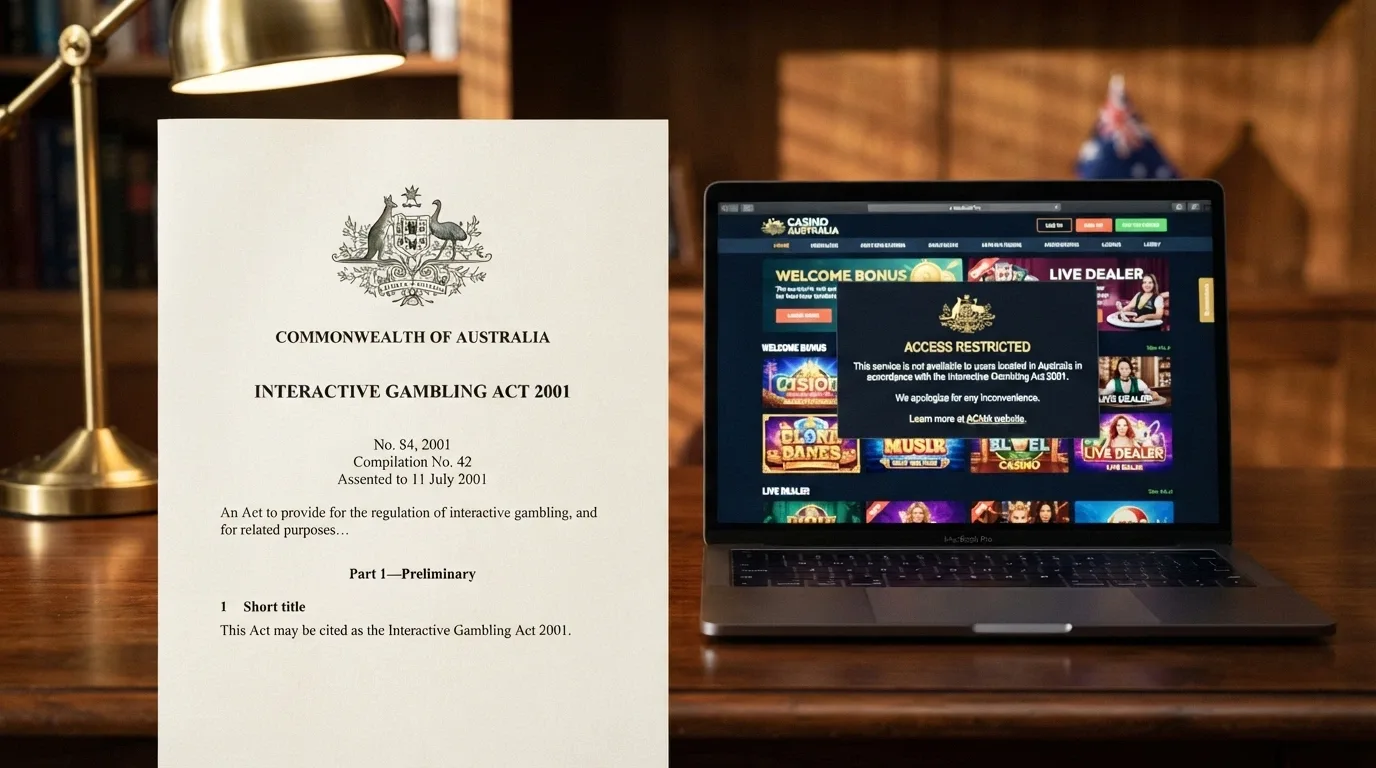
The Interactive Gambling Act 2001 — what it bans
The IGA 2001 prohibits the provision of online casino games and online pokies to persons in Australia. Banned services, as the ACMA names them, include online casino games, slots, and in-play betting. The prohibition targets the operator, not the player — the penalty structure runs up to A$1.65 million per day for corporations and A$220,000 per day for individuals, and it is the provider who faces those figures, not the customer.
That asymmetry is the entire offshore casino market. The operator breaks Australian law by offering the product. The player is not prosecuted for using it. Every affiliate page that lists offshore casinos to Australian readers is also stepping outside the line, but the practical enforcement focus is on operators and ISPs, not on individual players. A player who claims a no-wager bonus at an offshore casino is not committing an offence under the IGA. The casino offering it is.
The 2026 reform tightens the frame further. The Interactive Gambling Amendment (Gambling Reform) Bill 2026 passed Parliament on 19 August 2026 and commences on 1 January 2027. From that date, banks and payment providers gain express authority to block transactions to illegal gambling operators. The reform also restricts wagering advertising — caps, scheduling rules, an AdStop opt-out register — and bans inducements for new sign-ups during defined cool-off windows. The casino game prohibition itself is unchanged. What changes is the surrounding infrastructure that supports the offshore market.
What is actually licensed in Australia
The licensed online gambling products in Australia are pre-event wagering on races and sport, lotteries and keno. Casino games are not in that set. No state or territory issues an online casino licence. The Northern Territory Racing and Wagering Commission is the de facto national licensor for online wagering, with major operators like Sportsbet, bet365, Ladbrokes and roughly fifty others holding NT licences on terms that run up to twenty years.
State and territory regulators — the Victorian Gambling and Casino Control Commission, the NSW Independent Casino Commission and their counterparts elsewhere — license land-based casinos, lotteries, keno and TAB-style retail wagering. None of them license an online casino product. A page promising “the best licensed online casinos in Australia” describes something that does not exist.
The licensed bookmakers can offer a welcome bonus on a wagering product — a bonus bet, a deposit match on a racing bet, an odds boost — because wagering is the licensed activity. They cannot offer a free-spin package on a pokie because pokies are not the licensed activity. A no-wager casino bonus, by definition, requires an online casino product, and an Australian-licensed operator does not have one to offer.
Why offshore casinos are your only option for no-wager bonuses
The structural gap is the answer to why no-wager bonuses exist at all in the AU-facing market. An Australian-licensed operator cannot offer them because the product is banned. An offshore operator can offer them because the operator is outside the IGA’s reach, even though reaching Australian players requires the operator to break the Act.
ACMA’s enforcement has been substantial. As of April 2026, the regulator had requested ISP blocking for over 1,200 illegal gambling and affiliate websites. Since its first blocking request in November 2019, ACMA has had 1,564 sites blocked by Australian ISPs, and more than 225 illegal services have withdrawn from the Australian market since enforcement was strengthened in 2017. The block list is real, the withdrawals are real, and a player using an offshore casino is using a service that the Australian regulator has identified as illegal and that may stop being reachable from Australia at any time.
The 2026 reform layers bank-level blocking on top. From 1 January 2027, financial institutions gain the authority to refuse or reverse transactions identified as directed at illegal gambling operators. A deposit that clears today may not clear tomorrow. A withdrawal that is in flight when a block is issued may be reversed. The legal status of any funds caught in that reversal is unclear, because the offshore operator is outside Australian jurisdiction.
What offshore play costs you that no bonus can make up for
The cost of an offshore no-wager bonus is not the wagering requirement — there isn’t one. The cost is the protection gap. Every consumer protection an Australian-licensed product is required to provide is absent at an offshore casino, and that absence is the same whether the bonus is genuine or counterfeit.
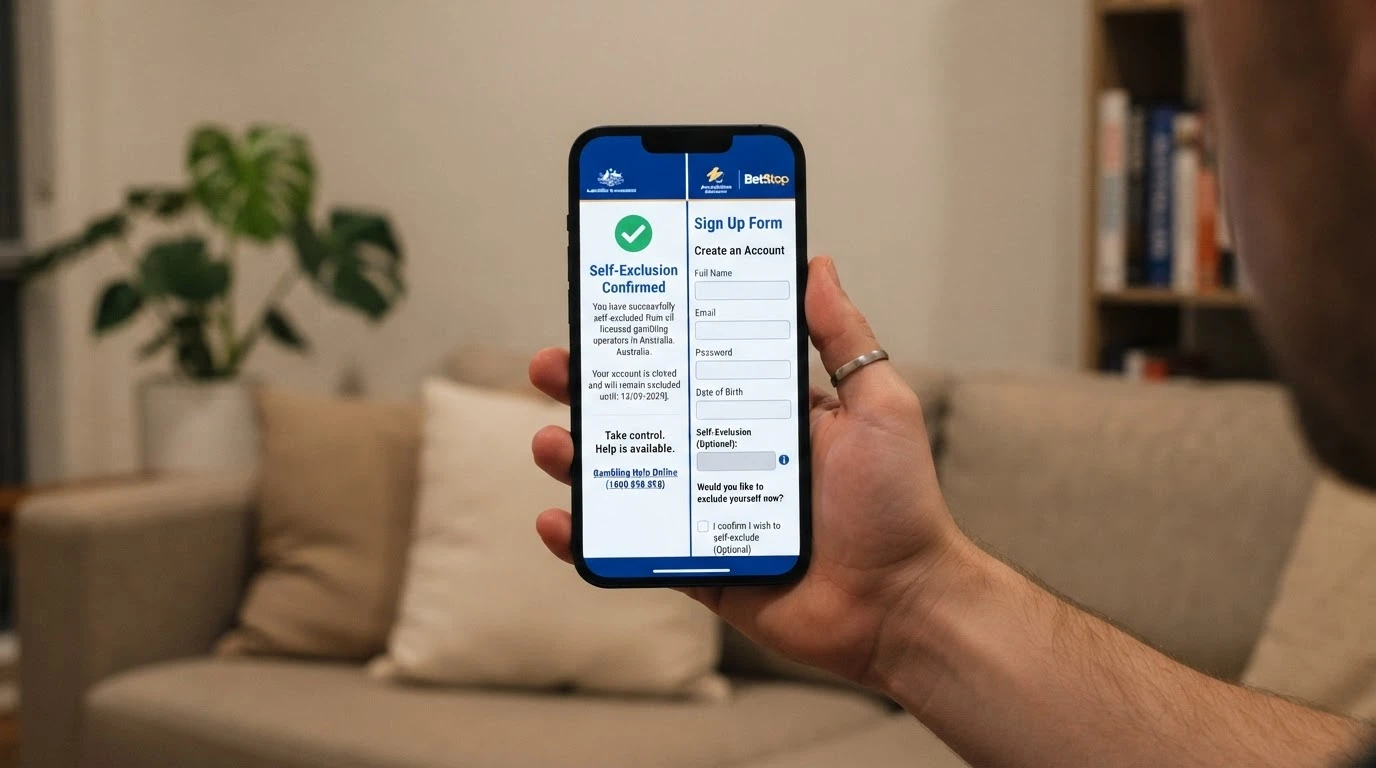
No BetStop — the self-exclusion gap
BetStop, the National Self-Exclusion Register, went live in August 2023. As at 31 July 2026, it had 67,480 registrations, of which 41,290 exclusions were still active. Seventy-eight per cent of registrants were under 40. Thirty-eight per cent chose lifetime exclusion. A single registration excludes a person from every Australian-licensed online and phone wagering service.
BetStop binds only Australian-licensed wagering services. An offshore casino is not connected to the register and will continue accepting a self-excluded person’s money. The mechanism that makes BetStop effective — a single registration covers every licensed operator simultaneously — does not extend to operators outside the regime. A player who has self-excluded and then signs up at an offshore casino is starting fresh from the offshore operator’s perspective, with no flag, no block, and no cooling-off period enforced.
The data on BetStop registrants tells its own story. The volume of registrations, the proportion under 40, the share choosing lifetime exclusion — these are signals of a population seeking help. The offshore gap means the help those people sought does not reach the operators most likely to take their deposits.
No consumer protection or complaints body
ACMA cannot recover a player’s money from an offshore operator. The regulator’s enforcement remit is operator-side: blocking, civil penalties, formal warnings. If a withdrawal is refused, winnings are voided, or a balance is held without explanation, the Australian player has no complaints body to approach, no ombudsman to escalate to, and no legal mechanism in Australia that reaches the operator’s books.
Pursuing a Curaçao-licensed operator from Australia is the practical alternative. Curaçao’s regulatory framework exists, but the cost of action — engaging a lawyer in Curaçao, filing in a Curaçao court, enforcing any judgement — is out of reach for almost any individual player whose dispute is a few hundred or a few thousand dollars. The framework is real; the recourse is theoretical.
Twenty-two of 27 tested no-wager offers voided winnings or applied hidden terms. The vast majority of players affected by those tactics have no meaningful remedy.
Gambling harm in Australia — the numbers
The harm context is what makes the offshore gap consequential. Three data sets describe the Australian picture:
Three data sets outline the Australian harm picture. The National Gambling Prevalence Study Pilot 2024, from the Australian Gambling Research Centre, found 15% of Australian adults were at some risk of gambling harm (PGSI score 1 or more), including 2.6% at high risk. Roy Morgan Research reported in 2025 that 2.9% of Australian adults — an estimated 622,000 people — have serious gambling problems, up from 2.4% the year before and 1.9% two years before that. Additionally, the ANU Centre for Social Policy Research’s 2025 ANUpoll found that risky gambling increased from 13.7% in 2024 to 19.4% in 2025, an increase of more than five percentage points in twelve months.
A separate finding from the same ANUpoll: 56.1% of Australians who gambled in 2025 mainly participated online, up substantially from prior years. The Australian Institute of Health and Welfare estimates Australians lose approximately A$25 billion on legal forms of gambling each year. The illegal offshore market sits outside that figure but inside the same population.
The numbers describe a market where a meaningful share of adults are at risk, where the share is growing, and where the bulk of the gambling activity has moved online — exactly the channel where the no-wager bonus lives and where the protection gap is widest.
Where to get help
Three resources every Australian player should know, free and confidential:
Three resources are available to any Australian player, each free and confidential. The National Gambling Helpline (1800 858 858) operates 24/7 with qualified gambling counsellors. Gambling Help Online (gamblinghelponline.org.au) offers online chat, counselling, and self-assessment tools. Finally, BetStop (the National Self-Exclusion Register) provides a single registration that excludes a person from every Australian-licensed online and phone wagering service. While BetStop does not cover offshore casinos, registering is still a recommended step for any player looking to limit their gambling, even if they choose not to restrict their play to the licensed market.
These resources exist because the harm numbers above are real, and they work because they reach the licensed market. They do not reach the operators on this page.
How you pay is how you know who you are dealing with
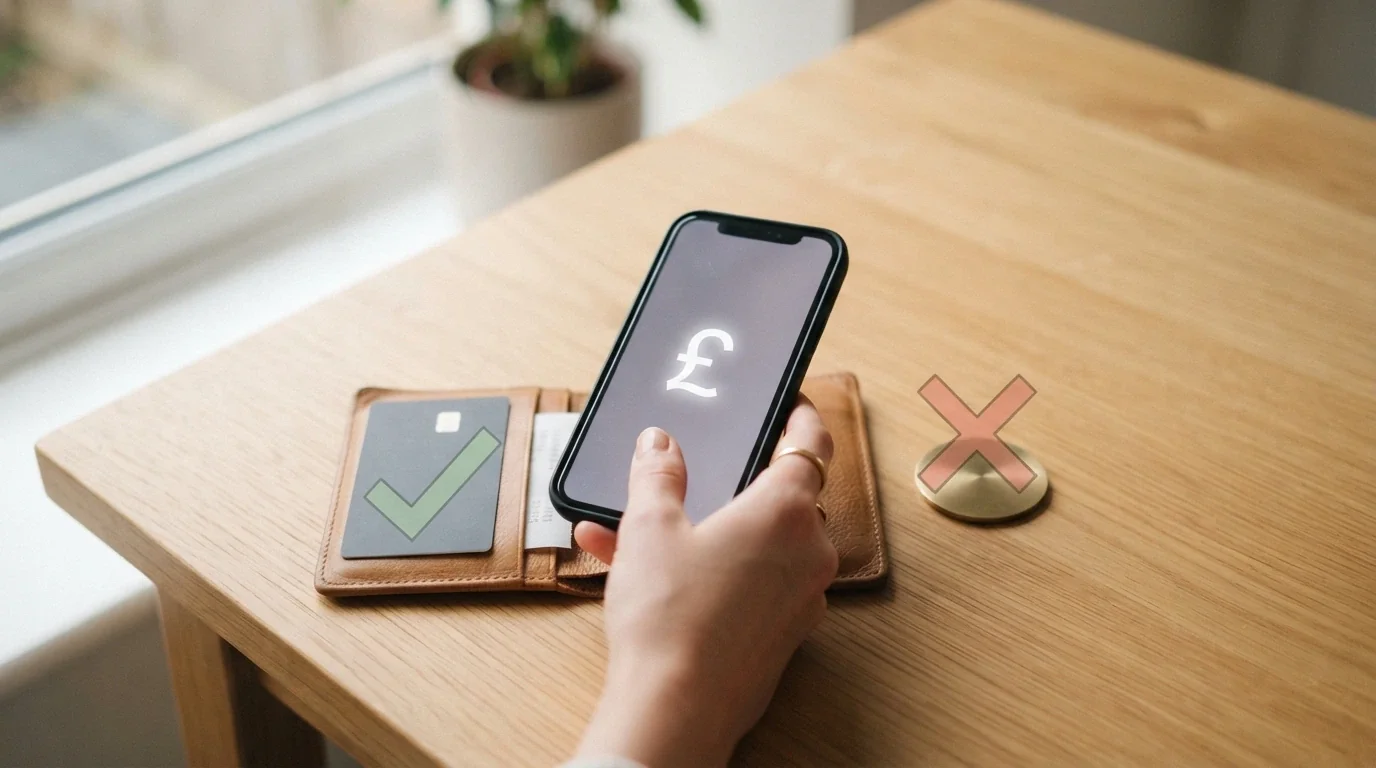
The payment method a casino asks for is a regulatory signal. Credit cards and crypto are banned as payment for licensed Australian wagering, effective 11 June 2024 under the Interactive Gambling Amendment (Credit and Other Measures) Act 2023. The penalty for a licensed operator accepting either is up to A$247,500. An Australian asked for a credit card or a crypto deposit by a gambling site is being served by someone outside the Australian rules.
Crypto casinos and no-wager bonuses
Crypto is the default deposit method at most offshore no-wager casinos. Bitcoin, Ethereum, Litecoin and stablecoins settle faster than card payments, carry lower processing costs, and sit outside the banking system that ACMA and the 2026 reform will use to enforce blocks from 1 January 2027.
The trade-off is anonymity and the regulatory signal it carries. A crypto deposit does not require the player to share card details with the operator, which some players prefer. But the same deposit also routes outside the consumer-protection mechanisms that card networks and Australian banks provide. A disputed transaction at a licensed bank can be reversed; a crypto transaction cannot. A bank can flag an unusual gambling transaction and pause it; a wallet cannot. The convenience is real and the protection gap is real, and they are the same gap.
The 2026 reform gives Australian banks express authority to block transactions to illegal gambling operators from 1 January 2027. The reform does not distinguish between crypto and fiat transactions — the authority extends to any payment directed at an identified illegal operator. A player who uses crypto at an offshore casino today is using the payment channel least likely to be intercepted today, and the most likely to lose access without recourse when enforcement begins.
PayID, cards and bank transfers
PayID/Osko is the standard fast AUD deposit method at licensed Australian wagering operators. Debit cards, bank transfers and BPAY round out the legal deposit routes for the licensed market. POLi — once a common AU deposit method — was decommissioned on 30 September 2023, and the post-POLi landscape is PayID, cards and crypto.
Most offshore no-wager casinos accept PayID alongside crypto and cards. An offshore casino offering PayID does not make it Australian-licensed. PayID is a payment rail, not a regulatory status. The transaction routes through an Australian bank or Osko participant, which is the only sense in which the deposit is “Australian” — the operator on the other end remains offshore, unlicensed, and outside ACMA’s enforcement reach for consumer-protection purposes.
The licensed deposit routes — debit card, bank transfer, PayID, BPAY — are the channels an Australian-licensed wagering operator accepts. An offshore casino accepting the same routes is using the same plumbing to reach Australian players, but the operator is not bound by the same rules around responsible gambling, bonus terms disclosure, or dispute resolution.
Mobile play and casino apps
Most offshore no-wager casinos run through a mobile browser rather than a native app. No operator in the featured set carries a confirmed native AU app-store listing; the iOS App Store and Google Play restrict real-money gambling apps by jurisdiction, and an Australian app-store listing for an offshore casino would not clear those restrictions in practice.
The mobile experience is browser-based: the player loads the casino site in Safari or Chrome, logs in, and plays through the mobile-optimised version of the site. Account access, bonus claims, deposits and withdrawals all run through that browser session. The mechanics are the same as on desktop, scaled to the screen.
A native app, where it exists for an offshore operator, is typically downloaded directly from the operator’s site rather than through an app store. The trade-off is the same as elsewhere on this page: convenience against the absence of the consumer protections an app-store listing would imply. Apple and Google curate what reaches their stores. An offshore operator that does not pass that curation is reaching the player through a less-reviewed channel.
How to spot a real no-wager offer — most aren’t
Five fields determine whether a no-wager bonus is what its headline claims. Missing any one of them is how players lose winnings they thought were theirs. The counterfeit rate above — 22 of 27 — is the reason the check exists.

Read the terms like a detective — the five-field check
Before claiming any no-wager bonus, a player should verify five fields. Each one is the kind of detail that disappears into a footnote if a player is not looking for it.
To verify an offer, a player should check five key fields. The wagering multiplier must be 0x, as anything higher indicates a standard bonus. The maximum cashout should exceed the operator’s minimum withdrawal to ensure the balance isn’t trapped. The expiry window must provide enough time — typically 5 to 10 days — to complete play and request a withdrawal. Eligible games should be clearly specified, as vague terms like “all slots” often mask exclusions. Finally, comparing the withdrawal minimum against the cashout cap is essential to confirm that any winnings are actually accessible.
The slot RTP table — what your “free” spins actually cost
Even a 0x-wager bonus carries the house edge. The slot’s return-to-player determines the average loss per spin across a session, and a no-wager bonus does not change that figure. The slots in the documented no-wager offers are mostly high-volatility games with RTPs in the 96% range; the table below covers both the slots attached to those offers and the higher-RTP slots a player can choose when the bonus allows game selection.
| Slot title | RTP | Provider | Volatility |
|---|---|---|---|
| Mega Joker | 99.00% | NetEnt | Low |
| 1429 Uncharted Seas | 98.60% | Thunderkick | — |
| Blood Suckers | 98.00% | NetEnt | Low |
| Sweet Bonanza | 96.51% | Pragmatic Play | High |
| Gates of Olympus 1000 | 96.50% | Pragmatic Play | High |
| Bonanza Megaways | 96.00% | Big Time Gaming | High |
The house edge is 1 minus RTP. On Mega Joker at 99% the player loses A$1 per A$100 wagered in the long run; on Blood Suckers at 98% the player loses A$2 per A$100; on Bonanza Megaways at 96% the player loses A$4 per A$100. On the high-volatility slots attached to the documented no-wager offers — Sweet Bonanza, Gates of Olympus 1000 — the house edge is roughly A$3.50 per A$100 wagered.
A worked example with the prescribed figures: 200 spins at A$1 per spin on Sweet Bonanza at 96.51% RTP produces an expected loss of 200 × A$1 × (1 − 0.9651) = A$6.98. That is the session’s statistical cost on a 0x-wager bonus — the bonus pays out the winnings, and the slot’s house edge takes A$6.98 across the 200 spins regardless. The figure is an average. Any single session will land well above or well below it; over many sessions, it converges.
Picking the right game for a no-wager bonus
The slot a player chooses for no-wager free spins determines how much of the offer they keep. The high-RTP, low-volatility slots in the table above are the optimal choice when the bonus allows game selection — the house edge is smallest and the returns come more steadily across the small spin count. On a 20-spin bonus, low volatility matters because the player is unlikely to hit a feature-driven payout that swings the balance significantly; the cumulative edge on a small sample is closer to the long-run average for low-volatility games than for high-volatility ones.
The documented offers, however, are tied to specific slots — Big Bass Splash, Sweet Bonanza 1000, Gates of Olympus 1000, Book of Dead. The player does not get to choose the game; the bonus names it. Each of those slots is a high-volatility game with an RTP in the 96% range, which is the operator’s standard selection for promotional spins. A player who values the highest possible RTP on a no-wager bonus should look for operators that allow game selection, or wait for a bonus attached to a higher-RTP title.
Live-dealer tables — blackjack, roulette, baccarat with a real dealer streamed to the player — are not attached to any of the documented no-wager offers. No specific live-dealer no-wager terms were confirmed in this run’s data. A player who prefers live tables over slots should expect to forfeit the no-wager segment entirely.
How we evaluate and rank no-wager casinos
Three sources informed the operator assessments on this page. First, the operator-data set collected this run, which captured market-share figures, licence numbers where verifiable, and bonus terms where the operators published them. Second, ACMA’s official register and the published list of blocked services, which established the legal frame every operator sits inside. Third, the operators’ own terms pages, which supplied the wagering multipliers, max bets, expiry windows and cashout caps that the bonus writeups name.
The criteria applied across the set: licence jurisdiction where confirmable, BetStop connectivity (the same answer for every operator — No), bonus terms verifiability, and AU tracked-traffic market share as a proxy for player uptake. Where the data was incomplete — the seven operators with no confirmed licence or bonus terms this run — the writeup says so rather than reaching for an estimate.
The limit of this run’s data set is honest. Three operators had full coverage; seven had partial coverage; the verification of licence and bonus terms on those seven is the player’s job, not this page’s. The ranking is market-share order because that is the only cross-operator comparable the data set provides. It is not a ranking by safety, fairness, or quality of offer, because the data set does not support that ranking across the whole set.
A player who treats this page as the starting point — not the conclusion — and who runs the five-field check on any operator they consider will get more value from the page than one who treats the table as a top-ten to sign up to.
Where no-wager bonuses leave an Australian player in 2026
The honest verdict sits in three places at once.

The genuine offers exist. SkyCrown’s 15 wager-free spins on Sweet Bonanza 1000, VegasNow’s 20 on Big Bass Splash, Wild Tokyo’s 25 on Gates of Olympus 1000, LuckyDreams’s A$10 chip, Crownslots’s 20 on Book of Dead, Goldwin’s tiered first-deposit package — these are real, documented, and cashable up to the stated cap. A player who finds one of them and clears the five-field check has found something concrete.
The counterfeit rate is the headline. Twenty-two of 27 offers not genuine is the figure that defines this market, and a player who skips the five-field check is rolling the dice across those odds. The offers are not hard to find; the genuine ones are hard to separate from the fakes without doing the work.
The legal and protection gap closes nothing. No bonus, however genuine, makes an offshore casino Australian-licensed. No bonus connects it to BetStop. No bonus gives the player a complaints body to approach when a withdrawal is refused. The 2026 reform tightens the frame further: from 1 January 2027, banks gain the authority to block transactions to illegal gambling operators, and the offshore sites Australians use today may become harder to reach and harder to pay. A balance held at an offshore casino when a block is issued may be unreachable, and the funds on it are outside Australian jurisdiction.
For a player who proceeds: the five-field check is non-negotiable. Wagering multiplier, maximum cashout, expiry window, eligible games, withdrawal minimum. Run it before claiming anything. Verify the licence on the operator’s footer against the regulator’s public register. Do not assume the headline matches the terms. Do not assume the terms will be honoured. Do not assume the bonus closes the protection gap.
For a player who is not sure whether to proceed: the National Gambling Helpline is 1800 858 858, free, confidential, twenty-four hours a day. Gambling Help Online at gamblinghelponline.org.au runs chat and counselling. BetStop is a single registration that excludes a person from every Australian-licensed service — it does not cover offshore casinos, but a player who registers and stays within the licensed market keeps the protections the offshore market cannot provide.
No bonus is worth skipping the checklist. No bonus closes the gap. The choice belongs to the player, and the information on this page is what the player needs to make it with their eyes open.
Frequently asked questions
What is the difference between a no-wager bonus and a low-wagering bonus?
A no-wager bonus applies a 0x multiplier, so winnings are withdrawable as real cash up to the stated cap without further play. A low-wagering bonus applies a reduced multiplier — typically 5x to 20x — that still requires the player to place a defined turnover before winnings convert. The 40x to 60x range is standard at AU-facing casinos; anything below 20x is low, and only 0x is genuinely no-wager. The distinction matters because the marketing term “low wagering” can sit anywhere in that range.
Can I withdraw winnings from a no-wager free spins bonus straight away?
Yes, once the wagering requirement (0x) is met and any eligible-game conditions are satisfied, the winnings are real cash up to the stated maximum cashout cap. The cap in the documented genuine offers runs A$30 to A$50, and the bonus also carries an expiry window — 5 to 10 days across the documented set — after which any unused bonus balance is void. Withdrawal speed then depends on the operator’s banking flow, not on a wagering barrier.
What is the most I can cash out from a no-wager bonus?
The maximum cashout is stated in the offer terms and varies by operator and offer type. Across the documented genuine offers: VegasNow A$50, Wild Tokyo A$50, SkyCrown A$40, Crownslots A$40, LuckyDreams A$30. Goldwin’s tiered deposit-gated package attaches whatever caps apply to each tier’s free-spin set. The cap is the ceiling regardless of how the session runs — wins above it are typically forfeit under the offer terms.
Why do most Australian-facing online casinos still have wagering requirements?
Because the casino needs to recover the bonus cost plus a margin, and a wagering multiplier is the mechanism that does it. A no-wager bonus is a free option on the house edge, which is why the genuine offers are small — A$10 chips, 15 to 25 free spins, modest cashout caps. The 40x to 60x range at standard AU-facing casinos reflects the conventional pricing of the bonus as a forced turnover. Genuine no-wager offers exist but are scarce precisely because the operator’s exposure on them is unhedged.
Does BetStop cover offshore online casinos in Australia?
No. BetStop, the National Self-Exclusion Register, binds only Australian-licensed wagering services. Offshore casinos are not licensed in Australia, are not connected to the register, and will continue accepting deposits from a self-excluded person. A single BetStop registration covers every Australian-licensed operator simultaneously, but that coverage does not extend to the offshore market. A player who has registered with BetStop and then signs up at an offshore casino is starting fresh from that casino’s perspective.