
What “best paying online pokies” actually means for Australian players in 2026
“Best paying” looks like one number on a page and behaves like three different ones in practice. An Australian player typing it into a search bar is usually asking one of three questions: which pokie returns the most per spin, which casino pays out fastest once you ask, or which welcome offer leaves the most money behind. Those three pull against each other. The pokie with the highest return rate may sit at a casino that takes three days to send a withdrawal. The fastest-paying casino may not carry that title at all. The biggest advertised bonus may pay out less than half of its face value once the wagering is done.

As of 12 November 2026, the licence claims in this page were verified against the ACMA register and each operator’s own published terms; RTP figures were cross-checked against developer-published documentation and at least one independent review per title.
Most of this page is about what that gap costs a real punter.
Table of Contents
- Why “best paying” means more than a single number
- Offshore casinos Australians actually use — ranked and compared for 2026
- Your 2026 bonus is smaller than it looks — payout speeds, payment blocks and RTP tricks
- The highest-RTP pokies you can actually spin in 2026
- Is playing online pokies legal in Australia? The law says no — here is what that means
- Staying safe when the safety net has holes — responsible gambling and offshore casinos
- How we selected and ranked these casinos and pokies
- What Australian players should actually do with all of this
- Frequently asked questions
Why “best paying” means more than a single number
“Best paying” gets used as if it described one thing. It describes at least three, and the answers point different directions depending on which one a player means.
What RTP tells you (and what it hides)
RTP stands for return to player. It is the percentage of all money wagered on a pokie that the game returns to players, measured across an enormous number of spins — millions, sometimes hundreds of millions. A pokie with a 96% RTP returns, on average, A$96 of every A$100 wagered across the long run. The house keeps the other A$4. That A$4 is the house edge, expressed in reverse.
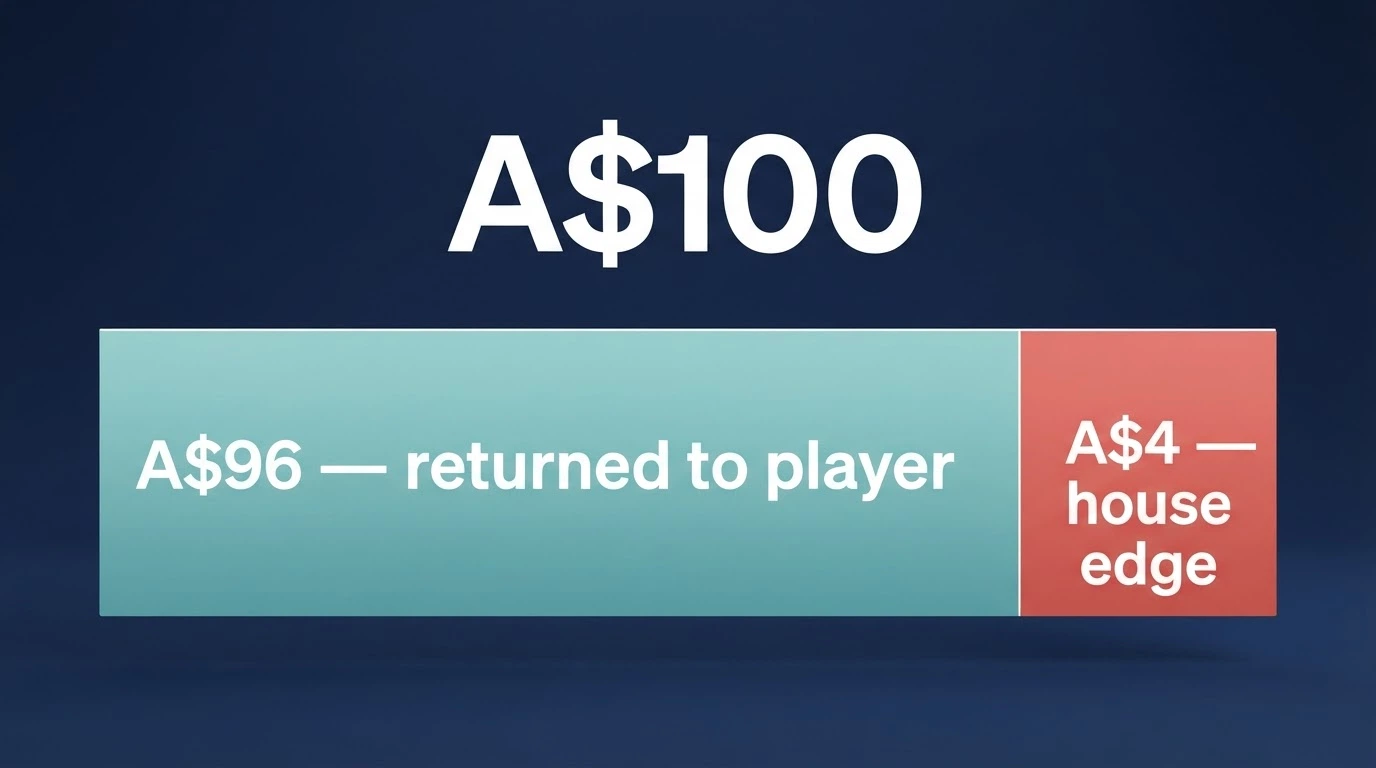
The long run is the part that gets lost. Most online pokies from major developers sit between 94% and 97% RTP, with only a small number above 98%. A 96% return rate means the house keeps A$4 of every A$100 wagered, but only across thousands of spins, not every session. A player can sit down at a 99% pokie and lose their entire deposit in twenty minutes. Variance is not the same thing as return rate. A high RTP does not promise a win on any given visit. It promises a slightly better average loss over time.
This is the gap the marketing tends to flatten. A “99% pokie” sounds like a high-odds prospect. It is, in fact, a game where the house keeps A$1 of every A$100 wagered over millions of spins, and the player can still walk out empty after any number of them.
Payout rate vs payout speed — why chasing one can cost you the other
The casino industry uses “payout” in two senses that mean entirely different things. RTP, or return to player, is the long-run statistical return on the games. Payout speed, sometimes called withdrawal speed or cashout time, is how long it takes the casino to send your winnings back after you ask. A casino can publish a 98% average RTP across its lobby and still take five business days to process a withdrawal. Another casino can pay out in twelve hours and run a lobby averaging 95%. Neither number tells the whole story. Both matter.
Fast-payout casinos in this market cluster at the offshore end of the licensing spectrum, and most fast-payout operators in this guide run in the 12 to 48-hour range. The catch is the same one that runs through every other dimension on this page: an offshore casino’s payout promise has no Australian regulator standing behind it. If a withdrawal stalls, the player has no ACMA to call. The speed claim is only as good as the operator’s willingness to honour it on the day it is tested.
The 2026 online pokies landscape — who’s actually offering what
No online casino holds an Australian licence. None. Not federally, not in any state or territory. The Interactive Gambling Act 2001 makes providing online casino games, online pokies and in-play sports betting to a person in Australia an offence, and the prohibition has been in place for more than two decades.
Every casino on this page is therefore operating from outside Australia under a foreign licence. Most carry a Curacao or Anjouan authorisation, neither of which is binding on Australian regulators and neither of which carries Australian consumer protections. Offshore licences differ widely in what they enforce: some require segregated player funds, some require dispute resolution through a named body, and some require very little at all.
The scale of the offshore market is not small. Around A$1.016 billion is spent by Australians each year on overseas gambling websites offering online pokies and casino games. Thirty-six per cent of Australia’s online gambling market is offshore, meaning Australians lose A$3.9 billion annually through illegal sites, a figure projected to reach A$5 billion by 2029. The licensed domestic industry calculates it will forego A$2 billion in government revenue and lose almost A$800 million to sports and racing over the next five years.
That is the structure every other section on this page sits inside.
Who’s playing — and what the law actually says
The IGA targets the provider, not the player. Australian players are not prosecuted for placing bets at offshore casinos. The Act makes it an offence to provide a prohibited interactive gambling service to someone in Australia. If you open an account at a Curacao-licensed operator from a Sydney address, the operator is the one breaking the law, not you.
That is not the same as being protected. The ACMA’s own wording is direct: even if a service looks legitimate, it is unlikely to have important customer protections. Australians who use illegal gambling services risk losing their money. The Act does not need to prosecute players because the absence of recourse is the punishment. There is no Australian regulator to complain to, no local alternative dispute resolution, and no guarantee the operator will process a withdrawal at all.
Around 2.1% of Australian adults — about 430,000 people — experience problem gambling, with the AIHW putting high-risk gambling at 1.8% in 2022. The combination of offshore access, fast deposit methods and the absence of the protections the domestic system provides is part of why that number stays where it does.
Offshore casinos Australians actually use — ranked and compared for 2026
The table below ranks ten offshore casinos Australian players actually reach by traffic share. Every one is operating from outside Australia under a foreign licence. No operator holds an Australian licence for online casino games. The ranking is by market presence, not by licence status — none is licensed in Australia, and no AU-licensed operator exists for this product category. Empty cells mark specifications that were not publicly available at the time of writing; they are not endorsements and they are not failures of the operators, just gaps in what the operator has published for an Australian audience.

| Casino | Welcome Bonus | Wagering | Free Spins | Game Providers |
|---|---|---|---|---|
| Rocket Play | Deposit match + free spins | — | Included in package | NetEnt, Pragmatic Play |
| Skycrown | Up to A$8,000 + 400 FS across 4 deposits | 40x bonus + FS | 400 | NetEnt, Pragmatic Play |
| Royal Reels | A$10 no-deposit + 100% up to A$500 | 30x bonus only | None | Push Gaming |
| WinSpirit | 200% match + 25 FS | 40x | 25 | Pragmatic Play |
| Stake | Rakeback/lossback (no traditional welcome) | — | — | — |
| Rainbet | 100% up to A$500 + 100 FS (tiered, 3 deposits) | 30–40x | 60–100 | NetEnt, Pragmatic Play, Quickspin |
| Scream Casino | — | — | — | — |
| Fair Go | 100% up to A$200 on each of first 5 deposits | 30x | 100 no-deposit | RealTime Gaming (280 games) |
| Bizzo Casino | Up to A$5,000 + 150 FS across 4 deposits | 40x bonus + FS | 150 | 60+ providers (3,000+ titles) |
| Rocket Casino | Deposit match + free spins | 45x | Included in package | — |
What the columns cannot show is what each operator actually delivers once the headline is past. The write-ups below cover the operators row by row.
Rocket Play
Rocket Play holds the largest market share of any AU-facing offshore casino in the operator pool at 9.4%, which puts it in the rare position of being the name Australian players land on first when they search. Its Curacao licence is referenced in operator materials, though the licence number was not independently verified in this round.
The welcome offer is a deposit match paired with free spins, though the exact figures were not confirmed in operator materials during this review cycle. NetEnt and Pragmatic Play are confirmed among the providers in the lobby, which puts at least some of the highest-RTP pokies discussed later in this page within reach. Beyond that, the public-facing information is thin.
Reach and familiarity, traded against fine print. The biggest name by traffic share, and the operator where a player is most likely to find terms buried rather than advertised.
Skycrown
Skycrown advertises the biggest welcome package in this set: up to A$8,000 in bonus funds plus 400 free spins, spread across four deposits. The structure is generous on paper. First deposit is a 120% match up to A$1,200 plus 125 free spins; second is 100% up to A$1,300 plus 75 spins; third is 80% up to A$1,500 plus 50 spins; fourth is 150% up to A$4,000 plus 150 spins. The cumulative cap on bonus cashout is A$20,000, with a per-deposit-part cap of A$5,000 and a maximum win from the free spins of A$300 per deposit part.
The wagering requirement is 40x on both the bonus and the free spins. Bonuses are not available for crypto deposits. NetEnt and Pragmatic Play are confirmed among the providers. The Curacao licence is referenced across multiple sources, though the specific identifier was not independently confirmed.
The headline is bigger than the payout. A$8,000 in headline credit at a 40x wagering wall and a A$5,000-per-part cashout cap means the bonus maths is the message; the section on bonus cost below works the numbers through.
Royal Reels
Royal Reels is one of the few offshore casinos in this market that publishes a no-deposit bonus — A$10 in credit just for signing up — alongside a 100% deposit match up to A$500. The wagering requirement is 30x on the granted bonus only, which is unusual; most offshore operators apply the multiplier to both deposit and bonus.
Push Gaming is confirmed as the exclusive provider in the lobby, which makes the game library narrower than the volume operators below but more concentrated. A review of the operator’s terms on a popular industry site flagged some clauses that were not favourable to players, and that flag stands for anyone planning to reload beyond the no-deposit offer.
Useful for testing a casino with no cash up front; read the fine print before reloading. The A$10 no-deposit offer is the genuine rarity in this market, and the T&C flag is genuine too.
WinSpirit
WinSpit offers a 200% welcome bonus plus 25 free spins, with a 40x wagering requirement on promotional play. The published withdrawal speed is 12 to 24 hours, which puts it at the fast end of the operators in this set.
Pragmatic Play is confirmed among the providers, and a full RTP database has been reported on the site. BetStop and deposit-limit links are reportedly accessible directly from the WinSpirit site, which is unusual for an offshore operator and worth noting. The links do not change the offshore status of the casino, but they do mean a player can reach the register without leaving the site.
The fastest published withdrawal in the set, by a margin. The bonus terms are ordinary for the segment; the speed is the strongest reason to consider it.
Stake
Stake sits at the other end of the bonus model. There is no traditional welcome package — no deposit match, no free spins bundle. Instead, the operator is known for a rakeback or lossback model, where a percentage of net losses is returned to the player over time. Crypto-native by design, with a Curacao licence referenced in operator materials.
This is not a casino for bonus hunters. It is built for players who stake consistently and value a steady rebate over a one-off headline. The trade-off is no upfront bonus value in exchange for ongoing return on activity.
Built for steady play, not bonus hunting. A different kind of offer for a different kind of punter.
Rainbet
Rainbet’s headline offer is a 100% match up to A$500 plus 100 free spins, though the structure is tiered across three deposits: 100% plus 20 free spins on the first, 50% plus 20 on the second, 100% plus 20 on the third. The wagering requirement is 30x on bonus plus deposit, or 40x with a Wager Lock option.
Two terms shrink the offer. The first is a maximum cashout from bonus of A$200, which is low by the standards of this segment. The second is a restriction on games with RTP above 97.4% during bonus play, which removes the highest-return pokies from the wagering requirement. NetEnt, Pragmatic Play and Quickspin are confirmed among the providers.
A A$200 cashout cap converts the headline into a small ceiling. The RTP restriction during bonus play is the more interesting clause: it is the operator explicitly steering play away from the pokies that pay back the most.
Scream Casino
Scream Casino holds a 0.99% market share, putting it at the smallest end of the operators in this set. Welcome bonus, licence, game providers and wagering terms were not publicly available for review. What is publicly documented is the market presence, not the operator’s terms.
This is the operator where depositing carries the most undisclosed risk, simply because the published information is thin. A bonus claim on the operator’s own page is not the same as a verifiable term.
Depositing where the terms are not publicly documented is itself the risk. Treat any bonus claim on the operator’s own materials as unverified until it can be checked against a third-party source.
Fair Go
Fair Go runs an RTG-only library of around 280 games, which makes it the most concentrated provider line-up in this set. The welcome package is a 100% match up to A$200 on each of the first five deposits, totalling up to A$1,000, alongside a separate 100-free-spin no-deposit bonus with 60x wagering on winnings and a A$180 maximum cashout.
The published wagering on the deposit bonuses is 30x on pokies with no maximum bet rule, which Fair Go’s terms call the fairest in the set among offshore operators. Withdrawal speed is published at 12 to 24 hours. Deposit limits are available through the account dashboard.
The most readable terms in the set, on a single-provider library. Players who value clarity over variety will find Fair Go the most straightforward read in this guide.
Bizzo Casino
Bizzo is the volume play in this set: more than 60 providers and over 3,000 titles in the lobby. The welcome package is up to A$5,000 in bonus funds plus 150 free spins across four deposits (100% plus 100 FS up to A$250; 50% plus 50 FS up to A$750; 30% up to A$2,000; 25% up to A$2,000). Wagering is 40x on both bonus and free spins. The maximum bet while wagering is A$6.50, with a minimum qualifying deposit of A$25.
The Curacao licence is referenced in independent reviews. Withdrawal speed is published at 24 to 48 hours. Recurring promotions include Monday free spins (20, 50 or 100 free spins for a A$25, A$75 or A$125 deposit respectively) and a Thursday reload of 100 free spins on The Magic Cauldron.
Best when variety matters more than bonus returns. The 3,000-title library is the strongest pitch in the set; the bonus terms are ordinary for the segment.
Rocket Casino
Rocket Casino rounds out the list with the highest wagering multiplier in this set at 45x, paired with a A$5 maximum bet while the wagering is being cleared. The welcome offer is a deposit match plus free spins, though the exact figures were not confirmed in this review cycle.
The published withdrawal speed is 24 to 48 hours. The RTP of games in the lobby is reportedly not easy to find on the operator’s site, which is itself information: a player who cannot verify what return rate a pokie is running is relying on the operator’s configuration without being able to check it.
The highest friction in the set, with the smallest information footprint. The 45x wagering and the hidden RTP configurations are not separate problems; they are the same problem, seen from two angles.
Your 2026 bonus is smaller than it looks — payout speeds, payment blocks and RTP tricks
The biggest line on a welcome offer is the bonus amount. It is also the least informative. What determines how much of it a player actually keeps is wagering, cashout caps, the payment method the casino asks for and the RTP configuration of the games it loads.
How fast these casinos actually pay out
The published withdrawal speeds across the operators in this set range from 12 hours to several days. WinSpirit and Fair Go publish 12 to 24 hours; Bizzo and Rocket Casino publish 24 to 48 hours; the others are not consistently published or vary by method. Same-day payout is a real possibility at the fast end of this range, though it depends on the payment method and the operator’s verification queue.
An offshore casino’s payout promise has no regulator behind it. The ACMA’s enforcement targets the operator, not the player, and an unresolved dispute at an offshore casino has no domestic alternative dispute resolution. The published speed is only as good as the operator’s willingness to honour it on the day it is tested. The same applies to the offer above: the welcome bonus is only as good as the operator’s willingness to credit it under the published terms.
PayID, crypto and the banned payment methods
The payment method a casino asks for is a tell. Credit cards, credit-related products and crypto have been banned as payment for licensed online wagering since 11 June 2024 under the Interactive Gambling Amendment (Credit and Other Measures) Act 2023. A licensed Australian operator cannot accept them. A site that asks for a credit card or a crypto deposit from an Australian player is therefore operating outside the licensed wagering framework, which means it is offshore.
PayID and Osko are the fastest domestic bank-transfer routes for Australian players, and POLi — the previous go-to — was decommissioned on 30 September 2023. Current AU deposit routes run through PayID, debit cards and crypto; the first two are signs the casino is at least nominally configured for Australian traffic, the third is a sign it is operating outside the licensed system. From 1 January 2027, banks and payment providers gain express authority to block transactions to illegal gambling operators, which means even PayID routes could be cut off at the bank side for sites on the ACMA’s blocked list.
RTP configurations — the same pokie, a worse number
The pokie’s published RTP is not necessarily the one the casino has loaded. Major developers publish multiple RTP configurations for the same title, and the operator picks which one to run. Pragmatic Play’s titles ship in at least three configurations — 96.5%, 95.5% and 94.5% — with the operator selecting which one. Sweet Bonanza is the clearest case: the game runs at 96.51% in its highest configuration, with lower versions at 95.45%, 94.51% and 91.51%. The 5% gap between top and bottom configuration is the difference between A$96.51 and A$91.51 returned for every A$100 wagered.
Sugar Rush 1000 follows the same pattern, with a default of 96.53%, a top configuration at 97.5%, and lower configurations at 95.50% and 94.50%. Big Bass Bonanza ships at 96.71% by default, with lower configurations available. Book of Dead is adjustable, with a top configuration reaching 96.21%. Gates of Olympus 1000 sits at a 96.50% typical.
The player can sometimes check which version is loaded by opening the game’s information or paytable screen inside the casino lobby. The figure shown there is the one the operator has selected. The version on the developer’s marketing page is the highest configuration, not necessarily the one the player is playing.
What an A$8,000 bonus actually costs
Take the Skycrown welcome package as a worked example, because its headline is the largest in this set. A A$8,000 bonus at 40x wagering means the required turnover is A$320,000, assuming only the bonus amount is wagered. At a 96% RTP — the middle of the typical online range, and a reasonable midpoint for the kind of pokies Skycrown carries — the house edge is 4%, and the expected loss over A$320,000 of wagering is A$12,800.
That is the arithmetic behind the offer. The bonus’s face value is A$8,000. Its expected cost is A$12,800. The number on the page is the marketing line; the number on the spreadsheet is what it actually costs a player, on average, to clear it.
This is a statistical estimate over many spins under the stated assumptions. It promises no win, no payout and no return. A single player can land anywhere on the distribution. But the average is the average, and an offer whose expected cost exceeds its headline value is not the bargain it looks like.
The highest-RTP pokies you can actually spin in 2026
The table below lists the highest-RTP online pokies available at AU-facing offshore casinos by their published maximum return, along with provider, volatility and maximum win where research confirmed those figures. Cells with no published figure carry the no-data marker rather than a guess; the table covers the titles the research confirmed, not the full lobby of any casino.
| Pokie | RTP | Provider | Volatility | Max Win |
|---|---|---|---|---|
| Ugga Bugga | 99.07% | Playtech | — | — |
| Mega Joker (Supermeter) | 99.00% | NetEnt | — | — |
| Book of 99 | 99.00% | Relax Gaming | — | 12,075x |
| Jackpot 6000 (Supermeter) | 98.86% | NetEnt | Medium | 2,000x |
| 1429 Uncharted Seas | 98.60% | Thunderkick | Low | 670x |
| Cowboy Coins | 98.08% | Pragmatic Play | Very High | 30,000x |
| Blood Suckers | 98.00% | NetEnt | Low | 900x |
| Starmania | 97.87% | NextGen Gaming | Low–Medium | 1,250x |
| White Rabbit Megaways | 97.72% | Big Time Gaming | — | 13,029x |
| Dead or Alive 2 | 96.82% | NetEnt | Very High | 111,111x |
| Big Bass Bonanza | 96.71% | Pragmatic Play | Medium–High | 2,100x |
| Razor Shark | 96.70% | Push Gaming | Very High | 25,000x |
| Sugar Rush 1000 (default) | 96.53% | Pragmatic Play | High | 25,000x |
| Gates of Olympus 1000 | 96.50% | Pragmatic Play | High | 15,000x |
| Sweet Bonanza (top config) | 96.51% | Pragmatic Play | — | — |
| Book of Dead (top config) | 96.21% | Play’n GO | High | — |
The list runs from the rarest top of the return range down to the cluster of popular titles most Australian players actually search for. Most online pokies from major developers sit between 94% and 97% RTP, with only a small number above 98%. Games above 97% RTP typically account for 3 to 5% of a casino’s slot library. The pokies in this table are the exception, not the rule.
The 99% RTP club — Mega Joker, Ugga Bugga and Book of 99
Only three pokies carry a genuine 99% RTP, and each one earns that number under specific conditions. Mega Joker, a NetEnt classic, returns 99.00% in Supermeter mode, but the base-game RTP sits between 76.9% and 85.1%. The headline figure applies when the player is betting at maximum coin value and entering the Supermeter bonus round; a player who never reaches that round is playing a much lower-return version of the same game.

Ugga Bugga, by Playtech, holds the highest published RTP of any online pokie at 99.07%. Book of 99, by Relax Gaming, also returns 99.00% with a 12,075x maximum win. Both are at the very top of the range, but both are also niche titles that not every offshore casino carries.
What the 99% club demonstrates is that the highest RTP figures in the market are not the games most players end up playing. The titles Australians actually search for sit lower in the table.
High-RTP runners-up that still beat the house edge
Beneath the 99% tier sits a small group of pokies at 98% to 97% RTP, several of them at low or low-to-medium volatility, which means they pay out more steadily rather than only over very long runs. Blood Suckers (NetEnt) returns 98.00% at low volatility with a maximum win of 900x. Jackpot 6000 (NetEnt) reaches 98.86% in Supermeter mode at maximum bet, at medium volatility, with a 2,000x max win. 1429 Uncharted Seas (Thunderkick) returns 98.60% at low volatility, with a 670x maximum win. Cowboy Coins (Pragmatic Play) returns 98.08% at very high volatility with a 30,000x maximum win — a different shape of payout profile, where wins are rarer but much larger when they land.
Starmania (NextGen Gaming) sits at 97.87% at low-to-medium volatility with a 1,250x maximum win. White Rabbit Megaways (Big Time Gaming) returns 97.72% with a 13,029x maximum win.
These are the titles that quietly beat the house edge more often than the 99% club. The volatility matters as much as the return rate. A 98% pokie at low volatility returns A$98 of every A$100 wagered over thousands of spins, in smaller and more frequent increments. A 98% pokie at very high volatility returns the same A$98 over the same long run, but the player can go through hundreds of spins without seeing a meaningful win and then hit one large payout. Same average, different experience.
Popular pokies with adjustable RTP — check which version you are playing
The pokies Australians actually search for are the ones with adjustable RTP configurations, and they sit lower in the table than the 99% club. Big Bass Bonanza (Pragmatic Play / Reel Kingdom) returns 96.71% by default at medium-high volatility with a 2,100x max win, but the configuration is adjustable. Sweet Bonanza (Pragmatic Play) ships in at least four versions — 96.51%, 95.45%, 94.51% and 91.51% — and the operator picks which one. Gates of Olympus 1000 (Pragmatic Play) returns 96.50% at high volatility with a 15,000x max win. Sugar Rush 1000 (Pragmatic Play) runs at 96.53% by default, with a top configuration at 97.5% and lower ones at 95.50% and 94.50%, at high volatility with a 25,000x maximum win.
Book of Dead (Play’n GO) is one of the most popular high-volatility slots and is adjustable up to 96.21%. Dead or Alive 2 (NetEnt) returns 96.82% at very high volatility with a 111,111x maximum win. Razor Shark (Push Gaming) returns 96.70% at very high volatility with a 25,000x maximum win.
The headline RTP for each of these titles is the highest configuration the developer publishes, not necessarily the one the player is playing. Checking the in-game paytable or help screen is the only way to confirm what is actually loaded.
Land-based vs online RTP — the 10-14% gap you never see on the machine
The most important RTP comparison is not between pokies, it is between venues. New South Wales mandates a minimum 85% RTP for land-based pokies in pubs and clubs. Victoria requires 87%. Those floors are the legal minimums, not the averages — many pub machines sit close to the floor.
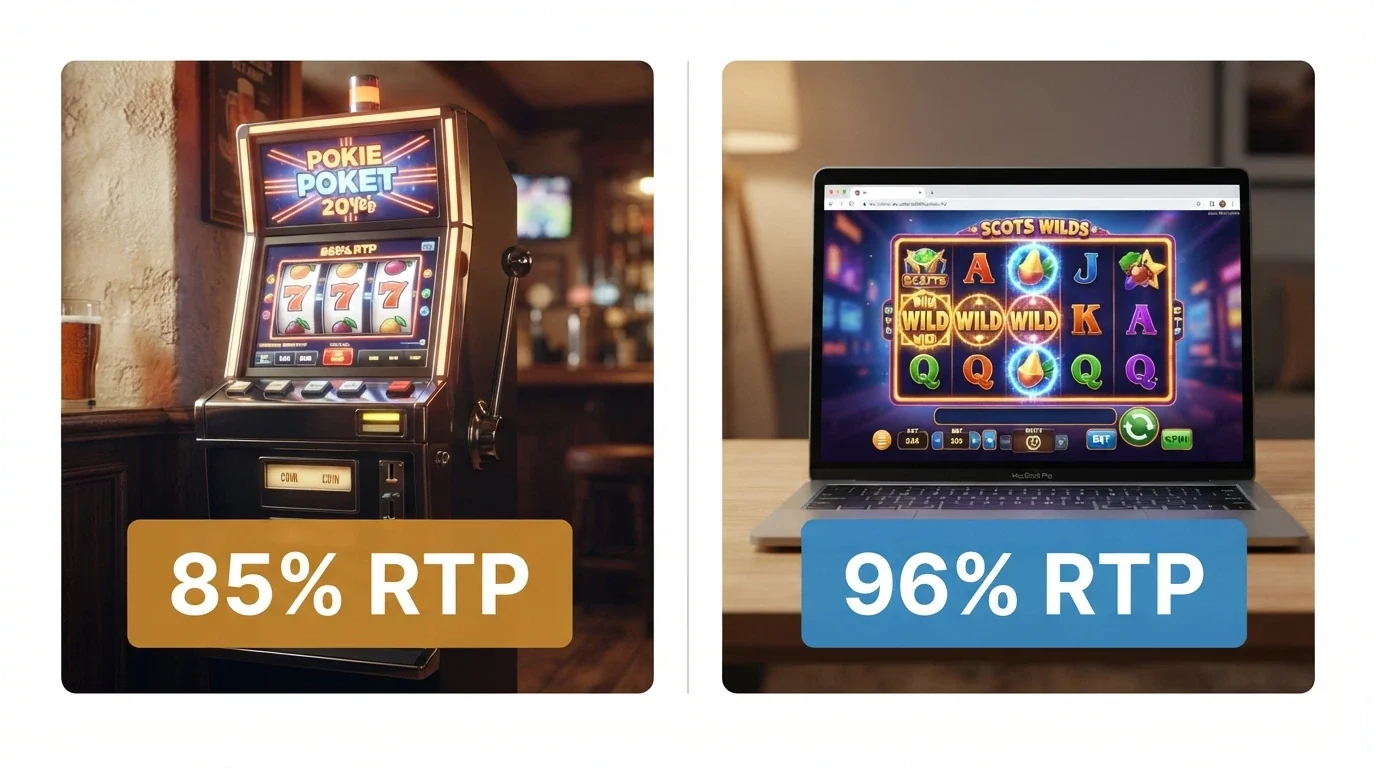
Online pokies from the same developers run at 94% to 99%, a gap of 7 to 14 percentage points. Put in dollar terms, A$100 wagered at a NSW pub pokie returns A$85 on the legal minimum, against A$94 to A$99 online. The difference is up to A$14 of every A$100 wagered. That gap is structural. It exists because the land-based tax and operating-cost structure forces the return down, and because online operators have lower fixed costs per spin and can run a higher return rate. The player pays for the venue, the staff and the machine in return rate.
Is playing online pokies legal in Australia? The law says no — here is what that means
The Interactive Gambling Act 2001 is the centre of this question. It was passed in 2001, strengthened by amendments in 2017, and further amended in 2023, 2024 and again in 2026. The 2026 reform — the Interactive Gambling Amendment (Gambling Reform) Bill — passed Parliament on 19 August 2026 and commences on 1 January 2027.
The Interactive Gambling Act — what it bans and what it does not
The IGA prohibits the provision of online casino games, online pokies and in-play sports betting to a person in Australia. The prohibition targets the provider, not the player. The penalties are civil, not criminal for most operators, but they are substantial: up to A$2,475,000 per day for an individual and A$12,375,000 per day for a corporation.
What the IGA permits is wagering on races and sport placed before the event begins, lotteries and keno, all through operators licensed by a state or territory. The Northern Territory Racing and Wagering Commission, administered through Licensing NT, is the de facto national licensor for online wagering operators. The minimum age is 18 across all commercial gambling.
There is no federal deposit, loss or stake ceiling for online gambling in Australia, because the product those ceilings would govern is banned outright. Australia caps how you can pay for licensed wagering, not how much you can wager.
ACMA enforcement — 1,788 blocks and counting
The ACMA has had 1,788 illegal gambling and affiliate websites blocked by Australian ISPs since November 2019. Over 230 illegal services have withdrawn from the Australian market since 2017, after ACMA started enforcing strengthened rules. In Q4 2025 alone, ACMA completed 23 investigations into 45 gambling sites, found 69 breaches of the IGA, issued 10 formal warnings and referred 133 websites for blocking.
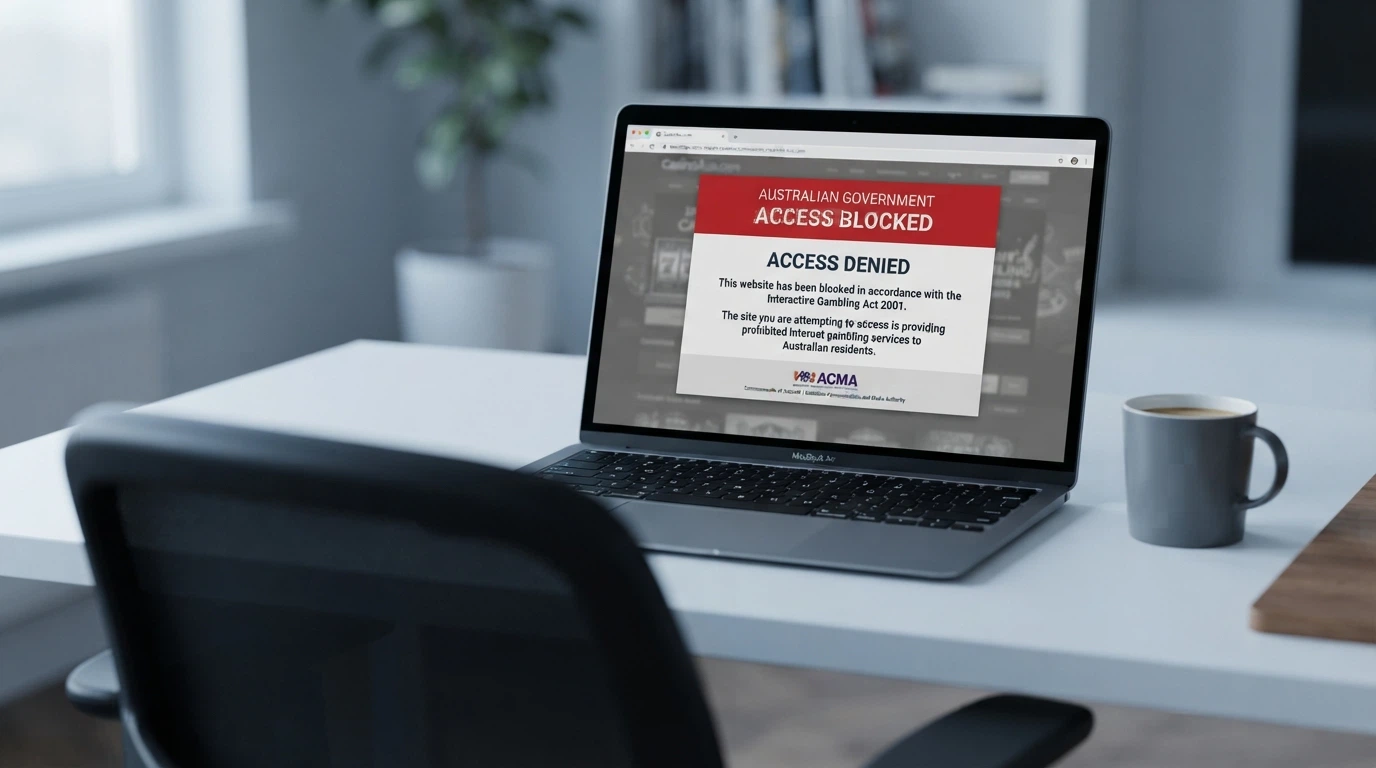
The Federal Court ordered pecuniary penalties totalling A$24.24 million against operators of prohibited online poker services marketed to Australians in ACMA v Jones (No 7) FCA 860, bringing total penalties in the litigation to A$29.24 million. On 16 January 2026, ACMA issued eight infringement notices to Tabcorp totalling A$158,400 for providing a prohibited in-play betting service.
The enforcement is real. The sites keep appearing. The block list grows; so does the operator list. The two move in parallel.
Why no online casino is licensed in Australia — and what that means for your money
No online casino licence exists in Australia. Not federally, not in any state or territory. The IGA prohibits the product outright. A page about “licensed online casinos in Australia” is describing a category that does not exist, and any operator claiming an Australian licence for online casino games is misleading the player.
What an offshore licence does provide varies. A Curacao licence requires some baseline compliance and dispute mechanisms; an Anjouan licence carries different rules again. None of these licences bind Australian regulators, none extend Australian consumer protections, and none require the operator to honour Australian responsible-gambling frameworks.
The practical risks for an Australian player at an offshore casino are concrete. There is no ACMA recourse for lost money. There is no BetStop coverage — the self-exclusion register does not extend to offshore operators. There is no guarantee the operator will process a withdrawal, and no Australian alternative dispute resolution if it does not. The site can be blocked at any time, including while a balance is on it. The ACMA’s own wording is that even if a service looks legitimate, it is unlikely to have important customer protections.
The 2026 reform — what changes on 1 January 2027
The Interactive Gambling Amendment (Gambling Reform) Bill 2026 passed Parliament on 19 August 2026. Its measures commence on 1 January 2027. Three changes matter to an Australian player considering the operators on this page.
The first is bank and payment-provider authority to block transactions to illegal gambling operators. From 1 January 2027, banks and payment providers gain express statutory authority to decline or block transactions they identify as flowing to illegal operators. PayID and card routes that work today may not work tomorrow for sites on the ACMA’s blocked list.
The second is tightened advertising restrictions. From 1 January 2027, no more than three wagering ads per hour between 6am and 8:30pm; a live-sport blackout from 15 minutes before to 5 minutes after events; radio ads barred during school-commute times; broadcasting of sporting odds banned outright; online ads only to logged-in, over-18 users who have not opted out; no ads in sports venues or on uniforms; athletes, celebrities and influencers barred from promoting wagering. An offshore casino advertising a welcome bonus to Australians is breaking the prohibition itself.
The third is direct-marketing restrictions. From 1 January 2027, direct marketing of inducements is prohibited for 14 days after sign-up, three months after BetStop deregistration, and indefinitely for customers flagged as at-risk.
Staying safe when the safety net has holes — responsible gambling and offshore casinos
Australia’s responsible-gambling infrastructure is world-class. It was built for the licensed wagering system, and an offshore casino sits outside every one of its protections.
BetStop — the self-exclusion register offshore casinos ignore
BetStop — the National Self-Exclusion Register — went live in August 2023. One registration excludes a person from every Australian-licensed online and phone wagering service simultaneously. As at 31 July 2026, BetStop had 67,480 registrations and 41,290 active exclusions. Seventy-eight per cent of registrants were under 40, and 38% chose lifetime exclusion.
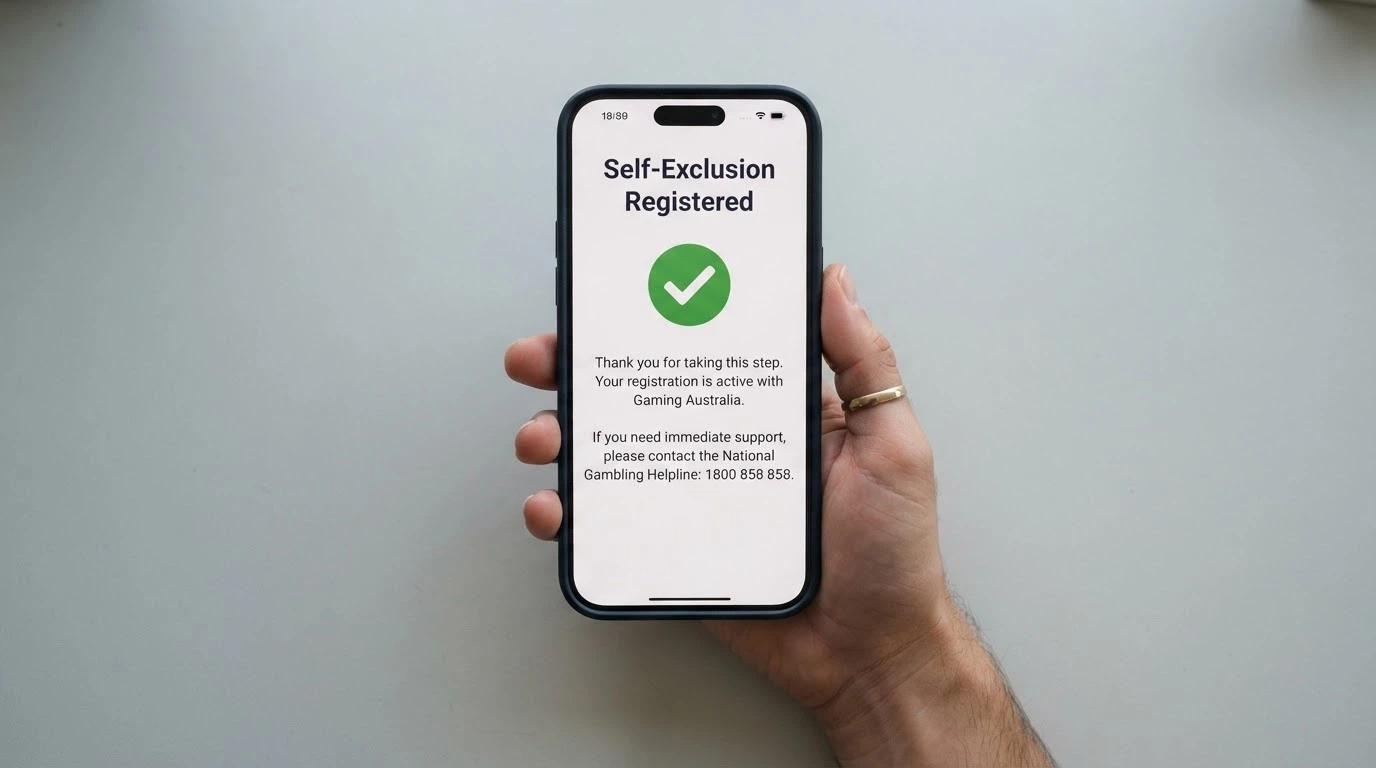
BetStop binds Australian-licensed wagering services only. An offshore casino is not connected to the register and has no obligation to honour it. A player who has registered with BetStop can still open an account, deposit and play at every operator listed on this page. From 1 January 2027, register operations are strengthened and direct marketing of inducements is banned for three months after deregistration, but the offshore gap remains.
Deposit limits, helplines and the 430,000 Australians at risk
The National Gambling Helpline is 1800 858 858, free, confidential and staffed 24 hours a day, seven days a week. Gambling Help Online at gamblinghelponline.org.au provides online chat and counselling. Around 2.1% of Australian adults — about 430,000 people — experience problem gambling, with the AIHW putting high-risk gambling at 1.8% in 2022.
Some offshore casinos publish deposit-limit tools on their account dashboards, and WinSpirit and Bizzo reportedly link BetStop and deposit-limit pages directly from the casino site. A self-set limit on an offshore site is not the same as a legally enforced one, but it is more useful than nothing. A player who needs the limit to hold against them should know that no Australian regulator will enforce it if the operator decides otherwise.
How we selected and ranked these casinos and pokies
The operator set is built from the AU-facing offshore casinos that Australian players actually reach by traffic share and market presence, drawn from the operators reviewed in the source pool. Inclusion is by market presence, not by licence status — none of the operators holds an Australian licence, and no AU-licensed operator exists for online casino games.
The ranking dimensions, in approximate order of weight, are: the RTP of the pokies available in the lobby, the published bonus terms and wagering requirements, the game-provider portfolio and library size, and the published payout-speed claims. The slot ranking is by published RTP only; volatility and maximum win are carried as supplementary data where research confirmed them. Where the research did not carry a figure for a specific slot or a specific operator specification, the cell or sentence carries the absence honestly rather than substituting a guess.
The licence-status check is against the ACMA’s official register and each operator’s own published terms. The RTP figures are cross-checked against developer documentation and at least one independent review per title. The terms change; the data is current as of 12 November 2026.
What Australian players should actually do with all of this
The highest-RTP pokies are real. They are available, in most cases, at the offshore casinos listed above. The fact that they are available is the part that needs to be held in the same hand as the rest of this page.
The core of the situation is this: no online casino holds an Australian licence, every casino on this page is offering a prohibited service, and the player carries every financial risk the offshore status creates. The RTP data is honest. The cashout caps are honest. The wagering requirements are honest. None of the protections players assume exist — ACMA recourse, BetStop coverage, alternative dispute resolution, a guarantee of withdrawal — apply at an offshore operator.
A player who chooses to play anyway can do three things to keep the choice as informed as possible. First, check the RTP configuration of the pokie they intend to play; the in-game paytable shows the loaded version, and the gap between configurations is real money. Second, read the wagering and cashout terms before claiming any bonus; the A$8,000 headline at Skycrown costs A$12,800 in expected loss on the calculation in this page, and similar arithmetic applies across the set. Third, know that the payment method is a tell — a casino asking for credit card or crypto is operating outside the licensed framework, and the protections that framework provides.
The legal position is that the player is not prosecuted. The financial position is that the player carries the loss. The National Gambling Helpline at 1800 858 858 is free, confidential and available 24 hours a day. The help is real, and it cannot reach the money already sent offshore.
Frequently asked questions
What does RTP mean and how does it affect how much a pokie pays out over time?
RTP, or return to player, is the percentage of all money wagered that a pokie returns to players, measured across millions of spins. A 96% RTP returns A$96 of every A$100 wagered on average over the long run. It does not promise any given session, and a player can lose their full deposit at a 99% pokie in twenty minutes.
What is the difference between a pokie’s maximum RTP and the lower RTP configuration some casinos load?
Major developers publish multiple RTP versions of the same title, and the operator picks which one to run. Pragmatic Play ships Sweet Bonanza in four versions ranging from 96.51% down to 91.51%, a 5% gap. Sugar Rush 1000 ranges from 97.5% down to 94.50%. The figure in the in-game paytable is the one actually loaded.
Can I use PayID or credit cards to deposit at online pokies sites in Australia?
PayID and debit cards work at most offshore casinos serving Australian players. Credit cards and crypto have been banned for licensed Australian wagering since 11 June 2024, so a casino asking for either is operating outside the licensed framework. From 1 January 2027, banks can also block transactions to illegal operators.
How does BetStop protect Australian players and does it cover offshore casino sites?
BetStop is the National Self-Exclusion Register: one registration excludes a person from every Australian-licensed wagering service simultaneously. As at 31 July 2026 there were 67,480 registrations and 41,290 active exclusions. It binds Australian-licensed services only; offshore casinos are not connected to the register.
What is the maximum win potential on the highest-paying pokies like Mega Joker and Book of 99?
Book of 99 has a published maximum win of 12,075x the stake. Dead or Alive 2 reaches 111,111x. Mega Joker’s 99% RTP applies in Supermeter mode only; the base game returns between 76.9% and 85.1%. High maximum win multipliers do not raise the return rate, they just describe the size of the rare payout.
Why are land-based pokie RTP minimums in Australia (85-87%) lower than online pokie RTPs (94-99%)?
NSW pubs and clubs must return at least 85% RTP, and Victoria 87%, reflecting the higher tax and operating-cost structure of venues. Online pokies from the same developers run at 94% to 99% because online operators have lower fixed costs per spin. The 7 to 14 percentage-point gap is structural, not a quality difference between games.