
The Real Cost of a $100 No-Deposit Bonus at an Australian-Facing Offshore Casino in 2026
 Available in AU
A “free $100” bonus at an Australian-facing online casino is one of the more carefully worded offers in iGaming. The headline reads like a gift. The terms read like a job. Between those two readings sits almost everything that determines whether a player walks away with anything at all.
The headline figure is real. The promotional credit lands in a separate bonus balance. The wagering requirement is the price of converting that credit into anything that can be withdrawn, and the cashout cap is the ceiling on what that conversion can ever amount to. None of this is hidden, exactly. It is just buried under marketing that prizes the $100 number and quietly omits everything that makes it smaller.
This page works through the lot. It explains what a no-deposit bonus actually is, runs the arithmetic on what $3,000 of turnover looks like at a $1 spin, lays out the offshore brands Australian players actually reach, and sets the whole offer against the Australian legal position — which is that no online casino licence exists, every site Australians access is offshore, and the protections a player assumes they have do not extend to that offshore transaction.
As of 2026, no Australian online casino licence exists anywhere in the country. Every brand in the comparison below operates from outside the IGA framework.
Pricing, bonus terms and licence status current as of 18 October 2026, cross-checked against the Interactive Gambling Act 2001 framework and each operator’s own published bonus terms.
Table of Contents
- What a $100 No-Deposit Bonus Actually Is (and Isn’t)
- Why Your $100 Bonus Almost Never Pays Out $100
- The Offshore Casinos Australians Actually Use for $100 No-Deposit Offers
- Can You Use PayID at an AU Casino? The Real Answer
- The Legality Gap: Why No $100 No-Deposit Casino Holds an Australian Licence
- Playing Safely When the Safety Net Isn’t There
- How We Evaluated These $100 No-Deposit Bonus Casinos
- Your $100 No-Deposit Decision: What Matters and What Doesn’t
- Common Questions
What a $100 No-Deposit Bonus Actually Is (and Isn’t)
A no-deposit bonus is promotional credit a casino credits to a new account without the player transferring any of their own money first. The casino is fronting play money, on the bet that the player stays, deposits later, and repays the front in expected value. That is the whole business model. The $100 figure is the size of the front, not the size of any guaranteed payout.
What No-Deposit Actually Means
“No deposit” describes the trigger, not the destination. The player does not pay in. The casino does. The casino’s money shows up in the account as a bonus balance — a separate wallet from any cash the player later adds, and separate from any winnings either balance produces. Until the wagering requirement is met, the bonus balance cannot be withdrawn. It can only be used to place additional bets on games the operator has approved.
That is the architectural point most marketing copy skates over. The $100 exists so the player has something to bet with. It is not $100 of withdrawable cash. It is not a $100 credit toward future losses. It is a $100 reservoir of bets, all of which must clear before any winnings they produce become cashable.
Casinos offer it because it works. A free credit lets a new player experience the lobby, the games and the cashier flow without committing a dollar. The casino’s expectation is not that the player loses the bonus. It is that the player enjoys the experience enough to deposit and play with their own money. From the operator’s standpoint, the no-deposit bonus is a marketing cost with a measurable conversion rate.
How a $100 Free Chip Works in Practice
Once the chip is credited, the player’s balance splits into two: real money on one side, bonus credit on the other. The bonus side can usually only be used on selected games — typically a subset of pokies, occasionally a table game or two. Some operators lock the bonus to a single title, often a flagship slot. Live dealer and progressive jackpot games are usually excluded.
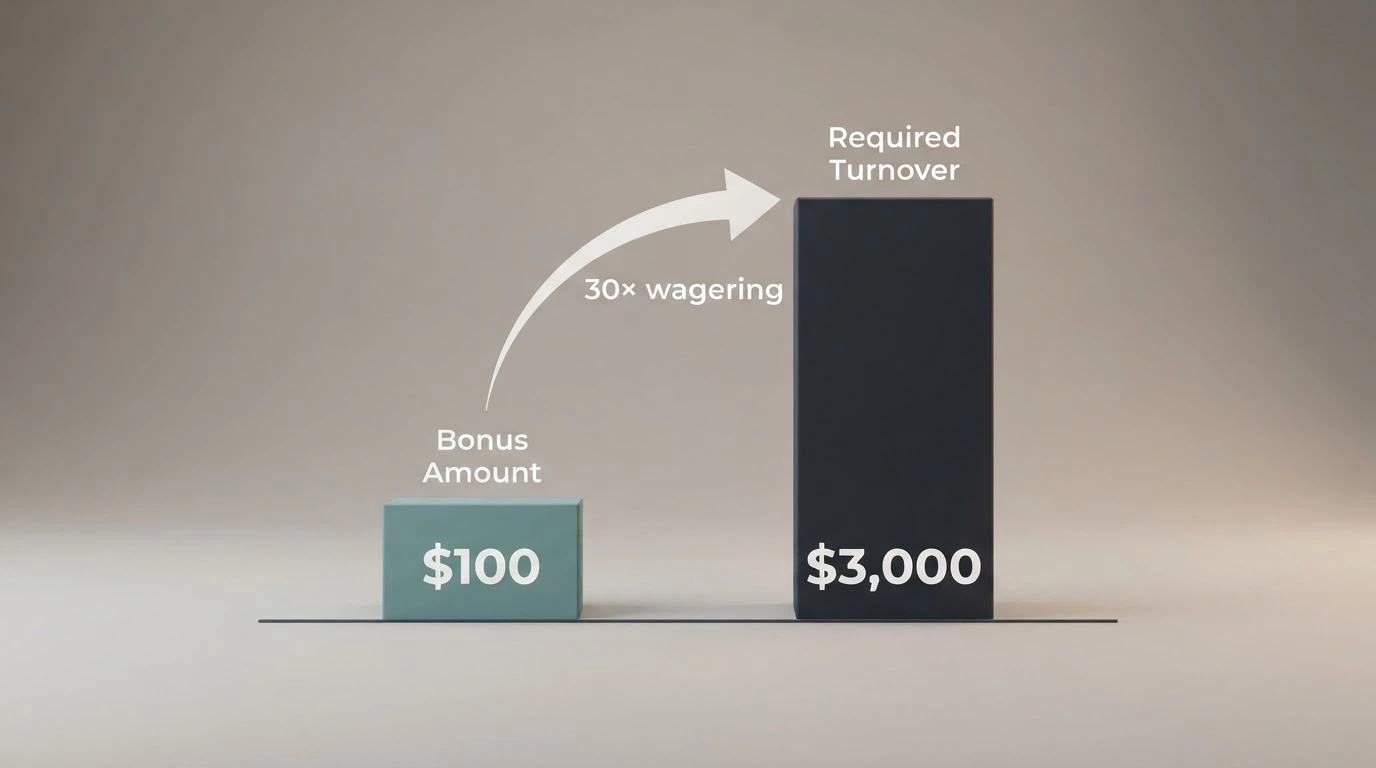
The wagering requirement is what converts the bonus side into the real-money side. A 30x requirement on a $100 chip means the player must place $3,000 in total bets before any winnings generated by those bets become withdrawable. The $3,000 is cumulative, not a single spin. It can be hit across hundreds of smaller bets. Until that cumulative threshold is reached, even a winning spin lands back in the bonus wallet, not the cash wallet.
Try to withdraw before meeting the requirement and the result depends on the operator’s terms. Some void the bonus and any associated winnings. Some let the player forfeit the bonus and withdraw their own deposit, if any was made. A few allow partial cashout once a lower threshold is met. The default, on most no-deposit offers, is that withdrawal is locked until the full requirement clears.
The Eligibility Rules Worth Checking
The fine print on a no-deposit offer is rarely long, but it is the only place the real cost of the bonus becomes legible.
- One bonus per household, IP address or payment method — the operator treats shared addresses and shared cards as a single player.
- New players only — anyone who has previously held an account at the same casino, sometimes at any casino in the same group, will not qualify.
- Country restrictions — even an offshore casino lists the countries it does not serve, and Australia is usually on that list at least for the regulated payment methods.
- Eligible games — most bonus credit is locked to a specific list of pokies, often with weighting that knocks down contribution from table games and excludes live dealer and progressive jackpies entirely.
- Time limits — the standard default is seven days from credit, and the requirement must be cleared in that window or the bonus and any winnings are voided.
- Maximum bet — a per-spin cap, usually between $5 and A$7.50, applies while the bonus is active, and a single spin over that cap can void the whole balance.
- Maximum cashout — a ceiling on what can ever be withdrawn from winnings produced by the bonus, regardless of how the play went.
These rules are not optional. They are the offer. Anyone who skips them is reading the headline instead of the contract.
Why Your $100 Bonus Almost Never Pays Out $100
The wagering multiple and the cashout cap, taken together, are the reason the headline figure is almost a fiction.
A $100 no-deposit chip at 30x wagering requires $3,000 in bets before any winnings become withdrawable. At a $1 minimum stake and roughly five seconds between spins, that is around three thousand spins. It is not impossible to clear. It is also not what a casual player expects from a “free $100” banner. The play time, on average, sits at over four hours of continuous play — and that play time is before the cashout cap even applies.
The cap is the second cut. Among the offers that did surface verification, the no-deposit $100 chip commonly caps withdrawable winnings somewhere between $50 and $200. The headline is the gross. The cap is the net. A player who wins $1,000 on a $100 free chip with a $100 cashout cap walks away with $100, not $1,000 — and only if the wagering was cleared.
The Three Bonus Types at a Glance
The comparison below summarises what an Australian player is likely to meet at an offshore casino today. The ranges come from the verified offers surfaced in this run; the columns are the ones a player can read before claiming.
| Bonus Type | Typical Wagering | Typical Max Cashout | Typical Validity |
|---|---|---|---|
| No-deposit free chip (e.g. $100 chip) | 30x–60x the bonus | $50–$200 | 7 days |
| No-deposit free spins (winnings) | 30x–35x on winnings | varies by code | 7 days |
| Deposit-gated welcome bonus | 30x–40x on deposit + bonus | usually no fixed cap | 14 days |
The wagering on a no-deposit chip is applied to the bonus alone. The wagering on a deposit-gated welcome bonus is applied to the deposit plus bonus combined, which roughly doubles the turnover the same multiplier would demand on a no-deposit offer.
How Long the Bonus Actually Takes to Clear
Working through one verified example: a $100 free chip at 30x wagering means $3,000 of total bets before any withdrawal is eligible. At a $1 spin — the typical minimum stake on most AU-facing pokies under a bonus — that is 3,000 individual spins. At roughly five seconds per spin, the cadence most pokies run at when played continuously, that is about 15,000 seconds of play, or around four hours and ten minutes of uninterrupted spinning.
That is the realistic clearing time. It does not include the time to set the bet, claim the bonus, find an eligible game, or check the wagering counter between spins. It assumes the player bets continuously and never stops. A casual session of thirty minutes a day would push the clearing into just over a week, and most no-deposit bonuses expire well before that.
The calculation also assumes only the bonus amount is wagered. Real sessions include losses, and the player’s own decisions about bet size, game choice and session length all move the clearing time up or down. The four-hour figure is the median, not a guarantee. As a statistical estimate — an average over many spins under these assumptions — it tells the player how long the offer will take, not what it will pay out.
No-Deposit Bonuses: Free Play With a Cap
A no-deposit free chip is the closest thing to a “free” casino offer a player will meet. It costs nothing to claim. The cashout cap is the operator’s price for that.

Among verified $100 chips, the lowest wagering multiple surfaced was 30x — equivalent to $3,000 turnover before any withdrawal is possible. The typical range sits at 30x to 60x. At the upper end of that range, a $100 chip requires $6,000 in bets, and the cashout cap is still in place. The player is taking on more play time, more variance, and the same ceiling.
The cap itself is the more revealing figure. Where the wagering is “merely” 30x, the operator is signalling confidence in the conversion rate. Where the cap is $50, the operator is hedging its exposure on the upside. Some chips carry both — a moderate wagering multiple combined with a modest cap — which is closer to a marketing budget than a player windfall.
Fair Go’s standing public chips are usually smaller than $100 — somewhere between $10 and $50 in most listings — and the larger $100 figures tend to be tied either to a deposit code or to a loyalty-tier reward rather than a public landing-page banner. One Fair Go $100 chip surfaced in this run carried 60x wagering with an approximate A$180 maximum cashout, which is a sharper read on the offer’s economics than any headline figure.
Welcome Bonuses: The Deposit Changes Everything
A no-deposit chip and a welcome bonus share the word “bonus”. The cost to the player is not comparable.
A welcome bonus is deposit-gated. The player pays in first, and the casino matches part of it. Fair Go’s five-stage welcome matches 100% up to $200 on each deposit, which means a player depositing $200 five times in a row banks $1,000 in bonus credit on top of their own $1,000 in deposits. The headline is bigger. The exposure is also bigger.
The wagering requirement on a deposit-gated bonus is typically applied to the deposit-plus-bonus total rather than the bonus alone. A $100 deposit with a $100 matched bonus at 30x on the combined amount means $6,000 in wagers before the bonus side becomes withdrawable. That is double the turnover a $100 no-deposit chip at the same multiplier would demand, because the player has skin in the game.
RocketPlay’s first-deposit tier matches 100% up to A$500 with 100 free spins on the side. The minimum deposit is A$25, the wagering is 40x on the bonus amount, and the package has to be cleared inside 14 days. Rainbet’s first-deposit tier lists 100% up to A$500 with 50 free spins, 35x on the bonus and 30x on free-spins winnings, with a separate variant running 250% up to $2,100 plus 60 free spins across three deposits under a 40x Wager Lock structure. Each offer trades on its headline figure. Each offer costs the player real money to clear.
Bonus Codes: Where the Offer Actually Lives
Most $100 no-deposit offers do not live on a casino’s homepage banner. They live behind a bonus code, entered at registration, in the cashier, or pasted into a dedicated field before the deposit.
The code-gated model exists because it lets an operator run several offers at once without confusing them. One code triggers the no-deposit chip. Another triggers the welcome match. A third unlocks free spins on a specific slot. The player sees a list of codes, picks the offer they want, and types it in. The casino sees clean attribution on which channel produced the conversion.
For the player, the code is also the point where the terms become binding. Most code listings on review sites carry a short summary — wagering, cap, eligible games — but the operator’s own bonus terms page is the legal reference. A code entered without checking those terms is the most common way a player ends up surprised by a cashout cap or a game exclusion.
RocketPlay operates a third path on top of codes and cashier entries. Players who write and verify a third-party review of the casino can claim 20 free spins on Book of Pyramids as a no-deposit path to play. It is a marketing exchange as much as a bonus — the casino gets a review, the player gets a small session on the house. The free spins carry their own wagering on any winnings, and the cap on what those winnings can convert to is set by the same bonus terms as the rest of the platform.
Match Bonuses: When the Casino Matches Your Deposit
A 100% match bonus pairs the player’s deposit dollar-for-dollar. A 200% match bonus triples it. The headline figure scales with the percentage, but so does the wagering commitment.
On a $100 deposit with a 100% match, the player has $200 in the account — $100 of their own money and $100 of bonus credit. The bonus side cannot be withdrawn until the wagering is cleared, and the wagering applies to the deposit-plus-bonus combined total under most Fair Go-style terms. The clearance cost is roughly $6,000 at 30x on a $200 balance, double what the same multiplier would demand on a no-deposit chip.
The match percentage also reframes the cost-benefit calculation. A 200% match bonus sounds more generous than a 100% match, but the larger the match, the larger the bonus side, and the larger the bonus side, the more turnover is needed to convert it. At 40x on the bonus only, a $100 deposit with a 200% match means $80 in bonus credit and $3,200 in turnover. At 40x on deposit-plus-bonus, the same offer requires $12,000 in turnover. Which structure applies is the difference between a feasible clearing target and a punishing one.
What a Bonus Actually Lets You Play: Pokies and Restrictions
A “$100 pokies bonus” does not mean a player can spend the bonus on any pokie in the lobby. It means a restricted subset, often weighted.
Pokies usually contribute 100% of each spin toward the wagering requirement. Table games often contribute 10% or are excluded entirely. Live dealer games are commonly excluded. Progressive jackpies are almost always excluded — the operator will not let bonus play compete for a pooled prize the casino itself underwrites. The eligible games list is short for a reason, and it is the first thing a sharp player reads.
The max-bet rule sits beside it. RocketPlay’s bonus terms cap wagers at A$7.50 while a bonus is active. Bizzo enforces a $5 maximum bet, and the cap is taken seriously — players have had winnings voided for a single $6 spin. The rule is not theoretical. It is the boundary between a cleared bonus and a forfeited one, and it applies to every spin in the session, not just the spin that lands the win.
The Offshore Casinos Australians Actually Use for $100 No-Deposit Offers
The ten brands below are the offshore casino operators that receive the most Australian traffic by current market-share data. None of them holds an Australian online casino licence, because no such licence exists. Each one operates from outside Australia under its own regulator, runs its own bonus terms, and answers to its own jurisdiction rather than to the ACMA.
The comparison is laid out so the licence status is visible at a glance, the welcome offer is quoted where it could be verified, and the wagering multiple is given where the operator’s terms surfaced a clean number. Where the data did not surface, the cell is left blank rather than estimated.
| Operator | Licensed for AU Online Casino? | Welcome Offer | Wagering Multiplier |
|---|---|---|---|
| RocketPlay | No | 100% up to A$500 + 100 FS (first deposit) | 40x |
| Skycrown | No | Up to $4,000 + 350 FS across five deposits | 40x |
| Royal Reels | No | — | — |
| WinSpirit | No | 200% welcome + 25 FS | 40x |
| Stake | No | — | — |
| Rainbet | No | 100% up to A$500 + 50 FS | 35x |
| Scream Casino | No | — | — |
| Fair Go | No | 100% up to $200 across five deposits | 30x |
| Bizzo Casino | No | — | 40x |
| Rocket Casino | No | — | — |
The licence column reads the same down the page on purpose. It is the single most important cell. Every operator in the table is offshore, every bonus term in the table is an offshore contract, and the protections a player has under an Australian wagering licence do not apply to any row above.
RocketPlay
RocketPlay runs the richest publicly documented bonus terms in the featured set. The first-deposit tier matches 100% up to A$500 with 100 free spins on the side, the second-deposit tier runs 200% up to A$500, and the package carries 40x wagering on the bonus amount with a 14-day clearing window from a A$25 minimum deposit. One RocketPlay bonus guide quotes an A$5,000 maximum win cap on the welcome package alongside a 5-day expiry on certain tiers — a tighter cap than most welcome bonuses in the set.
No-deposit players at RocketPlay are not the marketing priority. The general bonus terms flag maximum withdrawals in the $50 to $100 range on no-deposit bonuses and a default 7-day expiry if no period is specified. The free-spins path that does not require a deposit runs through a third-party review-verification scheme: write and verify a review of the casino, claim 20 free spins on Book of Pyramids. Free-spins winnings carry their own wagering — one source cites 35x on free-spin winnings at RocketPlay, another 30x at Fair Go — and the max-bet rule of A$7.50 per spin applies across the whole platform while a bonus is active.
The verdict: RocketPlay publishes more of its terms than most of the offshore brands in the table. That is worth something — a player can read the contract before signing — but every contract is still an offshore contract, and the A$5,000 win cap on the welcome package is a real ceiling on upside.
Skycrown
Skycrown’s headline figure is the largest in the set. The welcome package advertises up to $4,000 plus 350 free spins across the first five deposits, at 40x wagering. Crypto cashback and rakeback offers circulate around the brand.
Per-tier terms were not surfaced cleanly this run, and Skycrown is the kind of operator where the gap between headline and terms can matter. A $4,000 headline spread over five deposits means the player is committing to five separate deposits, each with its own wagering obligation, each with its own clearing window. A player chasing the full $4,000 is signing up for five times the deposit-and-clear cycle, not one.
The verdict: the headline is genuinely large, but every tier needs to be read individually before any deposit is made. The package rewards commitment; it does not reward a casual visit.
Royal Reels
Royal Reels appears in current AU traffic data as a brand Australians reach, but bonus-specific terms were not surfaced in usable form this run. The operator’s own bonus terms page is where the figures live, and a player considering a deposit there should treat verification as a step rather than a formality.
The verdict: Royal Reels sits in the awkward middle ground where reach is documented but terms remain elusive. Transparency-focused players will likely look elsewhere until the operator publishes clearer bonus terms.
WinSpirit
WinSpirit’s headline offer is a 200% welcome bonus plus 25 free spins at 40x wagering. The percentage is on the higher side of the set. One review page cites a Trustpilot score of 4.6 out of 5, which is a real signal — players who get there tend to leave positive feedback — but a Trustpilot score is not a substitute for bonus terms.
Per-tier conditions, eligible game lists and clearing windows were not surfaced this run. A 200% match at 40x on the bonus amount is a more demanding offer than a 100% match at 30x, and the difference shows up in turnover, not in the headline.
The verdict: the Trustpilot number is a real data point, but it is a measure of player experience, not a measure of bonus generosity. A 200% match at 40x is the same kind of offer it would be at any other brand — the rating does not change the multiplier.
Stake
Stake is a major global brand with Australian traffic behind it. Bonus-specific details were limited in this run’s usable snippets. The brand is best known outside the no-deposit-bonus category, and the AU-facing welcome offer structure was not clearly surfaced.
The verdict: Stake’s reach in AU traffic data is real. Its fit for a player looking specifically for a $100 no-deposit bonus is another question, and one this run did not surface a clean answer to.
Rainbet
Rainbet is the operator in the set with two competing welcome-package versions in circulation, and a player should know which one they are getting before they deposit.
One source describes a 100% match up to A$500 plus 50 free spins, with 35x wagering on the bonus amount and 30x on free-spins winnings only. A separate source describes a 250% match up to $2,100 plus 60 free spins across three deposits, structured around a Wager Lock at 40x on the bonus — and a No Wager Lock path that releases bonus funds gradually as the player wagers. Some bonus codes come with an approximately A$50 cashout cap, which is modest against a $2,100 headline.
The two packages are not interchangeable. A player who lands on the Wager Lock version is committing to a single, larger clearing target. A player on the No Wager Lock path trades the clearing target for a slower release, and may end up with bonus funds they never fully convert. A $50 cashout cap on some codes is a third variable — and it changes the offer’s economics regardless of which package is active.
The verdict: the two welcome packages are not interchangeable. Anyone choosing the wrong code for the wrong structure risks committing to an unreachable clearing target.
Scream Casino
Scream Casino is present in AU traffic data. Bonus-field details were not surfaced in usable snippets this run.
The verdict: Scream Casino is reachable from Australia. The question of whether it is the right place to spend a deposit is a question only the operator’s own terms page can answer.
Fair Go
Fair Go runs an RTG-only lobby, which is narrower than the multi-studio platforms in the set but means the eligible-games list is shorter and easier to read. The welcome package matches 100% up to $200 across five deposits, with a $20 minimum per stage and up to $1,000 in total bonus funds. The wagering is 30x on deposit-plus-bonus combined — a $100 deposit with a $100 matched bonus requires $6,000 in bets to clear.
Fair Go’s standing public no-deposit chips are smaller than the $100 figure the headline search term implies. The chips that do surface publicly are usually $10 to $50, and the $100 versions tend to be tied either to a deposit code or to a loyalty-tier reward. One Fair Go $100 chip listed in this run carried 60x wagering with approximately A$180 maximum cashout. A separate $15 no-deposit chip carries the same 60x wagering and the same $180 cashout ceiling. Payouts run through BTC, USDT and bank transfer.
The verdict: Fair Go’s terms are well documented for a player who wants to read them, and the wagering structure is clearer than most of the set. The $100 chip is a real offer, but it is not the headline landing-page offer — it is the smaller, more demanding end of the no-deposit spectrum.
Bizzo Casino
Bizzo enforces the strictest max-bet rule in the featured set. The bonus terms cap wagers at $5 per spin while a bonus is active, and the cap is taken seriously — players have had winnings voided for a single $6 spin. The wagering multiplier is 40x, and one free-spins offer runs until 31 December 2026.
The deposit-based welcome structure was not surfaced cleanly this run, but the underlying terms — max bet, wagering multiplier, free-spins expiry — are the operative rules and they are documented.
The verdict: Bizzo’s $5 max-bet rule is real, and the reports of voided winnings for a single $6 spin are not isolated. A player who reads the cap and stays under it plays by the operator’s contract. A player who does not plays against the operator’s discretion.
Rocket Casino
Rocket Casino shares a name pattern with RocketPlay but is a separate operator. Both appear in AU traffic data, and confusing the two is easy if a player is moving quickly.
Bonus-field details for Rocket Casino were not surfaced in usable snippets this run. The operator’s own terms page is the source that matters, and a player who intends to deposit should verify directly.
The verdict: do not conflate Rocket Casino with RocketPlay — they are different operators with different terms. Treat Rocket Casino as a separate brand, and verify its bonus terms on the operator’s own page before any deposit.
Can You Use PayID at an AU Casino? The Real Answer
PayID is fast. PayID is Australian. PayID is also a payment rail, not a licence, and using an Australian payment method at an offshore casino does not make the casino Australian-licensed.
PayID as an AU Deposit Rail
PayID and Osko together let Australian bank account holders send and receive money in near-real time, using a phone number, email address or ABN instead of a BSB and account number. Deposits clear in seconds rather than the hours a traditional bank transfer takes. For a player funding an online casino account, the speed is the appeal.
The featured operators in this comparison reference PayID as one of several AU deposit options, alongside crypto and direct bank transfer. The rail is real and the deposits land fast. What PayID does not do is change the operator’s regulatory position. A PayID deposit at an offshore casino is still a deposit at an offshore casino. The payment method is Australian; the operator is not.
That distinction is the one most “PayID-friendly” marketing copy skips over. A licensed Australian wagering operator is permitted to take PayID because it is licensed. An offshore casino can take PayID because PayID does not check whether the recipient is licensed — PayID moves money between Australian bank accounts, full stop. The compliance question sits with the operator, not the rail, and the offshore operator has no Australian licence to put on the line.
Instant Deposits vs Real-World Payout Speed
A PayID deposit lands in seconds. A PayID withdrawal is rarer, and the typical withdrawal at an offshore casino takes longer — sometimes a day, sometimes several, sometimes longer if identity checks or bonus clearance hold things up.
The asymmetry is structural. Deposits are designed to be fast because the operator wants the player playing. Withdrawals are designed to be processed because the operator has to send money out, and every step in that process is a chance for the operator to verify the player, check the bonus status, and confirm the withdrawal fits the bonus terms. A player used to instant deposits will not see instant payouts at most offshore casinos, and there is no Australian body to chase if a withdrawal stalls.
The ACMA directs ISP blocks, but it does not adjudicate individual withdrawal disputes with offshore operators. A player whose withdrawal is delayed, capped, or refused has recourse to the operator’s own dispute process and, in some cases, to the licensing jurisdiction the operator holds. An Australian licence is not in that mix. ACMA’s role is to enforce the prohibition, not to recover player funds from the operators Australians accessed in spite of it.
The $100 Deposit Amount in Context
$100 is the threshold at which most deposit-gated welcome bonuses reach their full match. A player depositing $100 at a 100% match offer banks $100 in bonus credit; depositing less leaves part of the headline on the table.
The number is also a round figure, which is why it appears so often in marketing copy and in player searches. A player looking for a “$100 no deposit bonus” and a player looking to “deposit $100” are searching for different offers, but the dollar figure is the same, and the offshore casino’s marketing tends to use both search terms to route traffic to whichever offer converts.
The structural point: a $100 deposit at an unlicensed offshore casino is a $100 deposit outside every Australian consumer-protection framework. The bonus terms may be transparent. The withdrawal may be processed cleanly. Neither outcome is guaranteed, and there is no Australian regulator to escalate to if either fails. The $100 sits outside the protection, not above it.
The Legality Gap: Why No $100 No-Deposit Casino Holds an Australian Licence
Online casino is prohibited in Australia. The Interactive Gambling Act 2001, strengthened by the Interactive Gambling Amendment Act 2017, makes it illegal to provide online casino games, online pokies and in-play sports betting to a person physically in Australia. There is no online casino licence anywhere in the country, and there is no path to one under the current framework. The Interactive Gambling Amendment (Gambling Reform) Bill 2026 was introduced to the House of Representatives on 2 July 2026 and passed Parliament on 19 August 2026. Most of its measures commence on 1 January 2027.
The first tightening that affects the comparison in this page is the payment-blocking reform. From 1 January 2027, banks and payment providers gain express authority to block transactions to illegal gambling operators — which means a player funding an offshore casino account from an Australian bank could see the transaction declined at the bank side, regardless of what the offshore operator accepts. The second tightening affects inducements: from the same date, direct marketing of wagering inducements is restricted for 14 days after signup, for three months after BetStop deregistration, and indefinitely for customers flagged as at risk of gambling-related harm. From 11 June 2024, credit cards, credit-related products and crypto were already banned as payment for online wagering in Australia, with penalties of up to $247,500 for non-compliant operators.
Licensed vs Offshore: Two Completely Different Worlds
The legal Australian gambling market is narrow on purpose. Wagering on races and sport before the event begins is licensed, and lotteries and keno are licensed. Online casino games and online pokies are not. The Northern Territory Racing and Wagering Commission, operating through Licensing NT, is the de facto national wagering licensor, with licences running up to 20 years. The NT regime was reformed in 2026. State and territory regulators license the rest. Minimum age across the country is 18.
Every operator in this page’s comparison table sits on the other side of that line. Each one is offshore. Each one operates under a non-Australian licence — Curaçao, Malta, the regulator behind Stake, the regulator behind Fair Go — and each one accepts Australian players in spite of, not because of, the IGA. The ACMA does not license them. The state and territory regulators do not license them. The NTRWC does not license them. They are reachable because Australian ISPs cannot block every site and because Australian payment rails cannot yet refuse every transaction — and both of those gaps close partially from 1 January 2027.
What the ACMA Actually Does
The Australian Communications and Media Authority enforces the prohibition. It investigates complaints, issues formal warnings, runs civil penalty proceedings against providers, and directs Australian ISPs to block illegal sites. Since its first blocking request in November 2019, the ACMA has had 1,564 illegal gambling and affiliate websites blocked at the ISP level as at March 2026. More than 225 illegal services have withdrawn from the Australian market entirely since enforcement was strengthened in 2017.

Those are enforcement numbers. They are not customer-service numbers. The ACMA does not arbitrate disputes between an Australian player and an offshore casino. It does not process complaints about delayed withdrawals, voided winnings, or account closures. The agency’s role is to push providers out of the Australian market; the individual player who reached an offshore casino before the block is on their own. The individual player who reaches one tomorrow, before any block lands, is also on their own — and if the site is blocked while a balance is still on it, that balance is what it is.
No Online Casino Licence: What That Means for Your Money
Because no Australian online casino licence exists, the player who deposits at an offshore casino has zero Australian legal recourse if the operator refuses a withdrawal, voids a win or simply disappears.
The licensed wagering operator has obligations. It must offer customer-set deposit limits and activity statements. It must honour BetStop self-exclusion. It must answer complaints through Australian dispute-resolution channels. It must pay out according to its own terms, and an Australian regulator will back the player if the operator does not. None of these obligations bind an offshore casino. The offshore operator’s contract is its own terms, its own regulator’s framework, and whatever its own dispute process decides. Australian consumer law does not reach it.
The 2027 reforms narrow that gap from the Australian side. Banks can block transactions to illegal operators. Inducement marketing is restricted. New federal advertising rules cap where and how wagering ads can run. None of these reforms licence an online casino or refund a player who lost money at one. They make the market smaller. They do not make it safer for a player who is already in.
Playing Safely When the Safety Net Isn’t There
The Australian safety net — BetStop, deposit limits, activity statements, the National Gambling Helpline — is real and it works. It works on the licensed market. The offshore casinos in this page’s comparison sit outside it.
BetStop and Self-Exclusion
BetStop is the National Self-Exclusion Register, live since August 2023. A single registration excludes a person from every Australian-licensed online and phone wagering service. As at 31 July 2026, BetStop had recorded 67,480 registrations. Of those, 41,290 exclusions were still active. Seventy-eight per cent of registrants were under 40. Thirty-eight per cent chose a lifetime exclusion.
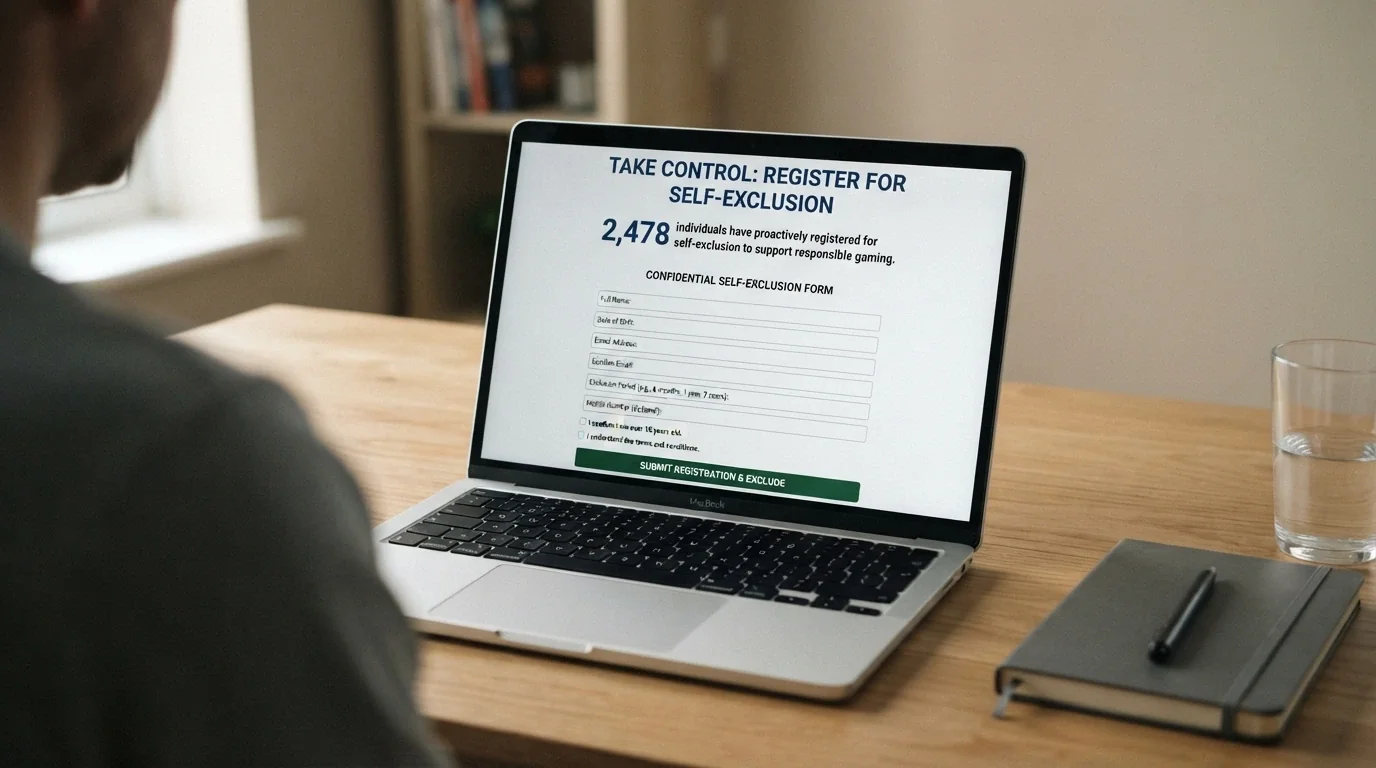
None of that covers an offshore casino. BetStop is an Australian register; an offshore operator has no obligation to consult it, no mechanism to consult it, and no incentive to honour it. A player who has self-excluded from licensed Australian wagering is correctly excluded from licensed Australian wagering, and is not at all excluded from the offshore brands that reach Australian traffic. The protection is real. Its boundary is real too.
Deposit Limits and Activity Statements
Licensed Australian wagering operators are required to offer customer-set deposit limits and activity statements under state and territory conditions. A player can set a daily, weekly or monthly deposit ceiling, and the operator has to enforce it. The activity statement gives the player a clean view of how much they have wagered, how much they have deposited, and how much time they have spent on the site.
There is no federal deposit, loss or stake ceiling in Australia because the relevant product — online casino — is banned outright. The deposit limits and activity statements that exist apply to the licensed wagering market. An offshore casino is not required to offer either tool. Some do. Some do not. The player at an offshore casino cannot assume the licensed-market protections are running in the background.
About 2.1% of Australian adults experience problem gambling, and the Australian Institute of Health and Welfare put high-risk gambling at 1.8% in 2022. Those numbers sit behind every section of this page.
Where to Get Help
Free, confidential, 24-hour help is available across Australia, regardless of where the gambling took place.
- National Gambling Helpline — 1800 858 858. Free, confidential, staffed around the clock, every day of the year.
- Gambling Help Online (gamblinghelponline.org.au). Online chat, counselling and self-help resources, also free and confidential.
- BetStop — National Self-Exclusion Register. One registration excludes a person from every licensed Australian wagering service, online and over the phone.
These services do not ask whether the gambling happened on a licensed or unlicensed site. They are there for the player, not for the operator.
How We Evaluated These $100 No-Deposit Bonus Casinos
The ten operators in this comparison were drawn from a current AU market-share snapshot of the offshore casino brands receiving the most Australian traffic. The list is not a quality ranking. It is a reach ranking — these are the brands Australians are actually reaching — and the comparison is built on that basis.
Every operator was checked against the IGA framework, and every operator in the table sits on the unlicensed side of that framework. None holds an Australian online casino licence, because none exists. Each brand operates under a non-Australian regulator, accepts Australian traffic in spite of the prohibition, and is answerable to its own licensing jurisdiction rather than to the ACMA.
Bonus terms were checked against the operator’s own published bonus terms pages where those pages could be surfaced. Where a term is shown in the comparison, it is shown because the operator’s own page or a directly attributable third-party verification carried it. Where a term is not shown, it is not shown because it was not surfaced cleanly this run — not because it does not exist, but because the verification did not produce a quotable figure. The audit gap is itself information. A player who lands on one of the operators with a sparse row should treat the operator’s own terms page as the source that matters.
Where a different comparison site lists a $100 no-deposit offer, that offer is described as the competitor presents it, then compared against the operator’s own terms where those could be cross-checked. Where the operator’s terms and the external listing disagree, the operator’s terms win. They are the contract.
Your $100 No-Deposit Decision: What Matters and What Doesn’t
The decision this page is built around is not which casino to play at. It is whether a $100 no-deposit bonus is worth the time it takes to clear, and the answer turns on three numbers the marketing never puts on the banner.
The first is the wagering multiple. At 30x, a $100 chip requires $3,000 of turnover before any winnings are eligible for withdrawal. At 60x, the same chip requires $6,000. The marketing copy highlights the smaller number; the player pays the larger one if the offer’s terms land higher.
The second is the cashout cap. Among the $100 chips that surfaced verification this run, the cap sat between $50 and $200. A player who hits a big win on a capped chip walks away with the cap, not the win. The cap is the ceiling, and it applies regardless of how the play went.
The third is the licence status of the operator running the offer. None of the brands in this page’s comparison is licensed to offer online casino in Australia. None can be, because the licence does not exist. Every $100 no-deposit bonus an Australian player can claim sits on the unlicensed side of the IGA, and the protections that licence would carry — deposit limits, activity statements, ACMA complaint pathways, BetStop coverage — do not apply.
What does not matter is the casino’s brand name, the colour of its homepage, the size of its welcome headline, or the number of free spins attached to a separate deposit offer. None of those figures change the wagering multiple, the cashout cap, or the licence status. None of them shortens the time it takes to clear the bonus. None of them restores the protections an Australian licence would have provided.
A player who claims a $100 no-deposit bonus from one of the brands in this comparison should know what they are doing. They are taking promotional credit, wagering it through a published multiplier, and trying to clear a cashout cap before the bonus expires or the site is blocked. The arithmetic is the same at every operator in the table. The protection is the same absence at every operator in the table. The decision is whether the offer is worth the time, and that is a decision only the player can make.
If the gambling has stopped being a decision and started being a pattern, help is available. The National Gambling Helpline at 1800 858 858 is free and confidential, 24 hours a day. Gambling Help Online (gamblinghelponline.org.au) offers chat and counselling on the same terms. Neither service asks where the gambling took place. They are there for the player.
Common Questions
Can Australian players legally claim a $100 no deposit bonus for online pokies?
No. Online casino games, including online pokies, are prohibited in Australia under the Interactive Gambling Act 2001. No Australian online casino licence exists. Every casino offering a $100 no-deposit bonus to Australian players is an offshore operator accessing the Australian market in spite of the prohibition. The player is not prosecuted for claiming the offer, but the player also has no Australian consumer protection if the operator refuses a withdrawal, voids a win, or disappears.
Do $100 no deposit bonuses pay out real money in Australia?
Sometimes, but not $100 of real money. The $100 is bonus credit, not cash. To convert any winnings into withdrawable funds, the player must clear a wagering multiple — commonly 30x to 60x the bonus amount — and accept a maximum cashout cap, which most verified $100 chips place between $50 and $200. A player who wins big on a $100 free chip with a $100 cashout cap walks away with $100, not the win amount.
What wagering requirements usually apply to a $100 no deposit bonus?
Verified offers this run ranged from 30x to 60x the bonus amount. A 30x multiple on a $100 chip means $3,000 of total bets before any withdrawal is eligible. A 60x multiple means $6,000 of bets on the same chip. The multiple is set by the operator’s bonus terms and is non-negotiable once the bonus is claimed. Reading the operator’s own bonus terms page is the only way to confirm the multiplier on a specific offer.
What is the maximum cashout on a typical $100 no deposit bonus?
Verified $100 chips this run carried maximum cashout caps between $50 and $200, with $100 a common ceiling. The cap is set by the operator’s bonus terms and applies to total withdrawable winnings from the bonus, regardless of how the play went. Any balance above the cap is forfeited when the player withdraws. The cashout cap is the more revealing of the two figures, because it determines what the bonus is actually worth at the moment of conversion.
Why do some casinos advertise a $100 free chip but attach a small cashout cap?
Because the casino’s liability has a ceiling, and the ceiling is the operator’s price for fronting the play money. A $100 free chip with no cap and low wagering would let a lucky player convert a small promotional credit into a large withdrawal. The cashout cap, combined with the wagering multiple, prevents that conversion and keeps the offer’s economics predictable for the operator. From the operator’s standpoint, the cap is a cost-control tool. From the player’s standpoint, the cap is the difference between the headline figure and what the bonus is actually worth.
What protections do Australian players lose by using an offshore casino instead of a licensed wagering operator?
Australian-licensed wagering operators are required to offer customer-set deposit limits, activity statements, BetStop self-exclusion coverage, and dispute resolution through Australian channels. Offshore casinos are bound by none of these obligations. There is no ACMA complaints pathway for offshore disputes, no Australian consumer-law recourse for voided winnings or refused withdrawals, and no guarantee that the site will remain reachable — the ACMA has directed ISPs to block 1,564 illegal gambling sites as at March 2026, and a block can land with a balance still on the account. The protection gap is the structural cost of using an unlicensed operator, and it applies to every brand in this page’s comparison.
Created by the ”RTP Pokies Australia” editorial team.