
100 Free Spins No Deposit — The Terms, the Maths, and the AU Law Behind Them
A “100 free spins no deposit” offer promises a hundred spins on a real-money pokie without a deposit. For Australian players, the offer is real. It comes from offshore casinos, every one of them, and the price is paid in wagering requirements, capped withdrawals and protections that no Australian licence extends to the player.
Verified as of 16 October 2026 against the ACMA register and Curaçao licence records.
Table of Contents
- What 100 Free Spins No Deposit Actually Means for Australian Players
- Why Your 2026 Free Spins Bonus Is Smaller Than It Looks
- Every 100 Free Spins No-Deposit Offer We Checked, Ranked
- New Casinos Offering 100 Free Spins: Fresh Brands, Same Rules
- Claiming Free Spins on Mobile: What Changes on a Smaller Screen
- The Legal Reality: Offshore Casinos and Australian Law
- Playing Safely: Limits, Self-Exclusion and Where to Get Help
- How We Evaluated These 100 Free Spins No-Deposit Offers
- Should You Claim a 100 Free Spins No-Deposit Bonus in 2026?
- Frequently Asked Questions
What 100 Free Spins No Deposit Actually Means for Australian Players
A no-deposit free-spin bonus is a casino’s registration gift: spin a slot a fixed number of times, on the house, and keep whatever the spins return after the small print has had its say. There is no deposit to make. There is no purchase to authorise. The free spins are credited for signing up and, in most cases, completing some form of identity check.

The mechanics differ from a deposit-gated welcome bonus in one obvious way. A standard welcome offer asks the player to deposit first, then matches it by a percentage and tops it up with spins. A no-deposit offer skips the deposit. The casino hands the player a small amount of slot action to try the product, in the hope that the trial converts to a paying account later.
In Australia, the distinction matters because of the Interactive Gambling Act 2001. The IGA makes it an offence for a gambling provider to offer online casino games to a person physically in Australia. The Act targets the provider, not the player — the player is not prosecuted — but it rules out the existence of an Australian-licensed online casino. Every 100 free spins no deposit offer visible from Australia comes from an operator licensed outside the country, in places like Curaçao. None of them are licensed by an Australian regulator, none are overseen by the Australian Communications and Media Authority, and none of them connect to Australia’s self-exclusion register.
That is the single most important fact about this page. The “free” in “free spins” is not a giveaway. It is the marketing wrapper around a small slice of slot play whose actual value is decided by three restrictions that follow the offer: the wagering requirement, the maximum cashout cap, and the games the spins can be played on.
No-Deposit Free Spins: The Basic Mechanics
The claim flow looks simple from the player’s side. Register an account. Confirm an email address or mobile number. Sometimes, as Skycrown does, complete phone verification. In a few cases — BitStarz is the obvious example — enter a promotional code at the cashier or registration step. The free spins land in the account automatically, or after a confirmation click.
Each step has friction built in. Email confirmation is routine. Phone verification is a small wall: a one-time code sent by SMS, meant to cut down on duplicate-account abuse. Promo codes are silent tripwires. A player who registers without entering the code forfeits the offer; the casino’s system has no way to attach a bonus to an account that did not request one.
Once credited, the spins are usually pre-loaded onto one title or a small group of titles. The casino selects the games, not the player. Spins on table games are typically worth nothing to the bonus — pokies contribute 100% to wagering, while table games contribute around 5%, or zero, depending on the operator. The wagering clock starts the moment the spins are played.
The mechanics are not the part most players overpay for. They are the easy part. The cost is buried in the next two layers.
The Australian Context: Why These Offers Come from Offshore
The Australian Communications and Media Authority is unambiguous. The IGA makes it illegal for gambling providers to offer online casino games to people in Australia. Online casinos, online pokies and in-play betting are prohibited services. A licensed Australian operator cannot offer 100 free spins no deposit because the underlying product — online casino games — is banned from being supplied to Australian residents.
What does exist on the licensed side is wagering on races and sport placed before the event, lotteries and keno, run by operators licensed by a state or territory. None of those products carries a free-spins bonus. A no-deposit free-spin offer can therefore reach an Australian player only from an offshore operator, licensed somewhere else, advertising into a market the Australian regulator has tried to fence off.
The ACMA has been working that fence since 2017. Since the regulator’s first blocking request in November 2019, 1,788 illegal gambling and affiliate websites have been blocked at the ISP level. More than 230 illegal services have pulled out of the Australian market over the same period. Yet the offers keep arriving, often through new domains the ACMA has not yet blocked, and through affiliate sites that promote them. The reason is straightforward: offshore operators face no domestic consequence for serving Australian customers, and the demand is real.
A reader who wants to know “is this legal?” needs both halves of the answer. It is illegal for the operator to provide the service to a person in Australia. It is not illegal for the person to use it. The IGA targets the provider, and the player keeps whatever civil and criminal position they had before clicking register. What the player does give up, by design, is every protection an Australian licence would have extended.
Why Your 2026 Free Spins Bonus Is Smaller Than It Looks
A 100 free spins no deposit bonus looks like a hundred chances to win for nothing. The arithmetic of an average 96% RTP slot tells a different story.
At $0.10 per spin — a typical stake for a free-spin bonus — 100 spins place $10 in real-money action. A 96% return-to-player slot returns, on average, $9.60 across those hundred spins. So the headline value of the offer, before any restriction, is around $9.60. That is the most a player can expect to see in their bonus balance from the spins themselves.
The headline evaporates against three reductions that sit in every bonus’s small print.
Wagering requirements multiply the bonus. To withdraw any of those winnings, the player must play through a multiple of the bonus amount — usually between 40 and 60 times. A $9.60 return at 40x becomes $384 of required slot play. At 60x it becomes $576. None of that $384 or $576 is the player’s money. It is the volume of betting the casino requires before it will let the player keep what they have already won.
Maximum cashout caps cap the winnings. Once wagering is cleared, the operator limits what can actually be withdrawn. Typical no-deposit free-spin caps in the Australian market sit between $50 and $200 AUD. The most generous in the featured set is $180 AUD. A player who lands a 2,000x-coin windfall on Wolf Treasure — the largest theoretical payout the game allows — and clears a 40x wagering requirement still cannot withdraw the headline figure. They walk away with the cap, or less.
Game eligibility restricts where the turnover can be earned. The free spins are tied to specific titles, and only certain games contribute fully to the wagering requirement. Pokies almost always count at 100%. Table games typically count at 5% or not at all. A player who tries to grind through wagering on blackjack will, in practical terms, never finish.
Add the three reductions together and the “free” becomes a marketing label, not a price tag. The next sections look at each reduction in detail.
Wagering Requirements: The Hidden Multiplier
A wagering requirement is the volume of real-money betting a player must place before a bonus balance becomes withdrawable cash. It is expressed as a multiplier of the bonus. Forty times means the player has to bet forty times the bonus amount. Sixty times means sixty.

For a 100 free spins no deposit offer, the “bonus amount” is whatever the spins return. Using the average return of $9.60 on a 96% RTP slot, a 40x wagering requirement translates into $384 of required slot play. A 60x requirement, found at Ozwin and Fair Go in the featured set, translates into $576.
The wagering is on the bonus, not on a deposit. The player is not betting $384 of their own money — they are running $384 of the casino’s money through the slot. That is what makes it feel like a free ride. The cost is statistical, not nominal.
Statistically, every $384 wagered on a 96% RTP slot loses about $15.36 to the house edge on average, before any of the bonus’s other restrictions come into play. A 60x requirement runs $576 through the slot, against an expected loss of around $23. These are averages over many spins, not guarantees for any single session — a player might run hot and beat the average, or run cold and lose more. The point of the calculation is to put a number on what the bonus actually costs the player in expectation. The expected loss is what the wagering requirement quietly extracts from a player who clears it.
Two operators in the featured set are at the lower end of the band. Skycrown and BitStarz both run 40x on their no-deposit free-spin offers, with a $150 AUD maximum withdrawal. The expected cost in statistical terms is around $15 in slot turnover losses, against a cap of $150 AUD in withdrawable winnings. The maths favours a player who runs well above the RTP average during the wagering clear.
Ozwin and Fair Go sit at 60x, with cashout caps of $180 AUD and $100 AUD respectively. The expected loss at 60x is higher — around $23 in turnover losses — and Ozwin’s higher cap is the only offset. Fair Go’s $100 AUD cap is the tightest ceiling in the field for a 60x requirement.
The middle ground is where the rest of the featured set sits. Joe Fortune at 40x. Ignition at 45x. PlayAmo, Bizzo and Casinonic at 50x. The wagering tier changes the expected cost by roughly $2 per ten multiples. A player who lands the same $9.60 average bonus value at 50x is looking at an expected loss of about $19.20 on $480 of turnover. At 45x, the expected loss is around $17.28 against $432 of turnover.
Maximum Cashout Caps: The Ceiling on Your Winnings
The maximum cashout cap is the second reduction on the offer. Once wagering is cleared, the operator limits what can actually be withdrawn, regardless of how much the bonus balance shows.
The cap exists for a reason the player should understand before claiming. A no-deposit free-spin offer is a marketing cost. The casino accepts that some players will run well above the RTP average during the wagering period, and the cap is the operator’s way of putting a ceiling on that cost. Without a cap, a single lucky player hitting a 2,000x-coin payout on Wolf Treasure would consume a chunk of the marketing budget for an entire quarter of player acquisitions. The cap is the operator’s hedge.
For the player, the cap turns the offer into a bounded trade. The maximum withdrawable amount across the featured set sits between $100 AUD and $180 AUD. Ozwin’s $180 AUD cap is the most generous. BitStarz and Skycrown sit at $150 AUD. Fair Go’s $100 AUD cap is the tightest. For the operators whose terms vary period to period — Joe Fortune, Ignition, PlayAmo, Bizzo, Casinonic, Rocket Play — the cap is typically set in the terms attached to the specific promotion, and the player must read it before playing.
What happens to winnings above the cap? The excess stays with the operator. The bonus balance may show a larger figure after wagering, but the withdrawal screen will only release the cap. The rest is forfeit. This is not a glitch in the terms — it is the term. Reading the cap before claiming is the single most useful habit a player can build around these offers.
A practical reading of the cap and the wagering together: at Skycrown’s 40x and $150 AUD cap, a player must clear about $384 of wagering and finish the bonus with a balance below $150 AUD to withdraw anything. The expected return on the wagering alone is around $9.60 in average value, with a roughly one-in-four chance of finishing above $20 — and a much smaller chance of finishing above the $150 cap in a way that the wagering actually clears.
Real-Money, Cashable Free Spins
A real-money or “cashable” free-spin bonus is one where winnings become withdrawable cash after the wagering requirement is cleared. The distinction that matters is between bonus funds and cashable funds.
Bonus funds stay bonus funds until the wagering requirement is met. They sit in a separate balance. The player cannot withdraw them. They cannot use them outside the games the bonus allows. They exist only to be wagered through, and they convert to cash only at the rate the wagering terms specify.
Cashable funds, by contrast, are withdrawable as cash once the wagering is cleared. The balance type does not change what the player can win. It changes what happens to those winnings before wagering is complete. A player who wins $200 on free spins and the wagering requirement is $300 — they have not yet met the requirement — cannot withdraw the $200. They must continue wagering until the requirement is met, and then the cashable balance releases.
All the operators in the featured set run a bonus-funds model on their no-deposit offers. There is no path to instant cash on a 100 free spins no deposit bonus in this market. Reading the bonus-balance type is the second-most-useful habit a player can build around these offers, after reading the cap.
Promo Codes: What They Unlock
A promotional code is a short string the player enters at registration or in the cashier to attach a specific bonus to an account. BitStarz uses one for its 100 free spins no deposit offer. Ozwin also requires a code for its 100 free spins deal.
The mechanism behind codes is segmentation. The casino uses them to track which affiliate, promotion or campaign a player came from, and to attach a specific bonus configuration — wagering multiple, cap, eligible games — to that acquisition channel. A code issued for one campaign might unlock 40x wagering and a $150 cap. A code issued for another might unlock 50x and a $100 cap. The bonus is configured to the code, not to the player.
What happens if the player registers without the code? The bonus is not attached. The casino’s system has no instruction to credit the spins. The player gets an account, plays with their own money if they deposit, and the free-spin offer sits unused.
The codes are public, and they change. Affiliate sites publish them, and they cycle. A code that worked last month may not work this month. A player who wants to claim a coded offer should retrieve the code from the source that lists it as active, enter it during the registration or cashier step the operator specifies, and confirm the bonus is attached before playing. If the spins do not appear in the account after the code is accepted, customer support is the next stop.
Crypto Casino Free-Spin Offers
Crypto casinos — operators that run on Bitcoin, Ethereum and other digital currencies — have become a noisy part of the offshore market. BitStarz, the most prominent in the featured set, is one of them. The casino holds 79 or more game providers, accepts crypto across its cashier, and markets 100 free spins no deposit offers to the same Australian audience as every other offshore operator.
The complication is Australian law. Since 11 June 2024, credit cards, credit-related products and digital currency have been banned as payment methods for online wagering in Australia. The ban applies to wagering — sports and race betting — rather than explicitly to casino play, because casino play is already prohibited at the licensed level. For an Australian player using an offshore crypto casino, the practical effect is that any deposit made in Bitcoin or another digital currency sits outside the Australian payment system and outside any payment protection the player might otherwise have.
A reader using an offshore crypto casino is therefore operating in two layers of legal grey at once. The casino itself is offering a prohibited service under the IGA. The crypto payment method sits outside the licensed payment framework that Australian banks and payment providers operate under. A bank-blocked deposit, a transaction the bank flags and reverses, or a withdrawal that never arrives — none of these have a clear Australian recourse path, because the activity itself is not regulated.
A player who chooses to use a crypto casino should treat it as a higher-risk proposition than an AUD-only offshore casino, and should understand that the friction on deposits is a feature of the legal landscape, not a technical glitch.
Eligible Games: Why Your Favourite Pokie Might Not Count
Free-spin offers are not portable across the casino’s game library. The spins are tied to specific titles — usually one or two — and only certain games contribute fully to the wagering requirement.

Wolf Treasure, a 5×3 pokie from IGTech with 25 fixed paylines, a published 96% RTP and medium volatility, is one of the pokies that appears repeatedly across the offshore offers aimed at Australian players. It carries a maximum theoretical win of roughly 2,000x the stake, a feature set heavy on stacked cash symbols and a money-respin bonus. Its 96% RTP sits near the average for the genre, and its medium volatility produces a steady distribution of small to mid-range wins with the occasional larger payout.
The reason a casino ties free spins to a specific title is twofold. It guarantees the wagering is run on a game with a known RTP profile, so the casino can model its marketing cost accurately. And it lets the casino negotiate a promotional rate with the game’s provider — IGTech, Pragmatic Play, BGaming — in exchange for the volume of player-days the offer drives.
For the player, the implication is straightforward. The free spins are not a buffet. They are a fixed menu. And when the wagering is met, only certain games count towards clearing the remaining turnover. Pokies almost always count at 100% of stake. Table games — blackjack, roulette, baccarat — typically count at 5%, or zero. A player who tries to grind a 40x wagering requirement on roulette will, in practical terms, run out of bonus balance long before they hit the multiplier.
Every 100 Free Spins No-Deposit Offer We Checked, Ranked
The table below compares the ten operators we checked against the criteria that matter most for a no-deposit free-spin offer: wagering multiple, maximum cashout, and the game-provider roster. Every operator is offshore, Curaçao-licensed, and not licensed in Australia. The wagering and cap columns reflect what each operator currently publishes for its 100 free spins no deposit offer where the figures are fixed; where terms vary by period, the column carries that fact rather than a number that may not be in force.
| Operator | Licence / Status | No-Deposit Wagering | Game Providers |
|---|---|---|---|
| Skycrown | Offshore (Curaçao) | 40x | IGTech, BGaming, Booongo, Pragmatic Play |
| BitStarz | Offshore (Curaçao) | 40x | 79+ providers |
| Ozwin | Offshore (Curaçao) | 60x | RTG |
| Fair Go | Offshore (Curaçao) | 60x | RTG |
| Joe Fortune | Offshore (Curaçao) | 40x | RTG, Rival |
| Ignition | Offshore (Curaçao) | 45x | RTG, Rival |
| PlayAmo | Offshore (Curaçao) | 50x | Various |
| Bizzo | Offshore (Curaçao) | 50x | Various |
| Casinonic | Offshore (Curaçao) | 50x | Various |
| Rocket Play | Offshore (Curaçao) | — | Various |
A few points the table cannot carry on its own. The two 40x entries — Skycrown and BitStarz — share the lowest wagering in the set, but BitStarz requires a promotional code to claim the offer, while Skycrown gates the spins behind phone verification. The two 60x entries — Ozwin and Fair Go — sit at the same multiple but Ozwin’s $180 AUD cap is the most generous in the set, while Fair Go’s $100 AUD cap is the tightest. The middle operators run at 40x, 45x or 50x, and most of them carry terms that vary by promotion period; the reader must verify the live offer before registering.
Rocket Play sits at the bottom of the table for a reason. Its wagering and cashout terms are not pinned down in the operator’s published conditions at the level of detail the other nine publish. It is a Curaçao-licensed offshore casino offering a no-deposit free-spin deal, but the specific wagering multiple and cap change by campaign. A reader who lists Rocket Play among their options should treat it as a brand to check live, not a brand to rank against fixed numbers.
Skycrown: The Deepest Welcome Package Alongside a 100-FS No-Deposit Offer
Skycrown pairs its 100 free spins no deposit offer with the deepest welcome package in the featured set: up to A$8,000 in matched bonuses and 400 free spins across a four-tier structure, with a 14-day validity window and 40x wagering on the deposit bonus.
The no-deposit side is the more interesting offer for a player who wants to try the casino without committing cash. 100 free spins land after phone verification, with 40x wagering on whatever the spins return and a maximum cashout of 150 AUD/NZD. The combined picture is a casino that pays above the market average on the welcome side while keeping the no-deposit terms inside the 40x-$150 band.
A few terms the welcome package adds to the picture. Free-spin winnings from the welcome package are capped at A$300. The maximum bet while a welcome bonus is being wagered is A$7.50 — a cap that prevents a player from running a single large spin to clear turnover. The 14-day validity window is tight against the larger bonus: clearing four tiers at 40x in two weeks requires a serious time commitment.
The provider roster is strong for a casino targeting Australian players. IGTech, BGaming, Booongo and Pragmatic Play covers the genre — high-volatility pokies, hold-and-win bonus mechanics, the Wolf Treasure-style cash-respin format — and gives a player clearing the no-deposit wagering a broad catalogue to choose from.
For a player who wants the deepest combined offer in the set, Skycrown is the clearest match. The cap and the 14-day validity are the costs to weigh.
BitStarz: The Crypto-Native Option with a 100-FS No-Deposit Code
BitStarz is the crypto-native pick. The casino accepts Bitcoin and a wide range of other digital currencies across its cashier, runs a 79+ provider game library, and markets a 100 free spins no deposit offer unlocked by a promotional code at 40x wagering and a 150 AUD/NZD maximum cashout.
The welcome bonus is the headline for most readers: 100% up to 1 BTC plus 180 free spins on the first deposit. The crypto denomination puts it outside the AUD-pricing comparison most readers do, but it does the same job — it gives the depositing player more slot play for the same outlay.
The complication is Australian law. Since 11 June 2024, digital currency has been banned as a payment method for online wagering in Australia. The ban sits on the wagering side — sports and race betting — because casino play is already prohibited at the licensed level. For an Australian player at BitStarz, the practical effect is that any deposit made in crypto sits outside the Australian banking system entirely. A deposit that the player’s bank flags, a transaction that gets reversed, or a withdrawal that never arrives has no Australian recourse path.
For a player comfortable with crypto and the offshore market, BitStarz offers the broadest game catalogue in the featured set at the lowest wagering tier. For a player who wants AUD-denominated banking and Australian consumer-law protection, the same features do not exist anywhere in this market.
Ozwin: 100 Free Spins with the Highest Cashout Cap but Steep Wagering
Ozwin runs the highest maximum cashout cap in the featured set — $180 AUD — but pairs it with 60x wagering and a promotional code requirement. The offer is unlocked with a code at registration or in the cashier, and the game library is RTG-only.
The 60x wagering is the most expensive in the set. On the $9.60 average return from 100 spins at $0.10, the required turnover is $576, and the expected loss to the house edge during clearing is around $23. The $180 AUD cap is what makes the trade worthwhile. A player who runs above the RTP average during clearing has more headroom than at any other operator in the table.
The RTG-only library is the trade-off. RealTime Gaming has produced a steady stream of medium-volatility pokies with hold-and-win bonus mechanics and a few progressive jackpots, but the catalogue is narrower than the multi-provider casinos. A player who wants a specific title — Pragmatic Play’s Gates of Olympus, BGaming’s Bonanza — will not find it here.
For a player who weighs the cap heavily and does not mind an RTG-only library, Ozwin is the highest-ceiling no-deposit offer in the table. For a player who weighs the wagering, the 60x multiple is the steepest price in the field.
Fair Go: RTG-Only with 60x Wagering and a $100 AUD Cap
Fair Go runs the same 60x wagering as Ozwin but caps winnings lower, at $100 AUD. The combination is the worst of both — the highest wagering in the featured set and the tightest cap.
The casino is RTG-only, like Ozwin, with a similarly narrow catalogue. The welcome bonus is more modest: 100% up to $200 on the first deposit. The target audience is Australian players specifically, and the AUD-denominated banking and the AU-friendly branding sit on top of a Curaçao licence.
The terms on the no-deposit side are the issue. A player who lands the $9.60 average return and clears 60x wagering has run $576 of slot play through the casino. The expected loss during clearing is around $23. The $100 AUD cap means a player must finish the bonus with a balance above $100 to feel the offer’s value, and a balance above $100 on a 96% RTP slot during a $576 clear is not the common outcome.
Fair Go suits a player who specifically wants an AUD-only, RTG-only, AU-branded casino. The no-deposit offer is the weakest trade in the table on a wagering-and-cap basis.
Joe Fortune: 40x Wagering Across RTG and Rival Titles
Joe Fortune sits at 40x wagering with a dual RTG/Rival provider library — a more diverse catalogue than Fair Go at the same low wagering tier. The no-deposit offer terms vary by period, so the reader must check the current promotion before claiming.
The 40x wagering matches Skycrown and BitStarz at the lowest end of the table. The provider mix adds some titles Fair Go does not carry. The cashout cap on the no-deposit side is not fixed in the casino’s published terms at the same level of detail as the 40x-50x operators that do publish fixed figures, which is why the table leaves the column blank for Joe Fortune.
For a player who wants the lowest wagering in the set without giving up provider diversity, Joe Fortune is worth checking live. The terms the reader finds at registration are the terms that matter.
Ignition: 45x Wagering, RTG and Rival Providers
Ignition runs 45x wagering on its no-deposit free-spin offers — a modest premium over the 40x tier for the same RTG/Rival provider mix. The casino also runs a poker product alongside the casino library, which sets it apart from the RTG-only and multi-provider casinos in the table.
The 45x multiple is roughly halfway between the 40x floor and the 60x ceiling. On the $9.60 average return, the required turnover is $432, with an expected loss during clearing of around $17.28. A reader who prefers Ignition’s poker-and-casino combination over a casino-only product pays the 5x premium for it.
The no-deposit terms vary by promotion period, so the wagering and cap on the specific 100-spin offer the reader sees must be checked at registration.
PlayAmo: 50x Wagering Across a Broad Provider Range
PlayAmo runs 50x wagering on its no-deposit free-spin offers with a multi-provider library. The 50x sits in the upper half of the table, and the provider roster is broader than the RTG-only or RTG/Rival casinos.
A player clearing a 50x wagering requirement on the $9.60 average bonus value runs through $480 of slot play, with an expected loss to the house edge of around $19.20. The provider breadth — which PlayAmo does not enumerate in detail in its published terms — is the offset for the higher multiple.
The no-deposit terms vary by promotion period. The reader should check the live offer before claiming.
Bizzo: 50x Wagering, Multi-Provider Platform
Bizzo matches PlayAmo at 50x wagering across a multi-provider library. The two casinos share a tier, and the choice between them comes down to the games each carries, the cashier options, and the specifics of the live offer.
The 50x multiple on $9.60 produces the same $480 of required turnover and the same $19.20 expected loss during clearing. The provider mix at each casino differs in detail — Bizzo’s roster is not enumerated in the same way PlayAmo’s is — and the live terms on the no-deposit offer are what decide the actual trade.
For a player choosing between the two, the relevant comparison is the live promotion’s cap, the eligible games, and the validity window. The wagering tier is identical.
Casinonic: 50x Wagering, Terms Vary
Casinonic rounds out the 50x tier with a multi-provider library and no-deposit terms that vary by period. Like PlayAmo and Bizzo, the casino sits in the middle of the table.
A player who finds a Casinonic no-deposit offer at 50x with a $100-$150 cap is looking at a similar trade to PlayAmo and Bizzo — $480 of required turnover, around $19.20 of expected loss during clearing, and a final withdrawable balance capped at the offer’s stated limit.
The reading on Casinonic is the same as the reading on the other 50x operators. Check the live terms. The 50x tier is the middle of the market.
Rocket Play: Curaçao-Based, Terms Vary Per Period
Rocket Play is the operator to check rather than rank on fixed numbers. The casino is Curaçao-licensed and offers a no-deposit free-spin promotion, but the wagering multiple and maximum cashout cap change by campaign. The table reflects that variation by leaving the wagering column blank.
A reader who finds a Rocket Play no-deposit offer with terms they can verify before registering should treat the operator as a normal offshore casino — the IGA prohibition applies, the BetStop register does not cover it, the ACMA can block the domain, and any dispute over a withdrawal has no Australian recourse path. The casino’s specific terms are the only thing that distinguishes it from the rest of the table.
For a player who wants a fixed wagering tier and a fixed cashout cap to compare against, the other nine operators are the clearer comparison. For a player who watches specific promotions and is comfortable with terms that change, Rocket Play is worth checking live.
New Casinos Offering 100 Free Spins: Fresh Brands, Same Rules
New offshore casinos use 100 free spins no deposit offers as a customer-acquisition tool. The marketing pitch is identical to the established operators — “free” spins, “no deposit”, “real money wins” — and the underlying terms are the same as the rest of the market. A new casino launching into the Australian-facing offshore space faces the same IGA prohibition as an established one, runs on the same Curaçao licence as most of its competitors, and offers the same 40x-60x wagering with $50-$200 cashout caps.

The reason a new casino exists in this space is straightforward. Offshore casino licences are cheap relative to the customer-lifetime value of a depositing player, and the Australian-facing market is large enough to support new entrants even with the ACMA’s blocking activity. The reason a new casino might offer better terms than an established operator is the same reason any new entrant in any market does — it has not yet earned its player base and is willing to spend more on acquisition to get it.
What does not change with the casino’s age is the legal position. The Interactive Gambling Act applies to every provider regardless of when it launched. The ACMA’s blocking power applies to every new domain. The 1,788 sites blocked since November 2019 include new entrants alongside established operators. The 230+ services that have withdrawn from the Australian market since 2017 include new entrants that decided the regulatory risk was not worth the customer base. A reader evaluating a new casino should not assume its novelty puts it outside the legal framework.
New-Casino Welcome Spins: What to Look For
A new casino offering 100 free spins no deposit should be checked against the same terms an established one is checked against, with extra attention to the things a newer operator may not have settled yet. The points to verify before registering:
- The licence check is first. A new casino should publish its Curaçao licence number, the licence holder, and the regulator’s verification page. A reader who cannot find this in the footer of the site or in the terms and conditions should treat the absence as a signal.
- The wagering multiple, the maximum cashout cap, and the eligible games should appear in the bonus terms before the player registers — not after.
- Player feedback on independent forums, especially from Australian players who have already withdrawn, is the most useful single piece of evidence the reader can gather.
- A new casino with no withdrawal history yet is a higher-risk proposition than one with two years of player reports behind it.
The list is short, but it covers what the eye cannot see on a glossy landing page.
No-Deposit Free Spins at New vs Established Offshore Casinos
A new casino may offer better terms to build a player base. It may also carry less withdrawal history for Australian players to reference, which is the other side of the trade. The two facts are not contradictory — they are the same fact read from two angles.
The legal framework does not move with the casino’s launch date. The IGA prohibition applies to every provider. ACMA can block a new domain as readily as it can block an established one. A player using a new casino has the same absence of BetStop coverage, the same absence of Australian consumer-law protection, and the same absence of Australian payment-recourse paths. A new casino’s only distinguishing feature is the trade-off between potentially better terms and an unverified track record.
For a player who weighs the terms heavily and accepts the track-record risk, a new casino may be the better offer. For a player who weighs the track record heavily, an established operator with published terms and a history of Australian-player withdrawals is the safer trade. Neither trade is licensed in Australia, and neither offers the protections a player would have at a BetStop-covered wagering account.
Claiming Free Spins on Mobile: What Changes on a Smaller Screen
Mobile claiming is the dominant path for Australian players. The offer is the same on mobile — the same 100 spins, the same wagering requirement, the same cashout cap — but the verification flow, game performance and terms visibility change in ways that matter.

The registration step on a mobile browser is shorter than on a desktop, because the form fields stack vertically and the screen real estate forces fewer fields per page. Email confirmation arrives in seconds. Phone verification — the gate Skycrown uses for its 100 free spins no deposit offer — is faster on mobile, because the SMS code is delivered to the same device running the form. Promo codes, where required, are entered in the same registration or cashier step the desktop version uses.
The games themselves run on HTML5 in the mobile browser. There is no separate app to download. The pokies — Wolf Treasure and its peers — are the same titles, scaled to a smaller screen, with the same reels, the same paylines, the same RTP. The wagering requirement is met spin by spin, regardless of the device.
Where mobile introduces friction is in reading the terms. A full bonus terms page is harder to navigate on a phone screen. The relevant numbers — wagering multiple, cashout cap, eligible games, expiry window — are usually buried two or three clicks past the offer page. A reader who claims an offer on mobile without reading the terms on a desktop first is accepting the offer blind. Reading the terms on desktop, then claiming on mobile, is the safer sequence.
Casino Apps and Free-Spins Offers: What Is Actually Available
Most offshore casinos targeting Australian players do not publish a dedicated app in Australian app stores. The mobile experience is browser-based, and the casino runs as a website tuned for smaller screens.
What a reader sometimes sees labelled as an “app” is a progressive web app — a website that adds itself to the phone’s home screen and behaves like an app, but is still served over the web. There is no app-store review process, no platform-holder safety check, no automatic update mechanism. The casino runs whatever code it has chosen to publish.
The practical consequence is that the platform-holder protections a native iOS or Android app would carry — Apple’s App Review, Google’s Play Protect, the malware scanning both run on installed apps — do not apply. The reader is using a website, not an installed program, and the casino is responsible for its own security and integrity.
For a player who wants the mobile experience, browser-based play is the only realistic path with this operator set. The offer is the same. The protection level is whatever the casino chooses to provide. A reader who is uncomfortable with that trade can claim the offer on desktop, complete the verification and the wagering, and withdraw on desktop too.
The Legal Reality: Offshore Casinos and Australian Law
The Interactive Gambling Act 2001 is the foundation. The Act makes it an offence for a gambling provider to offer online casino games to a person in Australia. The prohibited services — online casinos, online pokies, in-play betting — are listed by name in the Act and the regulations. There is no federal or state licence for the supply of online casino games to Australian residents, and any website claiming an Australian online-casino licence is making a claim that does not correspond to any licence that exists.
The Australian Communications and Media Authority is the regulator. ACMA enforces the prohibition, blocks illegal sites, issues infringement notices, and brings civil penalty proceedings against operators. The Act targets the provider — the player is not prosecuted — but the player’s use of an offshore casino sits outside every protection an Australian licence would have extended.
The 2026 reform strengthens this picture. The Interactive Gambling Amendment (Gambling Reform) Bill 2026 passed Parliament on 19 August 2026, and its measures commence on 1 January 2027. From that date, banks and payment providers gain express authority to block transactions to illegal gambling operators. Direct marketing of inducements is prohibited for 14 days after a customer signs up, for three months after a BetStop deregistration, and indefinitely for at-risk customers. The reform does not change the IGA’s prohibition — that has been in force since 2001 — but it tightens the payment and marketing environment around it.
AU Licensing: Why No Online Casino Holds an Australian Licence
No online casino holds an Australian licence because no Australian regulator issues one. The Interactive Gambling Act prohibits the supply of online casino games to Australian residents. The state and territory regulators — the Northern Territory Racing and Wagering Commission, the Victorian Commission for Gambling and Liquor Regulation, the New South Wales Liquor and Gaming Authority, their counterparts in the other states and territories — license wagering on races and sport, lotteries and keno. None of them license online casino games or online pokies.
The Northern Territory Racing and Wagering Commission is the de facto national licensor for online bookmakers — wagering operators who take bets on sport and racing before the event. The NTRWC’s licence does not extend to online casino games. A wagering operator licensed in the Northern Territory cannot, under that licence, offer online pokies or table games to Australian residents.
A reader who sees an Australian-flagged casino website claiming to be licensed should treat the claim as false. The flag is a marketing asset, not a regulatory fact. The Australian licences that exist are for wagering, lotteries and keno — none of which carry a free-spins bonus.
ACMA Enforcement: Blocks, Fines and the 2026–2027 Reform Timeline
The ACMA has been the enforcement arm of the IGA prohibition for the better part of a decade. The numbers tell the story.
Since the regulator’s first blocking request in November 2019, 1,788 illegal gambling and affiliate websites have been blocked at the ISP level. Over 230 illegal services have pulled out of the Australian market since the ACMA began enforcing the new rules in 2017. Civil penalties for providing a prohibited interactive gambling service run up to $2,475,000 per day for an individual and $12,375,000 per day for a corporation — figures that put a real cost on the offshore operators who continue to target Australian customers.
The ACMA’s enforcement actions have produced some notable outcomes. In ACMA v Jones (No 7) FCA 860, Rangiah J ordered pecuniary penalties totalling $24.24 million against the operators and a promoter of prohibited online poker services. On 16 January 2026, the ACMA issued eight infringement notices to Tabcorp, each for $19,800, totalling $158,400, for providing in-play betting — a permitted wagering provider stepping outside the bounds of what a wagering licence allows.
The 2026 reform adds new tools. The Interactive Gambling Amendment (Gambling Reform) Bill 2026 passed Parliament on 19 August 2026 and commences on 1 January 2027. From that date, banks and payment providers gain express authority to block transactions to illegal gambling operators — a measure that closes one of the practical workarounds the offshore casinos have relied on. Direct marketing of inducements is prohibited for 14 days after a customer signs up. The reform does not legalise online casino games. It tightens the perimeter around them.
The enforcement picture is the most useful single piece of context for evaluating an offshore casino. The casino is operating in a market where the regulator has chosen to block it, fine it, and increasingly to block the payments to it. The reader’s use of the casino is the player’s side of the same picture.
Licensed vs Offshore: What Australian Players Give Up
A reader using an offshore casino gives up a stack of protections that an Australian licence would have extended. The table below summarises the comparison — what a licensed AU wagering account carries that an offshore casino account does not.

| Protection | Licensed AU Wagering | Offshore Casino (No-Deposit FS) |
|---|---|---|
| BetStop coverage | Yes — one registration excludes from all ~150 licensed providers | No — offshore casinos not connected to BetStop |
| Australian Consumer Law | Yes — ACL recourse through Australian courts and tribunals | No — disputes sit under the casino’s home-jurisdiction rules |
| Payment-method safeguards | Credit cards and crypto banned; BPAY/PayID/EFT available | No Australian payment-method regulation; method depends on casino |
| ACMA complaints pathway | Yes — ACMA accepts complaints against licensed providers | No — ACMA’s role is enforcement against the operator, not player recourse |
| Site blocking risk | None — licensed sites are not blocked | Yes — 1,788 sites blocked since 2019; balance may be held by a blocked domain |
The two columns are not symmetrical. A licensed AU wagering account is a product of a regulated industry with a complaints pathway, a self-exclusion register, payment-method rules and consumer-law recourse. An offshore casino account is none of those things, by design. The offshore casino operates under the rules of the jurisdiction that issued its licence, and that jurisdiction is not Australia.
A reader who chooses to use an offshore casino accepts this trade. A player who has a withdrawal dispute has no Australian regulator to escalate to. A player who self-excludes through BetStop is still able to play at every offshore casino offering 100 free spins no deposit. A player who uses crypto to deposit is outside the Australian payment system, with no recourse if the transaction goes wrong.
Playing Safely: Limits, Self-Exclusion and Where to Get Help
The responsible-gambling infrastructure in Australia is built around the licensed wagering market. Offshore casinos are not part of it. A reader using an offshore casino should understand which tools reach them and which do not.
The prevalence context is real and worth stating. About 2.1% of Australian adults — roughly 430,000 people — experience problem gambling. The number is not a comment on any individual player. It is the population the responsible-gambling infrastructure was built for, and the gap between that infrastructure and the offshore market is where most of the practical risk sits.
Deposit and Session Limits: What the Licensed Market Offers
Licensed Australian wagering providers are required to offer responsible-gambling tools: deposit limits, session timers, time-out features, and activity statements that show the player what they have spent over a given period. The tools are not federally mandated at a specific dollar level — Australia has no federal deposit, loss or stake ceiling — but the licensed operators must make the tools available and must honour the limits a player sets.
Offshore casinos are not bound by Australian responsible-gambling requirements. Some offer voluntary limit-setting as a marketing feature. Some offer nothing at all. A limit set at an offshore casino is a setting on the casino’s own software, not a regulatory constraint, and can in principle be changed by the player without the same friction a licensed operator would apply. A reader who wants deposit and session limits enforced at a regulatory level needs to be at a licensed Australian wagering provider, not at an offshore casino.
BetStop: Self-Exclusion That Does Not Reach Offshore Casinos
BetStop — the National Self-Exclusion Register — launched on 21 August 2023. A player who registers with BetStop is excluded from every Australian-licensed online and phone wagering provider — a footprint of around 150 operators. To the end of the third quarter of FY 2025-2026, 59,830 people had registered. As of 31 March 2026, 37,247 had active exclusions.
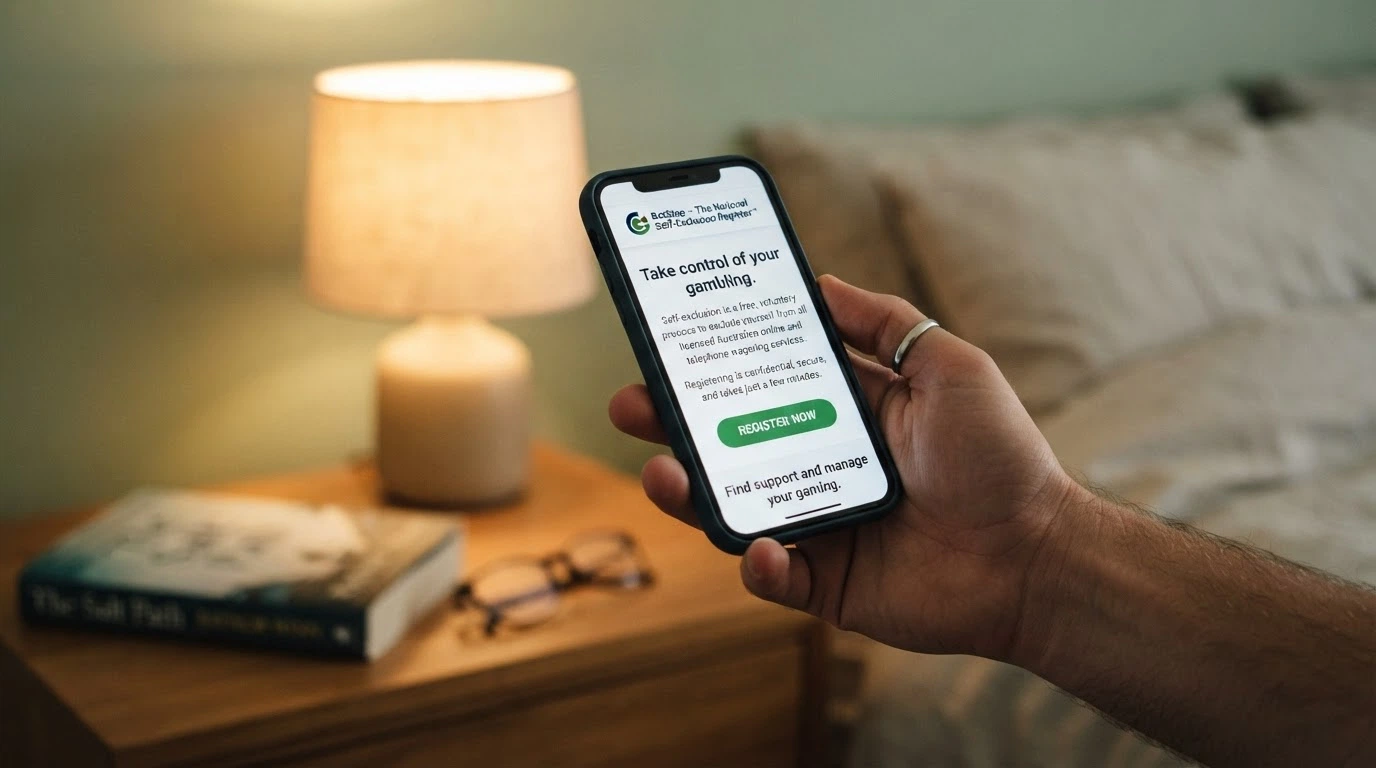
The exclusion itself is binary and serious. A minimum period of three months, up to a lifetime. The 38% of registrants who chose lifetime exclusion have made a permanent decision; the 78% of registrants under 40 are the demographic the register was designed to reach. Once registered, the player cannot open new accounts with any licensed wagering provider, and existing accounts are closed.
What BetStop does not do is reach the offshore casinos. The register binds Australian-licensed wagering providers only. An offshore casino offering 100 free spins no deposit is not connected to BetStop, does not check BetStop, and will accept a registered player as readily as anyone else. This is the single most important practical limitation of the register, and the one most relevant to the offers on this page.
A player using BetStop who also plays at offshore casinos has self-excluded from one half of the market only. The offshore half remains open. The 2027 reform does not change this — the payment-blocking powers target transactions, not offshore-casino membership.
Problem-Gambling Support: Helplines, Prevalence and Getting Help
The National Gambling Helpline — 1800 858 858 — is free, confidential, and staffed 24 hours a day, seven days a week. Gambling Help Online provides free counselling, information and support, with online chat, phone and face-to-face options. Both services are run for the Australian population and are accessible regardless of whether the person is using licensed or offshore gambling.
The prevalence context — 2.1% of Australian adults, around 430,000 people — is the scale of the population these services exist for. A reader who is reading this page and noticing their own play has crossed a line they are uncomfortable with should know that the helpline does not require the player to have stopped playing before they call. The helpline is the first call, not the last.
How We Evaluated These 100 Free Spins No-Deposit Offers
The evaluation here is qualitative, not statistical. The sources used were the operators’ own terms and conditions, the ACMA’s regulatory database and enforcement releases, independent player reports on affiliate and forum sites, and published RTP data from game providers. The licence whitelist checked was the ACMA register and the state and territory wagering-licence lists, both of which confirm that no online casino holds an Australian licence.
The ranking criteria applied to the featured operator set were four: wagering multiple on the no-deposit free-spin offer, maximum cashout cap, game-provider quality, and term transparency. The wagering multiple is the strongest single signal of the bonus’s expected cost to the player. The cashout cap is the strongest single signal of the bonus’s ceiling. The game-provider quality determines whether the wagering is cleared on games the player finds acceptable. Term transparency is the strongest signal of whether the offer is honest about what it costs.
No weightings or percentages were applied to these criteria. The table is ordered by the wagering tier, with the 40x operators first and the 60x operators last. The middle of the table reflects the wagering range in between. Rocket Play, whose terms vary by period, sits at the bottom because the lack of fixed terms makes a like-for-like comparison impossible.
What the evaluation did not measure is the player experience at each operator. Player reports are subjective, vary widely, and were used only to confirm whether an operator had a track record of paying out withdrawals — not to rank operators against each other on player satisfaction.
Should You Claim a 100 Free Spins No-Deposit Bonus in 2026?
The honest answer depends on what the reader is weighing. The offer is small — an average return of around $9.60 on a 96% RTP slot, with an expected loss during wagering clearing of around $15 at 40x and around $23 at 60x. The cap is bounded — $50 to $200 AUD across the featured set. The legal position is what it has been since 2001: the casino is offering a prohibited service, and the player is using a casino that no Australian regulator oversees.
For a reader who wants to try the offshore market and is comfortable with the trade — a small bonus, a bounded cap, no Australian protection — the offer is what it is. The arithmetic is straightforward: the player is paying $15-$23 in expected loss for a chance at $50-$180 of withdrawable winnings, with no Australian regulator to complain to if the withdrawal is refused. A player who chooses to proceed should verify the wagering multiple, the cashout cap, the eligible games, and the validity window before claiming. A player who chooses to proceed on a phone number or email that is not tied to their primary identity should understand that the offshore casino has the data and the player does not have the recourse.
For a reader who wants the protection of an Australian framework, the answer is different. The licensed Australian alternatives are wagering on races and sport placed before the event, lotteries and keno. None of those carry a free-spins bonus, because none of them are online casino games. The trade-off is the trade-off: a regulated product without a free-spin promotion, or an unregulated product with one.
The single most useful thing the reader can do, regardless of which path they take, is read the terms. The wagering multiple. The cashout cap. The eligible games. The validity window. The bonus-balance type. Each of those five terms is a number that decides what the offer actually costs. The marketing on the offer page is decoration; the terms are the price.
Frequently Asked Questions
Can I legally claim 100 free spins no deposit in Australia?
It is not illegal for the player. The Interactive Gambling Act 2001 prohibits providers from offering online casino games to people in Australia; it does not prosecute the player. The casino is operating illegally, and you are using it without that protection, but you personally face no prosecution.
Why do most 100 free spins offers have a maximum cashout limit?
The cap exists because a no-deposit free-spin offer is a marketing cost the operator wants to bound. Without a cap, a single player hitting a large payout would consume a disproportionate share of the marketing budget. The cap is the operator’s hedge, and it is universal across the featured operators at between $100 and $180 AUD.
Are these 100 free spins offers from Australian-licensed casinos?
No. No online casino holds an Australian licence. Every 100 free spins no deposit offer visible from Australia comes from an offshore operator, typically licensed in Curaçao. The Interactive Gambling Act prohibits the supply of online casino games to Australian residents; no regulator issues a licence for it.
How does BetStop work if I play at an offshore casino?
It does not. BetStop excludes a player from around 150 Australian-licensed wagering providers — every Australian-licensed sports and racing bookmaker in the country. Offshore casinos are not connected to the register, do not check BetStop, and will accept a registered player. The exclusion applies to licensed wagering only.
What happens if an offshore casino refuses to pay out my winnings?
There is no Australian regulator to escalate to. Disputes sit under the casino’s home-jurisdiction rules, typically Curaçao. The ACMA’s role is enforcement against the operator, not player recourse. A player with a withdrawal dispute at an offshore casino has no Australian consumer-law pathway.
Are the winnings from free spins considered taxable income in Australia?
No. Betting and gambling winnings are not assessable income under section 6-5 of the ITAA 1997, and losses are not deductible under section 8-1, unless the person is carrying on a business of gambling. The ATO does not require winnings from recreational gambling to be declared.
Wager-Free Spins: Do They Actually Exist?
A wager-free spin bonus is the cleanest offer in this market: keep what you win, no turnover, no multiplier, no hidden cost. They exist in the broader international market. None of the operators featured on this page currently advertise a wager-free 100 free spins no deposit deal.
That is not an accident. Wager-free offers are the marketing exception, not the rule, because they expose the operator to uncapped downside on a no-deposit bonus. A player who lands a 2,000x-coin payout and clears no wagering can withdraw the full amount, and the marketing budget is gone. So when a wager-free offer does appear, it usually replaces the missing wagering with one of two things: a tighter cashout cap, or a smaller spin count.
A reader who sees a wager-free claim — particularly on a site not listed here — should read the terms as carefully as they would a 60x bonus. The phrase “no wagering” can sit next to a $20 cap, a seven-day expiry, and a game-eligibility list that excludes anything with a real payout ceiling. A wager-free claim with a meaningful cap and a reasonable spin count is a genuine find. A wager-free claim with a $5 cap and a one-day window is a marketing slogan, not an offer.