
What the Best International Casinos Cost Australian Players in 2026
 Available in AU
Current as of 18 October 2026. Licence claims cross-checked against the issuing regulator’s public register (Curaçao Gaming Authority, Tobique Gaming Commission, Costa Rica) and operator terms pages.

“International casino” is the phrase Australians use for an online casino that operates outside Australia, because no online casino can legally operate inside it. The Interactive Gambling Act 2001 prohibits providing online casino games, online pokies and in-play sports betting to a person physically in Australia, and there is no licence for online casino anywhere in the country, federally or in any state or territory. Every operator named below is offshore, accepting Australian players without holding an Australian licence.
That single fact reshapes everything else on this page. A licensed Australian wagering operator can take a bet on Saturday’s races or Thursday’s footy, but it cannot legally run a single spin of roulette. The punter who wants pokies, blackjack, live-dealer tables or progressive jackpots has nowhere to go inside the regulated system. The international casino fills that gap, and the cost of filling it is the subject of this ranking.
Table of Contents
- What “International Casino” Means When You’re Playing from Australia
- The Best International Casinos for Australian Players in 2026
- How We Review International Casino Sites — and What We Reject
- Games, Pokies and Live Tables at International Casinos
- Why Getting Your Money Out Takes Longer Than Getting It In
- Why Your 2026 International Casino Bonus Is Harder to Clear Than It Looks
- The Law: What Playing at an Offshore Casino Costs You in Protections
- Staying in Control When the Safety Net Doesn’t Cover You
- How We Chose and Ranked Every Casino on This List
- What to Do Next: Your Call as an Australian Player
- Frequently Asked Questions
What “International Casino” Means When You’re Playing from Australia
The word “international” is doing two jobs in this market. It signals that the operator holds a licence from somewhere outside Australia — typically Curaçao, the Tobique Gaming Commission in Canada, or Costa Rica — and it signals that the operator accepts players from a long list of countries, Australia included. Both signals matter to a punter, and the second is the one that puts the operator on the wrong side of Australian law.
Australia’s online wagering market is structurally unusual. The country licences tens of thousands of retail and online bookmakers to take bets on races and sport, with the Northern Territory Racing and Wagering Commission running as the de facto national licensor and licences lasting up to 20 years. None of those licences covers casino games. Sportsbet, Ladbrokes, Bet365, TAB and the rest can offer pre-event wagering on the Melbourne Cup, the AFL or a Premier League fixture, but the moment the whistle blows the betting market closes; in-play betting is prohibited. A pokies reel has never been legal under an Australian licence because the product category is banned outright.
That is the structural absence an international casino fills. Where the licensed bookmaker stops at the start of the race, the offshore casino opens a 4,000-pokie lobby, a live-dealer studio running Evolution Gaming tables around the clock, and a Bitcoin withdrawal that settles in an hour. The marketing word for this is “freedom of choice”. The legal word for it is “prohibited service”.
What a top international site actually offers is concrete and worth listing. Game libraries running into the thousands: Wild Fortune lists 3,800+ pokies from 90+ providers; GameSpot launches with 14,000+ games; Royal Reels carries 5,400+ pokies from 40+ premium studios. Payment rails that licensed Australian operators cannot legally offer for casino play, including crypto and credit cards. Multi-currency accounts with AUD balances so a punter is not paying 1.5% conversion on every deposit. Welcome bonuses measured in the thousands of dollars plus hundreds of free spins. And payout speeds that, on the faster rails, beat the licensed market by days.
What it cannot offer is the matching Australian layer underneath. No ACMA complaints process if a withdrawal is blocked. No BetStop coverage if self-exclusion is wanted. No Australian Consumer Law standing if the operator voids a winning bet. No recourse from a bank, a state tribunal or any regulator who answers a phone in this country. The Interactive Gambling Act does not bother the player; it bothers the operator. The player walks away with nothing and no-one to call.
Local Bookmaker vs International Casino: Two Completely Different Products
A licensed Australian wagering operator and an international casino are not the same business with different branding. They are two products that Australian law has decided cannot exist in the same place.
The licensed product is narrow by design. State and territory regulators — most commonly the Northern Territory — license wagering on racing and pre-event sport, with operators paying a 5% wagering tax on wagers minus payouts plus a 0.05% racing levy, and states layering a further point-of-consumption tax of 10–15% of net revenue on top. The licensed product offers thousands of markets, fixed odds, exotics and multis. It does not offer online casino. The deposit routes that work are debit card, bank transfer, PayID/Osko and BPAY, with credit cards and crypto banned as payment for online wagering from 11 June 2024 and a non-enforcement penalty of up to A$247,500 per breach.
The international product is wider by design. A Curaçao-licensed casino running on SoftSwiss can offer 5,000+ slots, 100+ live tables, sportsbook and casino side-by-side, deposits in AUD, EUR, USDT and BTC, and welcome packages of A$2,000 plus 100 free spins. It accepts the credit card and the crypto the licensed bookmaker is forbidden to take. From the perspective of an Australian punter, it is everything the licensed market is not.
The credit-card and crypto ban on licensed wagering is the cleanest tell separating the two products. If a gambling website accepts a credit card or crypto from an Australian, the operator is not licensed in this country. The presence of either rail on a casino’s cashier page is enough to identify an offshore operator without reading any other field.
The trade-off follows directly. Bigger game libraries, larger bonuses, faster crypto payouts and multi-currency accounts in exchange for every Australian consumer protection an ordinary punter might assume is theirs. The maths is not on the operator’s side. The marketed benefits are real. So are the forfeited protections.
What a Top International Site Covers — and What It Can’t Offer
A top international casino covers four things Australian punters cannot get at home: game-library breadth, payment-rail variety, currency flexibility and bonus scale. The fifth thing — Australian consumer protection — is the one that drops off the list.
Library breadth is the visible one. Joe Fortune lists around 2,000 titles; Wild Fortune runs 3,800+ pokies from 90+ providers; GameSpot has launched with 14,000+ games. A licensed Australian bookmaker cannot legally offer a single one of those games because the entire category is prohibited under the Interactive Gambling Act 2001. Library scale is a structural advantage the offshore operator enjoys by sitting outside the Australian regulatory perimeter.
Payment rails and currencies come next. Crypto deposits and withdrawals account for roughly 22% of total AU pokies volume in 2026, with withdrawals clearing in 15 minutes to 2 hours on the fastest networks — the rail that licensed wagering operators are explicitly banned from offering. PayID sits on the AUD side: deposits under 60 seconds and withdrawals tested as fast as 25 minutes at verified casinos. AUD balances keep a punter off the conversion spread that a USD or EUR account would otherwise layer onto every transaction.
Bonus scale rounds out the offer. Welcome packages of A$2,000 plus 100 free spins, multi-deposit packages reaching A$7,500 plus 100 free spins across five deposits at Joe Fortune, and standouts like Wild Fortune’s 250 welcome free spins with zero wagering. The licensed Australian market runs no equivalent because it is not legally allowed to run casino games at all.
The structural absences are where the offer frays. No ACMA complaints body has jurisdiction over an offshore casino. The National Self-Exclusion Register, BetStop — 67,480 registrations and 41,290 active exclusions as of 31 July 2026 — binds only Australian-licensed wagering services. An offshore casino is not connected to the register and will keep taking deposits from a self-excluded person. DNS-level ISP blocking under ACMA direction means a site with a player balance can be ordered offline overnight. There is no local regulator to appeal to if a withdrawal is refused or a win is voided.
That is the full picture of what an international casino covers and what it does not. The marketing tells the first half. The rest is what makes the difference between choosing an offshore operator and not.
The Best International Casinos for Australian Players in 2026
Every operator below accepts Australian players and holds no Australian licence. The table ranks 14 brands by fit to the international-casino theme — game-library breadth, AUD and crypto support, AU player focus and bonus-term fairness — using Payoutverdict.com’s testing of 10 offshore casinos between February and May 2026 as one verification benchmark alongside operator terms pages and the relevant regulator’s public licence register. Operators with thin verified data are included with their gaps stated, rather than dropped, because an Australian punter weighing the field needs to see which brands were verifiable and which were not.
| Operator | Licence & Legal Status | Welcome Bonus | Wagering |
|---|---|---|---|
| RocketPlay | Curaçao 8048/JAZ2020-013 (Antillephone N.V.) — not Australian-licensed | 100% up to A$2,000 + 100 FS on Aztec Magic Deluxe | 40x (bonus + FS winnings), 7-day validity |
| Skycrown | Curaçao-licensed (number not confirmed) — not Australian-licensed | Region-dependent | Not confirmed |
| Royal Reels | No licence from any regulator per Casino.guru — not Australian-licensed | 100% up to A$500 + 50 FS | 30x |
| WinSpirit | Not confirmed — not Australian-licensed | Not confirmed | Not confirmed |
| Stake | Curaçao-licensed (number not confirmed) — not Australian-licensed | Reload/rakeback model rather than traditional welcome | Not confirmed |
| Rainbet | Not confirmed — not Australian-licensed | Not confirmed | Not confirmed |
| FairGO | Curaçao-licensed (number not confirmed) — not Australian-licensed | 100% up to A$500 | 30x on pokies |
| Bizzo Casino | Curaçao 8048/JAZ2017-067 — not Australian-licensed | Up to €400 + 150 FS | 35x |
| Scream Casino | Not confirmed — not Australian-licensed | Not confirmed | Not confirmed |
| Rocket Casino | Not confirmed — not Australian-licensed | Not confirmed | Not confirmed |
| Joe Fortune | Curaçao-licensed — not Australian-licensed | Up to A$7,500 + 100 FS across 5 deposits; first deposit 125% up to A$1,500 + 20 zero-wager FS on Dragon Pearls | 30x |
| Wild Fortune | Tobique Gaming Commission #0000064 (Metlait SRL) — not Australian-licensed | 250 welcome FS | 0x |
| PlayAmo | Not confirmed — not Australian-licensed | 100% up to A$2,000 + 150 FS | 30x–40x (tiered) |
| GameSpot Casino | Costa Rica licence — not Australian-licensed | Not confirmed | Not confirmed |
The single hardest constraint on reading this table is that the “Welcome Bonus” and “Wagering” columns are mostly thinner than the marketing versions of the same operators. A field that runs 14 brands cannot meaningfully rank on bonus size alone, because the actual offers vary by region, by payment method, by sign-up channel and sometimes by the week. What can be ranked is whether the operator publishes terms that could be read, holds a licence in a register that could be checked, and runs a withdrawal that could be tested or sourced from an independent tester.
Payoutverdict.com’s February to May 2026 test of 10 offshore online casinos accepting Australian players is the closest thing to an independent benchmark on this list. Two of the brands tested — Joe Fortune and Wild Fortune — appear above with verified withdrawal times and game-library figures drawn from that work. The remaining brands were checked against the relevant regulator’s public register, the operator’s own terms pages, and where available an established review site’s licence assessment.
RocketPlay
RocketPlay runs on a Curaçao licence issued under Antillephone N.V. (licence 8048/JAZ2020-013), a SoftSwiss platform that carries multiple providers, and a welcome package pitched at 100% up to A$2,000 plus 100 free spins on Aztec Magic Deluxe. The wagering requirement is 40x on bonus funds and on free-spin winnings, with a 7-day validity window and a A$30 minimum deposit.
That 40x multiple sits at the top of the featured set, while Royal Reels, Joe Fortune and FairGO run at 30x and Bizzo at 35x. Combined with a 7-day validity window — tight against an offer that requires A$80,000 of turnover to clear a full A$2,000 bonus — RocketPlay’s headline number looks heavier than its marketing. A punter who reads only the bonus figure underestimates what the requirement asks of them; a punter who reads the requirement and the clock sees what the offer actually costs. For a player who can commit large turnover over a short window, the SoftSwiss game library and the A$30 minimum deposit keep RocketPlay in the running. For anyone playing casually, the validity window rules them out before they start.
Skycrown
Skycrown is Curaçao-licensed, MiFinity-compatible and built mobile-first. The exact licence number, the headline welcome bonus, the wagering terms and the minimum deposit were not confirmed in the verification round for this ranking, so they are not reproduced here. MiFinity support and mobile optimisation are the visible features; everything else about the offer is what Skycrown’s own terms page shows when a punter reaches it.
For an Australian player comparing the field, Skycrown belongs on the same Curaçao shelf as RocketPlay and Bizzo, with a similar profile and similar gaps in what was verifiable. The honest summary is that Skycrown is on this list because the platform and payment rails are credible and because it sits inside a market segment that accepts Australian players without holding an Australian licence. Anyone claiming a specific bonus size or wagering figure should check Skycrown’s own terms page at the time of sign-up.
Royal Reels
Royal Reels is the operator whose absence of a licence is its most important feature. Casino.guru reports that Royal Reels has not obtained a gambling licence from any regulator, which makes the 5,400+ pokies from 40+ premium providers, the 100% match up to A$500 plus 50 free spins with 30x wagering, the A$10 no-deposit chip after phone verification with 40x wagering and a A$200 max cashout, and the 10-tier VIP with cashback all the more striking — and all the more risky. The Fair Bonuses Score of 53/100 from Casinoaudit.net captures that tension in one number.
The no-deposit offer is the most attractive part of the package on paper and the most restrictive in practice. A$10 after phone verification sounds like a free bet, until the 40x wagering on a A$10 bonus means A$400 of turnover before withdrawal, and the A$200 maximum cashout caps what a player can take out of the bonus itself. Royal Reels is also one of the few operators in this ranking where the Casino.guru licence check came back negative, which means there is no regulator behind the terms if a dispute arises. For a player who prizes bonus structure and library size above all else, Royal Reels is worth a look. For a player who prizes recourse, the missing licence is the closing argument.
WinSpirit
WinSpirit is on this ranking because it sits in the offshore segment that accepts Australian players, and not because the verification round turned up a confirmed licence, welcome bonus, wagering terms, minimum deposit or game-provider list. The brand is offshore and not Australian-licensed; beyond that the verified file is thin.
For an Australian punter shortlisting operators, WinSpirit is the kind of brand to read the terms page on before depositing, not after. The same logic applies to Rainbet, Scream Casino and Rocket Casino — three operators below whose verified data is similarly thin. Treating them as a single category — “offshore, licence unconfirmed, terms unconfirmed” — is more useful than pretending the ranking discriminates between them on specifications that could not be checked.
Stake
Stake runs a Curaçao licence (the exact number was not confirmed in this round), takes a crypto-first model, and pays out in sub-2-hour windows on crypto in some sessions. Stake is also a brand that built its reputation on reload offers and rakeback rather than the headline-grabbing welcome bonus the rest of this ranking competes on. For a punter comparing welcome packages of “A$2,000 + 100 free spins”, the absence of a comparable figure looks like a missing feature; for a high-volume crypto player, the rakeback and reload model is the feature.
The crypto-first design is what carries Stake on this ranking. Payouts clearing inside two hours are the fastest rail across the entire field, including AUD options, and a player already holding BTC or USDT does not need a deposit-match offer to start playing. The wagering multiple on Stake’s bonuses, where they exist, was not confirmed this round and the brand’s terms page is the place to check the current figure. Read Stake as the crypto-rail specialist in this ranking and pair it with Joe Fortune and Wild Fortune, both of which publish withdrawal times.
Rainbet
Rainbet sits in the same verification-thin category as WinSpirit — offshore, accepts Australian players, no Australian licence, and the licence number, welcome bonus, wagering terms, minimum deposit and game-provider data not confirmed in this round. The honest summary is one sentence: Rainbet is an offshore brand, and the verified file on it is empty.
Players weighing Rainbet against the verified brands above should do so on the basis that any concrete figure — bonus size, wagering multiple, payout time — is a marketing claim rather than a verified fact, until Rainbet’s own terms page proves otherwise. The same caveat applies to the other three operators in this category.
FairGO
FairGO is the AU-focused Curaçao operator with a 100% match up to A$500, 30x wagering on pokies, a maximum withdrawal limit of A$5,000 per week on bonus winnings, A$20 minimum deposit, 2–5 day payouts and Bitcoin and Neosurf support. The brand runs as an Australian-facing operation; the licence is offshore.
The A$5,000 weekly cashout cap on bonus winnings is the single most consequential figure in FairGO’s offer. On a high-volatility pokie a five-figure win can take more than a week to withdraw at the cap, which is a long time to leave money in an operator that does not run under Australian consumer protection. The 2–5 day payout window is slow against Wild Fortune’s 5h 24min crypto withdrawal or Joe Fortune’s 1h 14min Bitcoin test. FairGO is a reasonable pick for a small-stake Australian player who wants an AUD balance and a known brand; for a player chasing a large win, the cashout cap and the payout window both work against them.
Bizzo Casino
Bizzo runs on Curaçao licence 8048/JAZ2017-067, a SoftSwiss platform launched in 2021 with roughly 5,000+ slots plus tables and live, a welcome bonus of up to €400 plus 150 free spins (region-dependent) with 35x wagering and an A$10 minimum deposit. The A$10 minimum is the lowest figure on this list and the SoftSwiss library puts Bizzo in the same product class as RocketPlay and PlayAmo.
For an Australian punter who wants the largest game selection at the smallest deposit, Bizzo is the strongest fit on the list. The €400 cap is region-dependent, which means the headline figure may not apply to an AUD account signing up from Australia; the terms page is the only place to confirm the local offer. The 35x wagering sits between Royal Reels’ 30x and RocketPlay’s 40x, neither gentle nor severe for the segment.
Scream Casino
Scream Casino is in the same verification-thin category as WinSpirit and Rainbet. The brand is offshore, accepts Australian players, holds no Australian licence, and the verification round returned no confirmed figures on licence number, welcome bonus, wagering terms, minimum deposit or game providers.
The honest treatment is identical to the four other brands in this category: read Scream’s own terms page before depositing, treat any quoted bonus size as a marketing claim rather than a verified fact, and weight the brand against the verified operators above rather than the other unverified operators alongside it.
Rocket Casino
Rocket Casino is the fourth operator in the verification-thin category — alongside WinSpirit, Rainbet and Scream Casino. The brand is offshore, accepts Australian players, holds no Australian licence, and the verification round returned no confirmed figures. The summary for WinSpirit and Rainbet applies in full.
Joe Fortune
Joe Fortune is the AU-focused Curaçao-licensed operator running a welcome package up to A$7,500 plus 100 free spins across five deposits, with a first-deposit 125% match to A$1,500 plus 20 zero-wager free spins on Dragon Pearls at 30x playthrough. The library runs around 2,000 titles. The PayID withdrawal was tested at 2h 39min and the Bitcoin withdrawal at 1h 14min, both reported by Payoutverdict.com.
The 20 zero-wager free spins on the first deposit are the standout offer on this list — what the spins win is yours, no playthrough required. The wider welcome package across five deposits is heavier than most, and the 30x playthrough sits with the gentler end of the featured set. For an Australian player who wants a known AU-focused brand with a published payout test, Joe Fortune is the strongest fit on this list. The verified PayID test figure is rare across the field and worth more than another marketing claim of “fast withdrawals”.
Wild Fortune
Wild Fortune runs on a Tobique Gaming Commission licence #0000064 operated by Metlait SRL, carries 3,800+ pokies from 90+ providers, and offers 250 welcome free spins with 0x wagering — the standout zero-wager bonus on this list. Crypto withdrawals were tested at 5h 24min by Payoutverdict.com.
Zero wagering on 250 free spins is the rarest offer in the segment. The math is simple: whatever the spins win is the player’s to keep and withdraw, with no playthrough obligation. Combined with the 3,800+ pokies and 90+ providers — a library breadth only GameSpot exceeds on this list — Wild Fortune is the strongest pick for a player who values library and who is wary of bonus-clearing math. The Tobique licence is not as widely recognised as Curaçao but is verifiable in its own public register; the 5h 24min crypto withdrawal is on the slower end of the crypto rail but well inside the licensed bookmaker’s timeframe.
PlayAmo
PlayAmo is a SoftSwiss-powered operator with 3,500+ games and a welcome package of 100% up to A$2,000 plus 150 free spins at 30x–40x wagering (tiered). The licence number was not confirmed in the verification round for this ranking; the platform and library are.
For a player comparing the SoftSwiss cohort — RocketPlay, Bizzo and PlayAmo — PlayAmo sits in the middle on library size and at the heavier end on wagering. The tiered 30x–40x is unusual: not all games contribute the same percentage to the requirement, and the 40x applies to games the casino weights lower. The terms page is the place to read which games sit on which side of the multiple. Until that verification is done, treat the headline 30x figure as the floor rather than the offer.
GameSpot Casino
GameSpot Casino launched in 2026 under a Costa Rica licence and runs 14,000+ games — the largest library on this list — with an A$10 minimum deposit and crypto or e-wallet withdrawals within 0–24 hours after verification, plus card withdrawals at 1–5 business days. The licence sits in a jurisdiction that Australian regulators do not recognise, and the brand has not been tested independently in the same way as Joe Fortune or Wild Fortune.
For a punter who values library size above all else and is willing to read a Costa Rica licence’s terms and conditions rather than a Curaçao register, GameSpot is the new-entrant pick. The 14,000+ games are real; the verification on bonus terms and wagering requirements is not. The crypto and e-wallet withdrawal window of 0–24 hours after verification matches the top end of the rail, and the A$10 minimum keeps the entry bar low. The trade is library size and a recent launch against a thinner verification file.
How We Review International Casino Sites — and What We Reject
The review methodology behind this ranking has three parts. Every operator was checked against the issuing regulator’s public licence register, the bonus terms were read on the operator’s own terms page, and the withdrawal-speed data came from independent payout testing where it exists. Payoutverdict.com tested 10 offshore online casinos that accept Australian players between February and May 2026; two of the brands on this list were in that sample, and the published PayID and Bitcoin withdrawal figures are drawn from that work.
The verification backdrop is the ACMA’s enforcement record. Since November 2019 the Australian Communications and Media Authority has directed ISPs to block 1,564 illegal gambling and affiliate websites, and 225+ illegal services have withdrawn from the Australian market since enforcement was strengthened in 2017. The pace of withdrawal has not slowed. The ACMA’s published block list is the starting point for any Australian punter checking whether the casino they use is still reachable from Australia, and the regulator’s enforcement record is the practical reason why licence verification matters at all.
Operators were not excluded for lacking a marketing-friendly story. They were excluded for three reasons: no verifiable licence from any recognised regulator, a pattern of unresolved player complaints about blocked withdrawals or voided wins, and bonus terms with impossible wagering multiples or undisclosed cashout caps. Four of the 14 brands above — WinSpirit, Rainbet, Scream Casino and Rocket Casino — sit in a different category: their verified file is thin, rather than negative. They are included with their gaps stated, and a punter reading this ranking should treat any unverified figure as a marketing claim to be re-checked on the operator’s own terms page.
The Criteria We Apply to Every International Casino Review
The first criterion is licence verification. Every operator’s claimed licence is checked against the issuing regulator’s public register — Curaçao Gaming Authority for Curaçao licences, Tobique Gaming Commission for Tobique, the Costa Rica licence register for Costa Rica. A licence number that does not appear in the relevant register is treated as unverified, regardless of what the operator’s footer says. The ACMA’s record of blocking 1,564 illegal sites since November 2019 is the reason this criterion runs first; verification is the difference between an operator the regulator recognises and one that is one enforcement notice away from being blocked.
The second is bonus-term transparency. The full terms are read on the operator’s own page before quoting a bonus figure, a wagering multiple or a validity window. A “100% up to A$500” headline is treated as marketing until the terms page confirms the wagering multiple, the eligible games, the max cashout and the validity window. Royal Reels publishes a 100% match up to A$500 plus 50 free spins at 30x wagering and a A$10 no-deposit chip at 40x with a A$200 max cashout — four figures in one offer, all of them worth quoting.
The third is withdrawal-speed data. Where independent testing exists — Payoutverdict.com, Casinoaudit.net, the operator’s own published payout windows — it is used. Joe Fortune’s PayID test at 2h 39min and Bitcoin test at 1h 14min are the most cited figures on this list, with Wild Fortune’s 5h 24min crypto test a close second. Where independent testing does not exist, the operator’s claimed window is reported and flagged as a claim rather than a measurement.
The fourth is game-library breadth and provider quality. A library of 3,800+ pokies from 90+ providers is a different proposition from 2,000 titles. Provider breadth is a proxy for operator investment: 90+ studios are a real B2B cost, and the operator carrying them has decided the AUD market is worth paying for. That decision is the closest proxy available for “this brand will still be operating in 12 months”.
Red Flags: What Gets a Site Struck Off Our List Immediately
Four red flags disqualify an international casino from this ranking. No verifiable licence from any recognised regulator is the first. Casino.guru’s finding that Royal Reels has not obtained a gambling licence from any regulator is the live example: the brand sits on this ranking because it is the clearest illustration of the criterion and not because it has cleared it. A punter reading this should take Royal Reels as a flag, not a recommendation.
A pattern of unresolved player complaints is the second. Blocked withdrawals, voided wins, refused bonus payouts — a single complaint is a data point, a pattern is a red flag. This is where an operator’s history at the Casino.guru complaint desk, at AskGamblers or at a similar aggregator becomes the deciding input. A brand with a string of unresolved complaints at the size of a bonus withdrawal is a brand to leave alone.
Bonus terms with impossible wagering multiples or undisclosed cashout caps is the third. A 100x wagering requirement on a A$100 bonus is A$10,000 of turnover, which on a 96% RTP pokie carries an expected loss of A$400 against a A$100 bonus. The bonus is a liability. Disclosed cashout caps — Royal Reels’ A$200 max cashout on the A$10 no-deposit chip — are different; they are an honest limit on the bonus. Undisclosed caps are the disqualifier.
Operators blocked by the ACMA or named in active enforcement actions is the fourth. The ACMA’s block list is published; the regulator’s enforcement notices name operators by domain. A casino on either list is, by definition, an operator the Australian regulator has decided to act against. A punter holding a balance at that casino is one enforcement notice away from the site disappearing overnight, with no Australian body to call for the return of the funds.
Games, Pokies and Live Tables at International Casinos
Pokies are the dominant game type at every international casino on this list, and the gap between what an offshore casino offers and what a licensed Australian bookmaker offers is widest at this single category. Wild Fortune runs 3,800+ pokies from 90+ providers; GameSpot launches with 14,000+ games; Royal Reels lists 5,400+ pokies from 40+ premium studios. A licensed Australian bookmaker can offer zero of those games because the product is prohibited under the Interactive Gambling Act 2001.
The Australian punter’s mental model for “online casino” is built around the licensed retail environment — Crown Melbourne, The Star Sydney, the pokies at the local RSL — and the offshore casino sits several product generations beyond it. Live-dealer studios stream real croupiers dealing real cards and spinning real wheels in high definition from studios in Malta, Latvia and Costa Rica. RNG table games run on certified algorithms with published return-to-player figures. Game-show formats, multiplier mechanics and progressive jackpots fill out a library the licensed market has never had.
The trade-off the game library obscures is the house edge. Every game has one. A live-blackjack table from NetEnt runs at 0.50% house edge, the tightest of the three major providers; Ezugi and Evolution Gaming both sit at 0.61%. A 96% RTP pokie returns A$96 of every A$100 wagered, on average, over millions of spins. The arithmetic compounds over a session of thousands of spins, and the bonus obligations compound it again. The games are the show; the math underneath is what determines whether a player walks away with anything.
Pokies: The Engine Room of Every International Casino
Pokies dominate international casino libraries for the same reason they dominate Australian retail gaming floors: the games are simple to play, fast to spin, and offer prize structures a table game cannot match. Wild Fortune’s 3,800+ pokies from 90+ providers is a real measure of provider breadth — a single studio cannot build a competitive pokie library, and 90+ studios means the operator is paying 90+ B2B relationships to fill the page. Royal Reels lists 40+ premium providers; GameSpot’s 14,000+ games puts the library scale beyond anything else on this ranking.
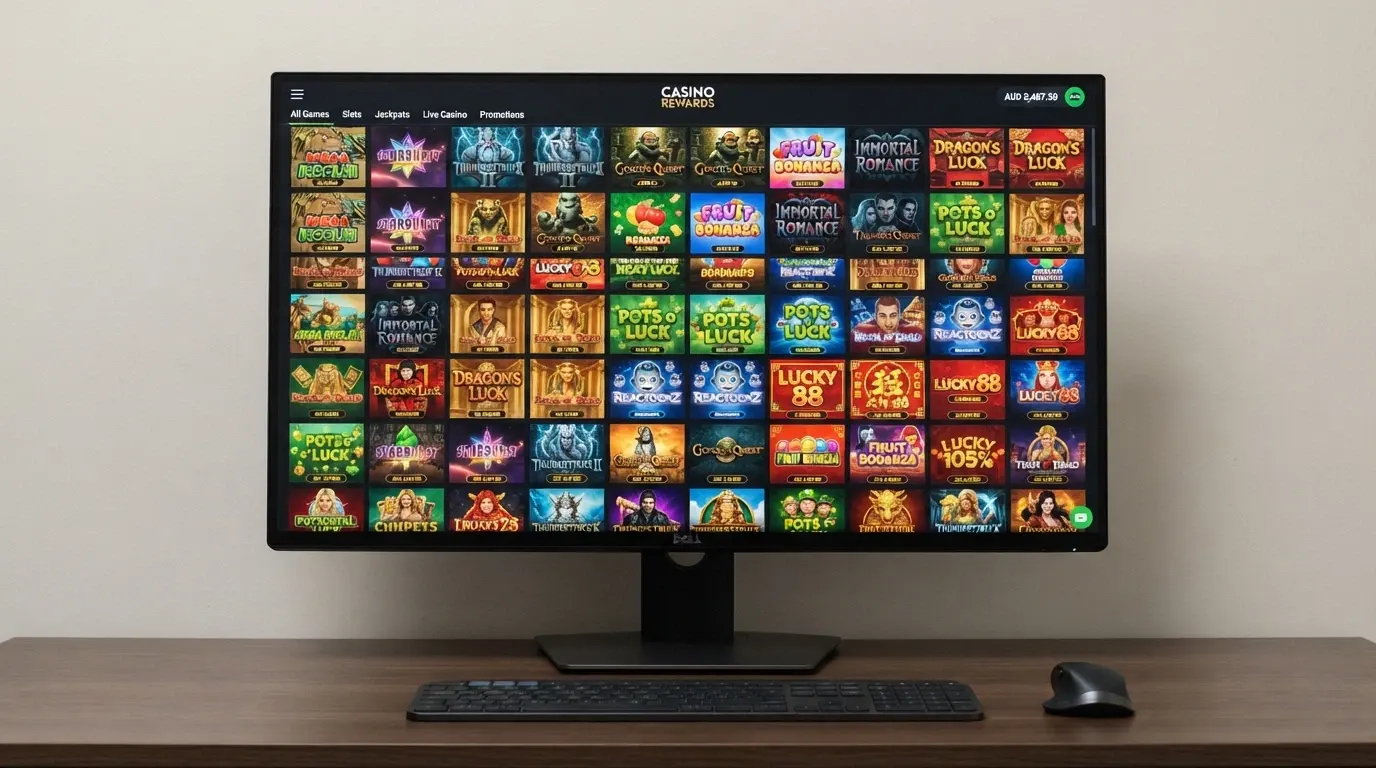
Provider breadth is a quality signal rather than a marketing figure. Studios compete on math design, theme and bonus mechanics; an operator running 90+ providers is choosing to expose its players to genuine competition between games rather than padding a lobby with one studio’s filler catalogue. A punter reading “3,800+ pokies” should treat that as “3,800+ pokies from 90+ studios competing on math and design” rather than “3,800+ ways for the house to take your money”.
The math under the pokies is the second thing to read. A 96% RTP pokie returns A$96 of every A$100 wagered on average; the 4% margin is the house edge. Over a session of A$3,500 turnover — the kind of figure a 35x wagering requirement on a A$100 bonus asks for — the expected loss is A$140. That is a statistical estimate over millions of spins and tells a player nothing about the next spin; over a long session, it tells them a great deal.
Progressive jackpots and high-volatility titles sit at the top of the risk ladder. A high-volatility pokie returns less often and in larger lumps; a low-volatility pokie returns more often and in smaller lumps. Both have the same RTP over enough spins, but the variance of the experience is different. A punter chasing a six-figure jackpot is playing a different game — in mathematical terms — from a punter stretching a A$100 bankroll across a long session. The library carries both. The player chooses.
Live-Dealer Tables: Real Croupiers, Real Stakes, Real Time
Live-dealer tables close the gap between an online casino and a physical one. Roulette, blackjack, baccarat and game-show formats stream from professional studios with real dealers, real cards and real wheels. The punter watches the dealer spin, deal and pay out in real time, with a betting grid overlay on the screen. The social layer is partial but real: chat functions, side bets and multi-camera angles approximate a casino floor more closely than an RNG game ever can.
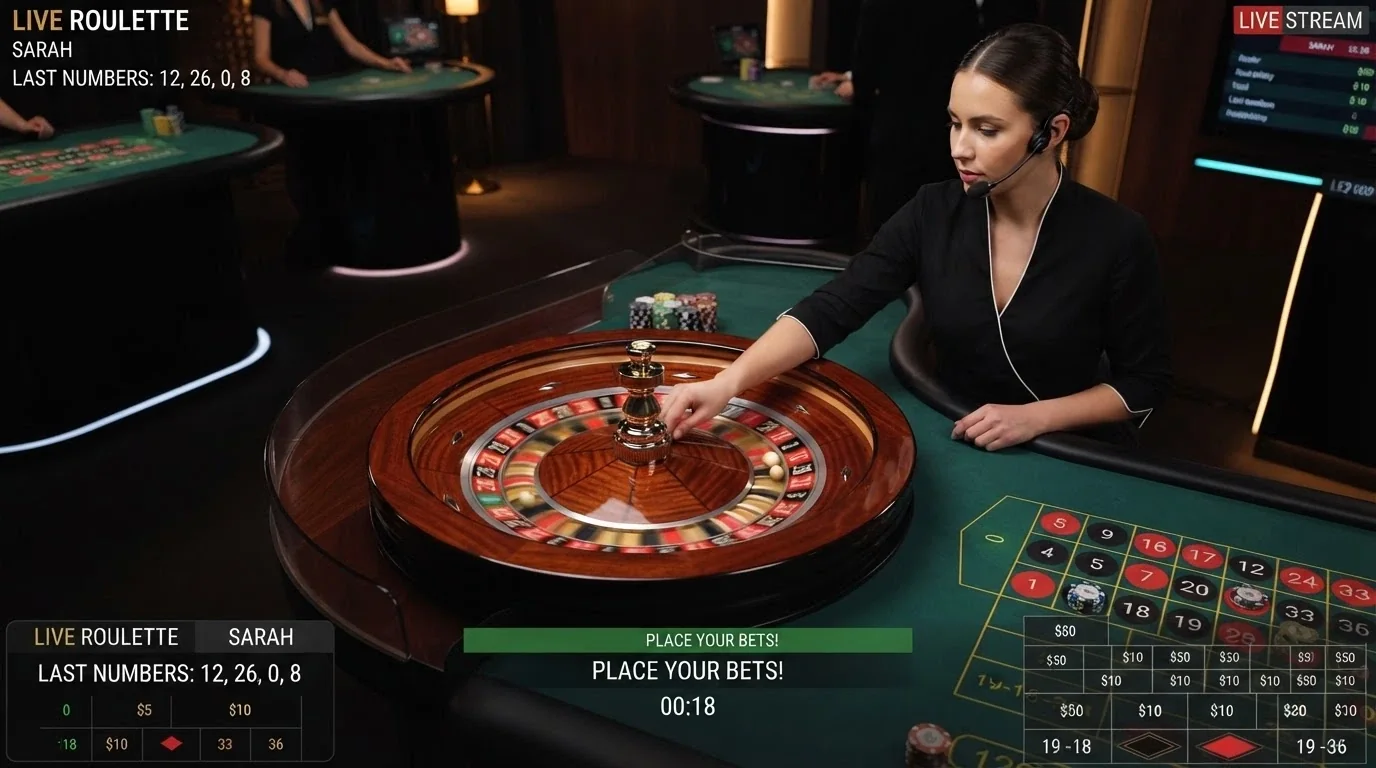
XXXTreme Lightning Roulette is the headline format for the multiplier generation. Standard roulette pays 35:1 on a single number. Lightning Roulette strikes several numbers every round with multipliers that boost the payout to 500x or 1,000x on the struck numbers. The trade is that struck numbers have lower straight-up payouts on the non-multiplied hits; the headline figure is real, the implied house edge is higher. A punter chasing the multiplier is paying for the privilege in expected return.
The house-edge comparison across providers is the cleaner figure to compare on. NetEnt live blackjack runs at 0.50% house edge; Ezugi and Evolution Gaming both run at 0.61%. The difference is small in absolute terms but real over a long session: at 0.50% the player loses A$5 of every A$1,000 wagered; at 0.61% the figure is A$6.10. Over a bonus-clearing turnover of A$3,500, that spread is roughly A$3.85 across the providers. Small in isolation, real over time, and the kind of figure a player who is serious about return will care about.
The trust dimension is the part an RNG game cannot offer. A live dealer in a studio cannot manipulate the spin in a way that survives camera scrutiny; the random number generator cannot make that claim. A punter who does not trust the algorithm can watch the dealer. That is the social and trust function live-dealer tables serve beyond the math — a verifiable randomness that does not require the punter to audit the code.
RNG vs Live Play: Why the Difference Matters for Your Bottom Line
RNG games run on certified random number generators with published return-to-player percentages. A 96% RTP pokie returns A$96 on every A$100 wagered over millions of spins; the remaining A$4 is the house edge. The algorithm determines outcomes, the return is set by the math, and the punter cannot see any of it happen. Live games run on the dealer’s actual hand — the spin of a real wheel, the deal of a real card — with the house edge set by the rules of the game rather than the RTP of an algorithm.
The two calculations are not equivalent. A live blackjack house edge of 0.50% (NetEnt) or 0.61% (Ezugi, Evolution) is set by the rules — dealer hits on 17, player blackjack pays 3:2, the deck reshuffles at a fixed point. The punter can count cards, can size bets, can vary strategy. A 96% RTP pokie has no such levers: the math is the math, the spin is the spin, and the only variable the punter controls is stake size and how often they press the button.
The transparency divide runs in the opposite direction. A punter can audit the live-dealer stream with their eyes — the dealer turns the card, the ball lands in the pocket, the result is what the camera shows. A punter cannot audit an RNG without access to the code, the seed and the certification record; the trust is in the certification body rather than the evidence. Both trust paths are real. Both are different.
The practical takeaway for a bonus-clearing session is that live-dealer tables contribute less to wagering requirements than pokies at most international casinos, which pushes most bonus clearing into the slots. The wagering math therefore runs on the RTP figure rather than the live-edge figure. Live-dealer tables are where the punter plays once the bonus is cleared and the wagering obligation is gone.
Why Getting Your Money Out Takes Longer Than Getting It In
The deposit experience at an international casino is fast. PayID deposits credit in under 60 seconds at verified casinos; BPAY clears within 24 hours at minimums of A$20–A$50, with best-in-class at A$20; crypto deposits settle on the next block on the network used. The casino’s cashier page makes the deposit flow look seamless. The withdrawal flow is where the marketing claim and the player experience start to diverge.
Crypto is the fastest cross-border payment rail for international casino play. Withdrawals clear in 15 minutes to 2 hours at the fastest end, with sub-2-hour payouts reported at Stake in some sessions and 1h 14min at Joe Fortune in a Payoutverdict.com test. PayID is the fastest AUD rail: deposits under 60 seconds, withdrawals tested as fast as 25 minutes. Bank wire is the slowest: 3–5 business days with receiving-bank fees of A$25–40 per wire, which is enough to make a small-stake player reconsider the rail entirely.
The verification bottleneck is the structural cause of the gap. The first withdrawal is always slower than the marketing window because the casino runs KYC checks: identity verification, payment-method verification, source-of-funds confirmation in some cases. A punter who deposits, plays and requests a withdrawal on the same day can wait several days for the first one to clear. Subsequent withdrawals on the same payment method are usually faster. The casino’s published “instant withdrawal” claim applies after the first withdrawal, not before.
Deposit Routes That Work from Australia — and the Ones That Don’t
| Payment Method | Deposit Speed | Withdrawal Speed | What to Know |
|---|---|---|---|
| PayID (Osko) | Under 60 seconds | As fast as 25 minutes at verified casinos | The fastest AUD rail; uses the New Payments Platform; available at most international casinos accepting Australian players |
| BPAY | Within 24 hours | 1–3 business days | Minimum deposits typically A$20–A$50; best-in-class at A$20; widely supported at AU-focused casinos |
| Debit Card | Instant at cashier | 1–5 business days | Universal fallback; the rail most international casinos support out of the box |
| Crypto (BTC, USDT, ETH) | Next network block | 15 minutes to 2 hours | Fastest cross-border rail; ~22% of AU pokies volume in 2026; banned for licensed wagering operators from 11 June 2024 — its presence on a casino’s cashier signals an offshore operator |
| Bank Wire | 1–3 business days | 3–5 business days | Slowest rail; receiving-bank fees of A$25–40 per wire apply on top of any operator fee |
| Credit Card | Instant at cashier | Not permitted | Banned for licensed wagering operators from 11 June 2024 with a penalty of up to A$247,500 per breach; an international casino accepting credit cards is operating outside Australian rules |
| POLi | — | — | No longer a payment method anywhere in Australia; replaced by PayID and crypto |
The credit-card and crypto ban on licensed wagering operators, in force since 11 June 2024, is the cleanest indicator separating an offshore casino from a licensed bookmaker. A gambling site that asks for a credit card or a crypto deposit from an Australian is, by definition, not licensed in this country. The presence of either rail on a casino’s cashier page is enough to identify the operator as offshore without reading any other field.
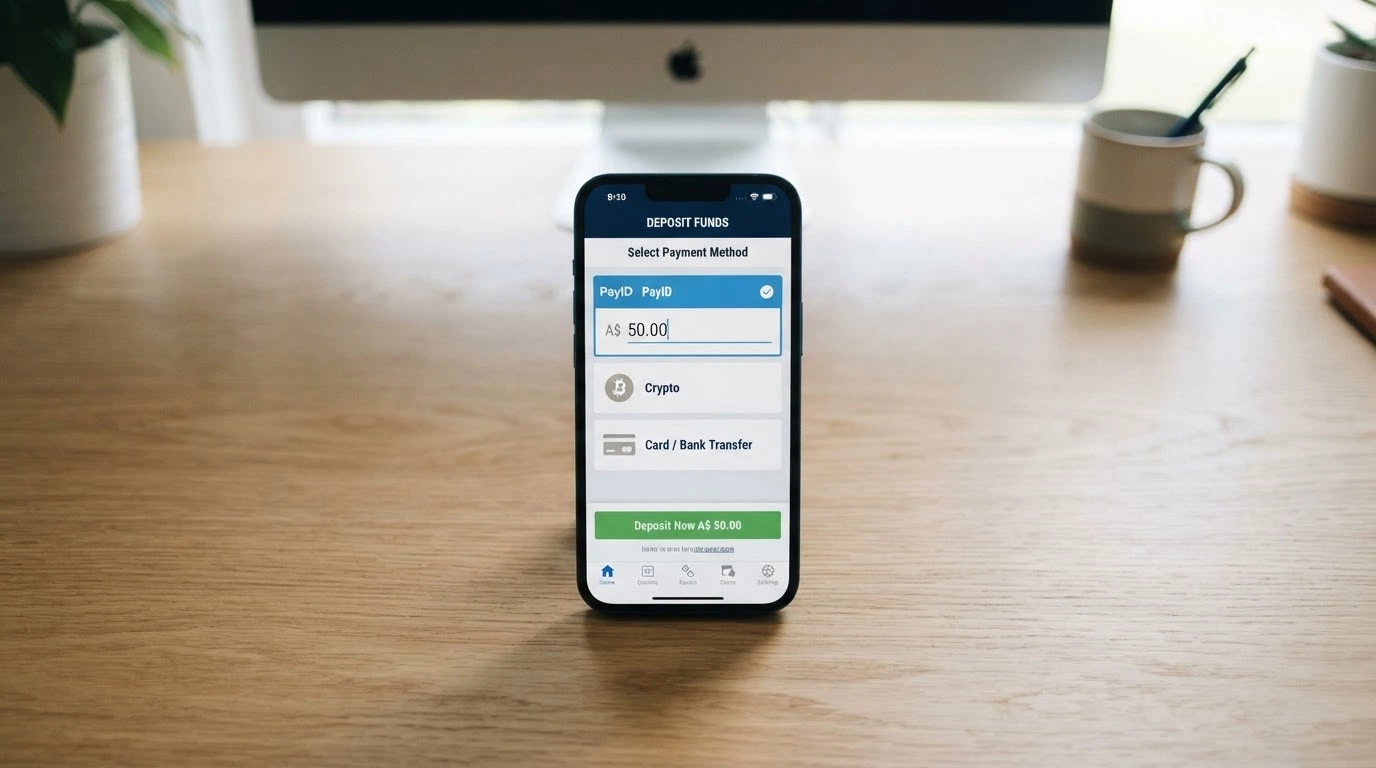
POLi is gone. The POLi Payments service, once the standard AUD instant-deposit rail for Australian online gambling, has been withdrawn from the market. Any reference to POLi as a current payment method is out of date. PayID, BPAY, debit card, bank wire and crypto are the practical options for an Australian punter at an international casino in 2026.
Withdrawal Speed: How Fast Your Money Actually Arrives
Crypto withdrawals at the fastest end clear in 15 minutes to 2 hours; Joe Fortune’s Bitcoin test ran at 1h 14min, Wild Fortune’s crypto test at 5h 24min, Stake reports sub-2-hour crypto payouts in some sessions. PayID withdrawals have been tested as fast as 25 minutes at verified casinos; Joe Fortune’s PayID test ran at 2h 39min. Bank wire is the slowest at 3–5 business days, with receiving-bank fees of A$25–40 on top of any operator fee. FairGO runs 2–5 days on payouts, on the slower end of the AUD options.
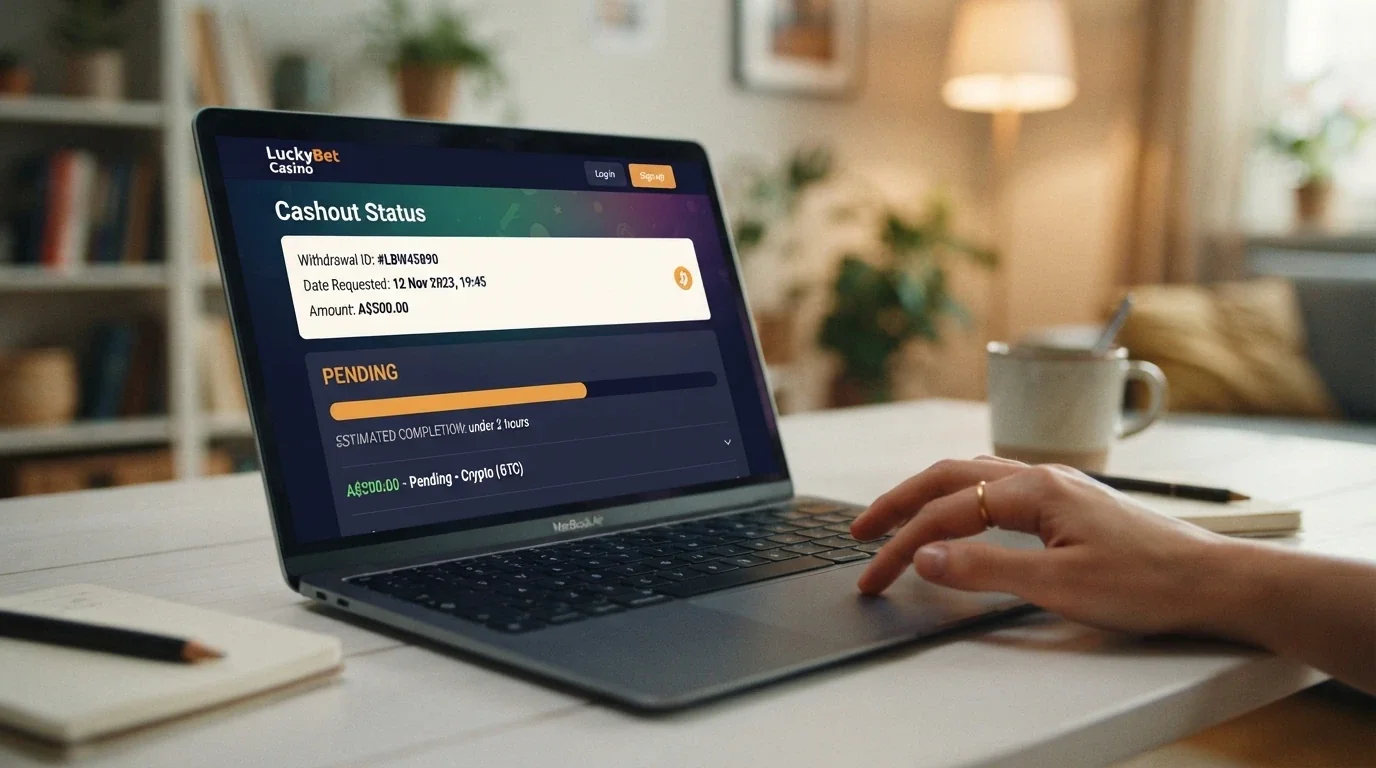
The verification bottleneck is the structural reason first withdrawals take longer than subsequent ones. Every reputable international casino runs KYC checks on the first cashout: identity verification against a government-issued ID, payment-method verification against the deposit source, source-of-funds confirmation in some cases. The first withdrawal can stall for several days while the casino works through the documents. Subsequent withdrawals on the same verified payment method usually clear much faster — often inside the operator’s published window.
The marketing claim of “instant withdrawals” should be read as “instant after the first withdrawal clears KYC”. A punter depositing for the first time and requesting a withdrawal on the same day should expect the casino’s published window plus the KYC review time. The marketing window applies once the verification is complete.
The receiving-bank fees on bank wire are the second reason the rail is unpopular. A$25–40 per wire is enough to wipe out a meaningful chunk of a small withdrawal, and the operator usually does not absorb it. A punter withdrawing A$500 by bank wire pays A$25–40 of that to the receiving bank, leaving A$460–A$475. Crypto and PayID avoid the fee entirely.
Crypto as Your Fastest Cross-Border Payment Rail
Crypto accounts for roughly 22% of total AU pokies volume in 2026, with withdrawals clearing in 15 minutes to 2 hours at the fastest end — the fastest rail across the international casino segment. Joe Fortune’s Bitcoin withdrawal tested at 1h 14min; Wild Fortune’s crypto withdrawal at 5h 24min; Stake reports sub-2-hour crypto payouts in some sessions. The figures vary by network (TRC-20 and ERC-20 settle differently), by operator queue and by verification status, but the order of magnitude is the same: crypto is measured in minutes, bank wire is measured in days.
The legal nuance is the part that catches Australian players out. Crypto is banned for licensed wagering operators from 11 June 2024; the operator-side penalty for non-enforcement is up to A$247,500 per breach. International casinos sit outside that ban — they are not licensed wagering operators under Australian law, so the credit-and-crypto prohibition does not bind them. A punter using Bitcoin at an offshore casino is not breaking Australian law. A punter using Bitcoin at Sportsbet is.
The practical side is wallet setup, network choice and exchange-rate risk. A punter holding AUD who wants to deposit BTC has to convert on an exchange, pay the network fee on the transfer, then deposit at the casino — three costs stacked on top of any bonus offer. The exchange rate moves between conversion and deposit, and a delay of an hour can shift the AUD value by a percent or two. None of the costs is large in isolation; together they cut into the edge a fast rail otherwise offers.
From 1 January 2027 the picture shifts again. Banks and payment providers gain express authority to block transactions to illegal gambling operators under the 2026 reform, which means an Australian bank can decline a card transaction to an offshore casino cashier without the punter having a route of appeal. Crypto sits outside the banking system, which is part of why it has become the rail of choice for offshore play and part of why the 2026 reform does not directly target it. The risk moves to the exchange on- and off-ramps, where compliance is tightening in parallel.
Why Your 2026 International Casino Bonus Is Harder to Clear Than It Looks
A welcome bonus at an international casino is a marketing figure that becomes a math problem the moment a punter reads the wagering requirement. A 100% match up to A$2,000 plus 100 free spins at 40x wagering with a 7-day validity window is, in plain terms, a promise to give a player A$2,000 in bonus funds on the condition they wager A$80,000 within a week. The expected loss on that turnover, at a 96% RTP pokie, is A$3,200. The “free” money costs A$3,200 in expected return before the bonus converts to withdrawable cash.

The arithmetic runs cleanly. On a A$100 bonus at 35x wagering the required turnover is A$3,500. At A$1 per spin with a five-second interval, that turnover takes approximately 291 minutes (about 4 hours and 51 minutes) of continuous play — assuming only the bonus amount is wagered. On a 96% RTP pokie the expected loss over that turnover is A$140. That is a statistical estimate over many spins and promises no win, no payout and no return; over the thousands of spins a 35x bonus requires, however, it tells a player a great deal about what the bonus itself costs. The “bonus” is, in this math, a negative-EV obligation: a player pays A$140 in expected loss for the privilege of clearing A$100 in bonus money.
No-Deposit Bonuses: What Australian Players Can Actually Claim
Royal Reels is the most prominent example on this list. A A$10 no-deposit chip after phone verification, 40x wagering, A$200 max cashout. The terms are honest: A$10 is credited after the player verifies a phone number, the bonus carries 40x wagering (A$400 of turnover required before withdrawal) and the maximum cashout from bonus winnings is capped at A$200. The terms appear in full on the operator’s own terms page; the offer is one of the few no-deposit deals on the international casino market that accepts Australian players.
The structural reality is that no-deposit bonuses are rare among international casinos accepting Australian players. Most operators reserve the no-deposit offer for players in specific jurisdictions or run it as a limited promotion; the long-running welcome offer is deposit-gated, with the no-deposit either absent or available only on a separate opt-in. Royal Reels is the outlier on this list in publishing a standing no-deposit offer.
The cashout cap is the catch on every no-deposit deal. A A$10 no-deposit chip with a A$200 max cashout means the player cannot win more than A$200 from the bonus itself; even a lucky spin on a high-volatility pokie is capped at that figure. The 40x wagering on a A$10 bonus means A$400 of turnover to clear it. At a 96% RTP pokie the expected loss is A$16, against a A$200 maximum upside and A$10 of bonus money — a positive-EV proposition for the player at the cap, but only because the cap is what stops the operator from taking a much larger loss.
A punter comparing no-deposit offers should read the cap first. A no-deposit bonus without a cashout cap is a marketing claim worth investigating; a no-deposit bonus with a A$200 cap and 40x wagering is the standard form on this market.
Wagering Requirements: The Number That Makes or Breaks a Bonus
The wagering multiple is the figure that decides whether a welcome bonus is worth claiming. The range across the featured set runs from 30x (Royal Reels, FairGO, Joe Fortune) to 35x (Bizzo) to 40x (RocketPlay), with Wild Fortune’s 250 welcome free spins at 0x wagering the standout exception. A 30x requirement on a A$500 bonus is A$15,000 of turnover; a 40x requirement on a A$2,000 bonus is A$80,000.
The 7-day validity window at RocketPlay is what makes its 40x requirement impractical for casual players. A$80,000 of turnover in seven days at A$1 per spin is 80,000 spins at 5 seconds each — about 111 hours of continuous play. A punter playing four hours a day for seven days commits 28 hours, which would clear roughly a quarter of the requirement. The bonus is for high-volume players only.
Wild Fortune’s 0x wagering on 250 free spins is the cleanest offer on this list. What the spins win is the player’s to keep; no playthrough obligation, no cashout cap on the winnings beyond the operator’s standard terms. The 250 spins are the headline figure, but the 0x wagering is the substance: a welcome bonus without a clearing obligation is rare across the international casino market and rarer still among operators accepting Australian players.
The 35x figure on Bizzo and similar sits between the two extremes. A$400 at 35x is A$14,000 of turnover, about 19 hours of continuous play at A$1 per spin — a workload that fits a long weekend rather than a working week. A punter who can commit 4–5 hours a day for three to four days can clear a Bizzo welcome bonus; a punter who plays an hour a week cannot.
The Law: What Playing at an Offshore Casino Costs You in Protections
Australia’s online casino market is structurally unusual in the developed world. The Interactive Gambling Act 2001 prohibits providing online casino games, online pokies and in-play sports betting to a person in Australia, and there is no licence for online casino anywhere in the country — not federally, not in any state or territory. The Australian market is closer to the French model of outright prohibition than the British model of licensed competition.
The individual player is not prosecuted. The Act targets the provider, not the consumer. No Australian case has held an ordinary punter’s gambling winnings assessable as income; section 6-5 of the ITAA 1997 exempts them, and losses are not deductible under section 8-1. That is genuine comfort on the tax side and on the criminal side.
What is not genuine comfort is the protection layer. The Australian consumer protection framework that an Australian punter assumes exists — the ACMA complaints process, the BetStop self-exclusion register, the Australian Consumer Law guarantees on misleading conduct, the state tribunal appeal — does not reach an offshore operator. An Australian punter at an international casino has the same consumer protections as an Australian punter at any other foreign website, which is to say, none of the ones the local framework provides.
The Interactive Gambling Act: What It Bans and What It Leaves Alone
The Interactive Gambling Act 2001 prohibits providing online casino games, online pokies and in-play sports betting to a person physically in Australia. The statute makes the provision of the service a criminal offence, not the receipt of it. The ACMA — the Australian Communications and Media Authority — is the federal regulator enforcing the prohibition: it investigates complaints, issues formal warnings, runs civil penalty proceedings and directs ISPs to block illegal sites. The published block list runs to 1,564 websites since November 2019.
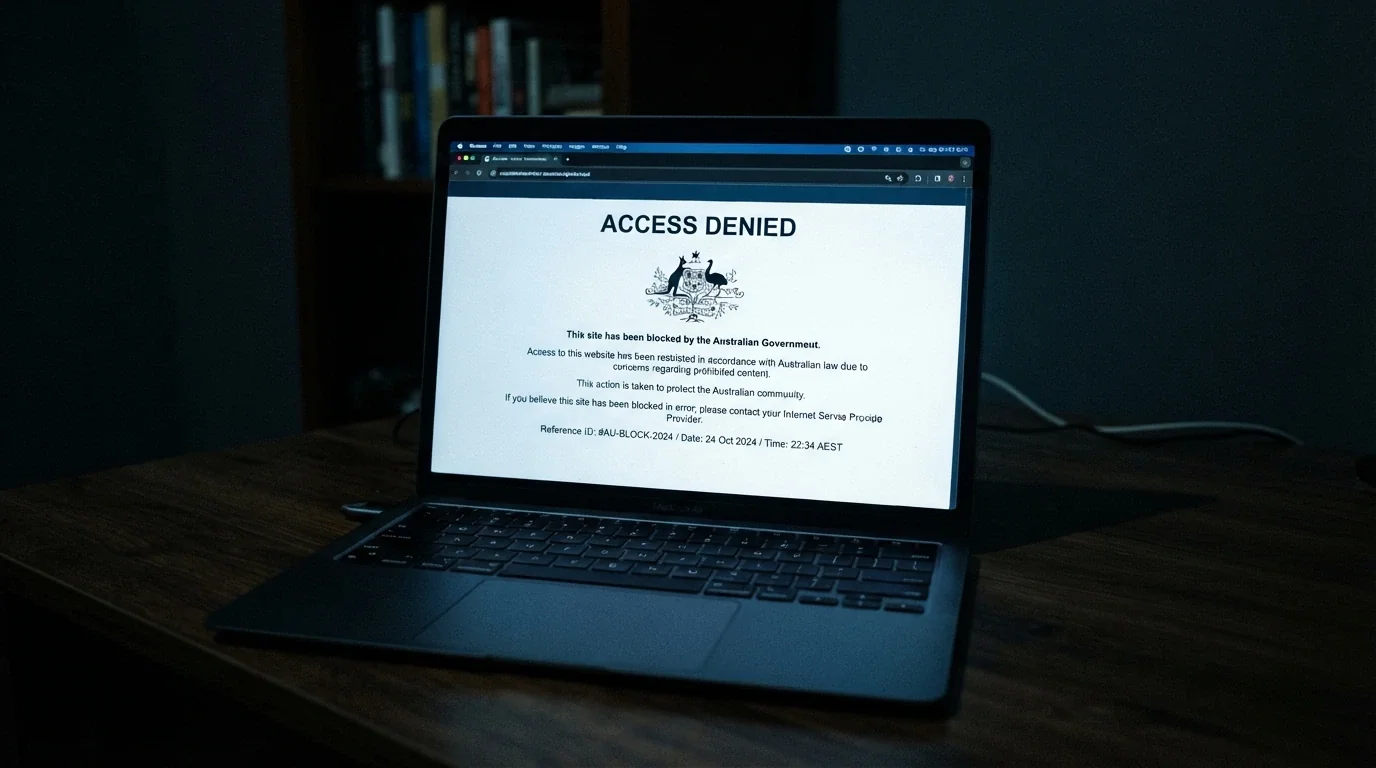
What the Act leaves alone is wagering on racing and sport placed before the event begins, lotteries and keno. Wagering on those products is state and territory business, with the Northern Territory Racing and Wagering Commission running as the de facto national licensor through Licensing NT and licences running up to 20 years. The minimum age for any commercial gambling in Australia is 18.
The credit-card and crypto payment ban from 11 June 2024 is the second limb of the enforcement regime. Credit cards, credit-related products and digital currency are banned as payment for online wagering; the operator-side penalty for non-enforcement is up to A$247,500 per breach. The ban applies to licensed wagering operators, not to offshore casinos — which is part of why the rail is a clean indicator separating the two products.
The reform that strengthens the regime passed Parliament on 19 August 2026 but does not commence until 1 January 2027. The measures — capped broadcast advertising, live-sport blackouts, bars on athletes and influencers promoting wagering products, broadcasting odds banned outright, banks and payment providers gaining express authority to block transactions to illegal gambling operators — are not yet binding. A punter reading this in 2026 is reading them as the future, not the present.
The 2026 Reform: What Changes on 1 January 2027
The Interactive Gambling Amendment (Gambling Reform) Bill 2026 passed Parliament on 19 August 2026. The measures commence on 1 January 2027. The headline changes touch advertising, marketing and the banking layer rather than the underlying prohibition, but the practical effect on an Australian punter at an international casino is significant.
Broadcast wagering advertising is capped at no more than three ads per hour between 6am and 8.30pm. A live-sport blackout runs from 15 minutes before kick-off to 5 minutes after the final whistle. Radio ads are barred during school hours. Online wagering ads are restricted to logged-in, age-verified users with an opt-out path. No wagering ads in sports venues, on uniforms, or with athletes, celebrities or influencers as the promotional voice. Broadcasting sporting odds is banned outright.
The direct-marketing rules are the most direct change for an Australian punter at an international casino. From 1 January 2027, inducements cannot be marketed directly to a customer for 14 days after sign-up and for three months after a person deregisters from BetStop. Inducements are barred indefinitely for at-risk customers. A punter who has signed up with an offshore casino is not in scope for these rules — the offshore operator is not bound by them — but a punter who has registered with BetStop and is being chased by marketing from any wagering operator is in scope, and the rules bind the operator rather than the punter.
The banking change is the one that reaches offshore casino play most directly. From 1 January 2027, banks and payment providers gain express authority to block transactions to illegal gambling operators. An Australian bank can decline a card transaction to an offshore casino cashier. Crypto sits outside the banking system, which is part of why the 2026 reform does not directly target crypto and part of why crypto has become the rail of choice for offshore play. The risk migrates to the exchange on- and off-ramps rather than to the casino cashier itself.
The reform does not change the underlying prohibition. Online casino remains illegal in Australia on and after 1 January 2027. The reform changes the advertising regime, the marketing rules and the banking layer; it does not legalise the product.
No ACMA, No BetStop, No Recourse: What You Actually Lose
The protections a punter assumes exist at an international casino are four, and none of them apply. The ACMA has no jurisdiction over an unlicensed offshore operator — if the casino refuses a withdrawal or voids a win, there is no Australian regulator to complain to. BetStop, the National Self-Exclusion Register, binds only Australian-licensed wagering services; an offshore casino is not connected, and a self-excluded person can keep depositing at any international brand. The Australian Consumer Law guarantees on misleading conduct and unfair contract terms do not reach an operator outside the country. And the state tribunal system — VCAT in Victoria, NCAT in NSW, QCAT in Queensland — has no jurisdiction over a Curaçao-licensed or Costa Rica-licensed operator.
BetStop is the concrete harm. The register has recorded 67,480 registrations since its August 2023 launch, with 41,290 exclusions still active as of 31 July 2026. 78% of registrants were under 40; 38% chose lifetime exclusion. The register is the most heavily used self-exclusion tool in Australian gambling harm-prevention, and it does not reach the offshore casino segment. A punter who registers with BetStop and then plays at an international casino is not breaking the self-exclusion, but they are also not protected by it.
The credit-card and crypto ban on licensed wagering operators is the practical tell that an operator is offshore. From 11 June 2024, licensed wagering operators in Australia have been banned from accepting credit cards and crypto. An offshore casino accepting either rail from an Australian player is, by definition, not a licensed wagering operator. The presence of either rail on a casino’s cashier page is enough to identify the operator as offshore without reading any other field.
DNS-level ISP blocking is the final layer. The ACMA has directed ISPs to block 1,564 illegal gambling and affiliate websites since November 2019. The block is at the DNS layer; the site goes offline for Australian ISPs regardless of the operator’s intent. A punter holding a balance at a blocked site has no Australian body to call for the return of the funds. The casino may honour the balance in theory and the punter may be unable to reach the site to ask for the payout in practice.
Staying in Control When the Safety Net Doesn’t Cover You
Australian gambling-harm statistics are uncomfortable to read. About 2.1% of Australian adults — roughly 430,000 people — experience problem gambling; the AIHW put high-risk gambling at 1.8% in 2022. Australians lose approximately A$25 billion on legal forms of gambling each year. In 2022, ACMA found more than one in 10 Australians (11%) had gambled online in the previous six months, up from 8% in 2020. The licensed wagering market is the bulk of that loss; offshore casino play sits inside it but is harder to measure, because the operators do not publish Australian-specific data.
The responsible-gambling tools a punter still controls at an international casino are deposit limits, session timers, activity statements and operator-level self-exclusion. Deposit limits are the most useful: a punter who sets a A$200 weekly deposit cap before the first deposit cannot deposit more than A$200 that week at that operator. The cap is not portable across operators — a punter setting a cap at one international casino can still deposit at another — but it is the strongest single tool a player has at the operator where the cap is set.
The structural gap is BetStop. The National Self-Exclusion Register binds Australian-licensed wagering services — around 150 operators — and excludes a registered person from all of them. The register does not reach an international casino. A self-excluded person who wants to gamble online in Australia can do so at any offshore operator. That is the harm the register cannot reach and the reason the tools a punter sets themselves are more important at an international casino than at a licensed bookmaker.
The help infrastructure in Australia is the same regardless of where a punter plays. The National Gambling Helpline on 1800 858 858 is free, confidential and staffed 24/7. Gambling Help Online at gamblinghelponline.org.au runs free 24/7 chat and email counselling. BetStop at betstop.gov.au is the self-exclusion register for licensed wagering. None of these tools is weakened by playing offshore; the help is the same. The harm-prevention coverage, however, is thinner — BetStop does not reach international casinos, and the operator-level self-exclusion a punter can set at one offshore brand does not reach another.
Deposit Limits, Session Timers and the Tools You Still Control
The tools a punter still controls at an international casino are the same tools that licensed wagering operators offer under state and territory conditions: customer-set deposit limits, activity statements, session timers, reality-check pop-ups and operator-level self-exclusion. None of these tools is mandated for an offshore casino in the way it is for an Australian-licensed operator; the reputable brands offer them, the verification file does not carry per-operator RG audits and a punter should check the responsible-gambling page before depositing.
Customer-set deposit limits are the strongest single tool. A punter who sets a weekly or monthly deposit cap before the first deposit cannot exceed it at that operator. The cap is enforced at the cashier level. A A$200 weekly cap on a player who has lost A$180 by Wednesday stops them depositing the remaining A$20 until the following Monday. The cap does not extend across operators, which is a real limitation, but it is the strongest single lever a player has at the brand where the cap is set.
Session timers and reality-check pop-ups are the second tier. A session timer logs the player out after a set period; a reality-check pop-up reminds the player how long they have been playing. Both are standard at reputable international casinos. Both are opt-in or pre-set at the operator’s discretion, which is the gap from the licensed market: an Australian-licensed wagering operator is required to offer them under state conditions; an offshore casino is not.
Operator-level self-exclusion works for the single site where it is set. A punter who self-excludes at Wild Fortune cannot play at Wild Fortune for the exclusion period. The exclusion does not extend to RocketPlay, Bizzo, Joe Fortune or any other operator. BetStop, which binds every licensed wagering service, does not reach an offshore casino. The structural gap is real and it is the most concrete harm of playing at an international brand.
Where to Get Help: What Australia’s Gambling Support Actually Covers
The Australian gambling-support infrastructure is the same regardless of where a punter plays. Three resources matter:

- National Gambling Helpline on 1800 858 858 — free, confidential, staffed 24/7, with online chat and email counselling through Gambling Help Online at gamblinghelponline.org.au
- Gambling Help Online at gamblinghelponline.org.au — free 24/7 chat and email counselling
- BetStop at betstop.gov.au — self-exclusion from all ~150 Australian-licensed wagering services for a minimum of three months up to lifetime
The 67,480 registrations and 41,290 active exclusions on BetStop as of 31 July 2026, with 78% of registrants under 40 and 38% lifetime exclusions, capture the demand for self-exclusion in one set of figures. The register does not reach offshore casinos. A punter registering with BetStop and then playing at an international casino is not breaking the self-exclusion, but they are also not protected by it.
If an international casino ignores a self-exclusion request, the first call is the National Gambling Helpline on 1800 858 858. The helpline cannot compel an offshore operator to act, but it can connect the punter with counselling, can advise on dispute resolution and can document the case. The Australian regulator cannot reach an offshore operator, but the Australian help infrastructure can reach the punter.
The structural gap — BetStop not reaching offshore casinos — is the single most concrete harm of using an international brand and the reason a punter worried about their play should set their own deposit limits, session timers and operator-level exclusions before the first deposit. The tools an Australian punter controls at an international casino are smaller than the tools an Australian-licensed operator is required to provide. The help outside the casino is the same.
How We Chose and Ranked Every Casino on This List
The ranking is built from three layers of verification. Every operator was checked against the issuing regulator’s public licence register, the bonus terms were read on the operator’s own terms page, and the withdrawal-speed data came from independent payout testing where it exists. Payoutverdict.com tested 10 offshore online casinos that accept Australian players between February and May 2026; two of the brands on this list were in that sample, and the published PayID and Bitcoin withdrawal figures are drawn from that work.
The criteria that ordered the ranking are game-library breadth, AUD and crypto support, wagering-term fairness and Australian-player focus. Game-library breadth is a structural advantage: an operator with 3,800+ pokies from 90+ providers is making a real B2B investment in the Australian market. AUD and crypto support is the second layer: a casino that takes PayID, BPAY, debit card and Bitcoin is meeting Australian players where they bank; a casino that takes only credit card and wire transfer is asking an Australian to convert twice. Wagering-term fairness is the third: an operator running 30x on a deposit bonus is in a different category from one running 50x, and Wild Fortune’s 0x wagering on 250 free spins is in a different category again. Australian-player focus is the fourth: a casino that markets to Australians, accepts AUD and runs Australian payment methods is closer to the audience than a casino that lists Australia as one of 200 supported countries.
Every operator was checked against the ACMA enforcement record and the Casino.guru licence database. The ACMA’s block list is the reason the verification step matters: 1,564 illegal sites blocked since November 2019 is the practical risk an Australian punter runs at an offshore casino. The Casino.guru database is the per-operator check: a licence that appears in the regulator’s public register but does not appear in Casino.guru’s record is worth a second look; a brand that appears in Casino.guru’s “no licence” file is a flag rather than a recommendation.
The honest limitation is that some operators are on this ranking with a thin verified file rather than a negative one. WinSpirit, Rainbet, Scream Casino and Rocket Casino sit in that category: offshore, accepts Australian players, no Australian licence, and the verification round returned no confirmed figures. They are included because excluding them would mean pretending the segment does not contain them, and a punter comparing the field needs to see which brands were verifiable and which were not. No operator was excluded for lacking a marketing-friendly story. One was flagged with its gap stated; the rest are presented with the verification they earned.
What to Do Next: Your Call as an Australian Player
The trade-off is the whole page. An international casino offers bigger game libraries, faster crypto payouts and larger bonuses than anything available from a licensed Australian wagering operator — and it costs every Australian consumer protection the local framework provides. A A$2,000 welcome bonus at 40x wagering is not A$2,000 in the player’s pocket; it is A$2,000 in bonus money that requires A$80,000 of turnover at a 4% house edge, which is an expected loss of A$3,200 before the bonus converts. The arithmetic favours the house by design, and the marketing word “free” is doing the work of disguising that.
The legal reality is the next layer. The Interactive Gambling Act 2001 prohibits the service, not the player. No Australian case has held an ordinary punter’s gambling winnings assessable as income. The ACMA can block the site a punter holds a balance on, but the punter is not personally at risk. The 2026 reform commencing on 1 January 2027 gives banks and payment providers the power to block transactions to illegal gambling operators, which means the card rail may stop working for an offshore casino deposit before the next decade is out. Crypto sits outside the banking system and is the rail the reform does not directly target.
The financial reality is the third layer. A A$100 welcome bonus at 35x wagering on a 96% RTP pokie costs A$140 in expected loss, not A$100 in free money. A A$500 bonus at 30x costs A$600 in expected loss on the same math. The bonus is a liability, not a gift, and the player who reads the bonus as marketing copy is the player who underestimates what it costs them. The “how long to clear” calculation sits beside the “expected loss” calculation: A$3,500 of turnover at A$1 per spin on a 5-second interval takes approximately 291 minutes (about 4 hours and 51 minutes) of continuous play for a single bonus.
The practical move for an Australian punter who decides to play at an international casino is four-part. Use crypto for the fastest withdrawals — 15 minutes to 2 hours, faster than every other rail, and outside the credit-card ban that the licensed market operates under. Set a deposit limit at the cashier before the first deposit — a weekly or monthly cap the punter cannot exceed at that operator. Save the National Gambling Helpline number 1800 858 858 in the phone, because the help infrastructure in Australia is the one thing the offshore segment cannot take away. And register with BetStop if the play has crossed from entertainment into something else, recognising that BetStop does not reach offshore casinos and the self-exclusion at the international brand is a separate, weaker tool.
That is the call. The figures, the laws and the math are on this page. What an Australian punter does with them is theirs.
Frequently Asked Questions
Is it legal for Australian players to gamble at international online casinos?
The 2001 legislation prohibits providing online casino games to a person in Australia; it is a provider offence, not a player offence. The individual punter is not prosecuted, and winnings are not assessable income under section 6-5 of the ITAA 1997. The cost is the forfeited Australian consumer protection layer: no ACMA complaints body, no BetStop coverage, and the ACMA can direct ISPs to block the site, including any balance a player holds.
Do international casinos accept Australian dollars (AUD)?
Yes — most accept AUD as an account currency alongside USD, EUR and cryptocurrencies. AUD balances keep a player off the conversion spread that USD or EUR accounts impose on every transaction. PayID and BPAY deposits are also AUD-denominated and clear through the New Payments Platform and the BPAY scheme respectively.
Can I claim a no-deposit bonus at an international casino from Australia?
No-deposit bonuses are rare on this segment. Royal Reels is the clearest example, with a A$10 chip after phone verification, 40x wagering and a A$200 maximum cashout. The wagering requirement and the cashout cap are the binding terms, not the headline figure: a “free” A$10 chip still requires A$400 of turnover before withdrawal.
What happens if an international casino blocks my account or refuses a withdrawal?
There is no Australian regulator with jurisdiction over an unlicensed offshore casino. The ACMA cannot compel an operator to release funds, and state tribunals have no reach outside Australia. The realistic options are the operator’s dispute process, a complaint at Casino.guru or AskGamblers, and walking away from the balance if the operator refuses to pay.
Are crypto deposits and withdrawals better for Australian casino players?
On speed, yes. Crypto withdrawals clear in 15 minutes to 2 hours at the fastest end, well ahead of bank wire at 3–5 business days. Crypto sits outside the credit-card ban that binds licensed Australian wagering operators from 11 June 2024. The trade is wallet setup, exchange-rate risk on the AUD conversion, and tightening compliance at crypto exchanges.
Does BetStop self-exclusion cover international casino sites?
No. BetStop binds only Australian-licensed wagering services — around 150 operators. Offshore casinos are not connected to the register and will keep accepting deposits from a self-excluded person. Self-exclusion at an international casino must be done at each operator individually, and the exclusion does not extend across brands.
Written by the editors at RTP Pokies Australia.