
What ‘Instant Withdrawal’ Means at Australian-Facing Offshore Casinos
The term ‘instant withdrawal’ does a lot of work in Australian casino marketing. In a Q2 2026 search for the fastest-paying operator, almost every result promises it; none defines it. The fastest rail at an offshore casino was cryptocurrency, settling in under 30 minutes once approved; PayID — the local rail that replaced POLi after 30 September 2023 — can run under an hour at the best operators. Everything else is a longer wait than the label suggests. None of the operators on this page is licensed in Australia, because no such licence exists. What follows is what ‘instant’ means in practice, which operators deliver it, and what the legal reality costs a punter who uses one.

Last reviewed against the ACMA and Curacao GCB registers on 12 November 2026 · Operator data verified against independent tested-payout sources and the regulator’s enforcement records.
Table of Contents
- Why “Instant Withdrawal” Rarely Means What You Think
- 10 Offshore Casinos Ranked by Tested Payout Speed in 2026
- The Payment Methods That Actually Deliver Same-Day Cash
- Why Your No-Deposit Bonus Winnings Are Harder to Withdraw Than You’d Expect
- The Pokies Worth Playing at an Instant-Payout Casino
- Crypto Is the Fastest Withdrawal Rail — and the One the Law Excludes
- The Legal Reality Every Australian Punter Needs to Know
- Staying in Control When the Casino Operates Outside Australian Rules
- How We Evaluated and Ranked These Casinos
- Your Move: What an Honest Look at Instant-Withdrawal Casinos Means for Your Next Deposit
- Frequently Asked Questions
Why “Instant Withdrawal” Rarely Means What You Think
The label has drifted. What the marketing claims and what the punter’s bank balance shows can be hours or days apart, and the gap lives in two places the punter cannot see from the cashier page: the operator’s processing queue and the receiving bank’s settlement window. Both are real. Both are invisible from the marketing.
What the Casino Means by “Instant” vs What Your Bank Means
Casinos describe their side of the transaction. The moment a payout moves from ‘pending’ to ‘approved’, the queue clears, and the operator considers the job done. That is what ‘instant’ means in their advertising. The reader’s definition usually starts later — when the money is actually in their bank account, and ideally when it can be spent.
For PayID, those two definitions live on opposite sides of a batch window. The operator typically processes a withdrawal in 12 to 18 hours after the request is submitted. The receiving bank then runs its own incoming PayID batch on a 12 to 30-hour cycle. End-to-end, the fastest tested PayID cashouts in Q2 2026 cleared in under 10 minutes; the slowest took just over 11 hours. The operator’s marketing copy describes the first window; the punter experiences the second.
The distinction matters because it tells the punter where delays come from. A casino that is ‘instant on our end’ but receives its payout queue at 6pm Friday may not see anything move until Monday morning, regardless of the rail. A punter who understands the two halves of the equation can time a withdrawal — Tuesday morning is not the same game as Saturday night — and pick a method whose batch windows align with their need. The choice is informed, not magical.
Real-Money Play at an Instant-Payout Casino: What Changes
Playing for AUD changes the arithmetic in specific ways. The minimum withdrawal floor — the smallest amount actually cashable out — sits between A$10 and A$30 across the major AU-facing operators. Below that threshold, a balance is technically winnable but practically unwithdrawable. The daily cap runs from A$2,000 to A$10,000, and weekly caps vary more sharply — one operator’s weekly ceiling is another’s daily one.
The local rail adds another wrinkle. POLi, the instant-deposit rail that connected Australian bank accounts to offshore casinos, shut down on 30 September 2023. PayID is what replaced it, and PayID’s speed depends on whether the casino’s cashier treats it as a same-day rail or a 24 to 48 hour one. The operator set this page ranks splits on that line. A handful process PayID in under an hour; others queue it into the next-day window.
The upshot is that an ‘instant’ casino for a European or Latin American punter — who can usually pull on Skrill, Neteller or a SEPA transfer — is not always an instant one for an Australian. The Australian bank account adds a layer. Crypto sits at one end. Cards at the other.
10 Offshore Casinos Ranked by Tested Payout Speed in 2026
The ranking below is built on tested cashout data where it exists, claimed speeds where it doesn’t, and a clear note where neither was confirmed this run. Speed is one of three things that separates these operators; the other two are the bonus structure and the licence status. None of the ten is licensed in Australia — no online casino can be, because no such licence exists. The set is not the entire offshore market. It is the operators who cleared the verification bar for this page’s topic.
| Casino | Licence | Welcome Offer | Tested Withdrawal Speed | Min Withdrawal |
|---|---|---|---|---|
| Rocket Play | Curacao (Hollycorn N.V.) | — | BTC 0.7h median, ETH 2.1h, LTC 1.2h | — |
| SkyCrown | Curacao OGL/2023/176/0095 | 120% up to A$1,200 + 125 FS | Crypto <1h, PayID same-day | A$30 |
| Neospin | Curacao (attribution conflicts) | Daily cashback 10–20% (3x rollover) | BTC 1.3h, ETH 2.9h, LTC 1.7h | A$30 fiat / A$45 crypto |
| BitStarz | Curacao | — | ~8–10 min crypto | A$10 |
| Stake | Curacao | Rakeback / VIP model | — | — |
| Goldenbet | Curacao GCB | A$100 cash gift (0x wagering) | 10–20 min processing, PayID <1h | A$20 |
| Wild Tokyo | Curacao | 250% up to A$5,300 + 600 FS | ~10–12 min crypto, PayID 1–3h | A$30 |
| Ricky Casino | Curacao 8048/JAZ | 550% up to A$7,500 + 550 FS | PayID 1–4h | A$30 |
| Rolling Slots | Curacao | 310% up to A$6,400 + 570 FS | PayID tested 15 min, typical 1–3h | A$30 |
| Royal Reels | — | — | — | — |
Rocket Play — Crypto-First Speed Across 3,900+ Pokies
Rocket Play runs the fastest median crypto times among the ten operators on this list. Bitcoin cleared at 0.7 hours median across tested cashouts in Q2 2026 — roughly 42 minutes end-to-end, including the operator-side approval queue. Ethereum was slower at 2.1 hours, reflecting gas-variable settlement; Litecoin landed at 1.2 hours. The trio runs 30 to 40% faster than sister casinos sharing the same Hollycorn licence stack.
The library is the talking point beyond speed. Rocket Play carries 3,900+ pokies, 67 crash games and a provably fair section that lets the punter verify each round’s outcome on-chain. Crypto is the intended rail — Rocket Play is crypto-first — and fiat options are limited, which is the practical trade-off for a punter who prefers PayID over Bitcoin.
The brand’s AU market share sits at 9.4% — the second-largest in this ranking. Verdict in a number: 0.7 hours median for Bitcoin is the best on this list. If holding crypto is the entry point, the 0.7-hour median payout sets the standard for the fastest operators on this list.
SkyCrown — 5,800+ Games and PayID That Clears Same-Day
SkyCrown carries the broadest game library in this ranking after Neospin: 5,800+ slots, 89 live tables and 340 jackpot titles. The welcome package runs 120% up to A$1,200 plus 125 free spins on the first deposit — the bonus carries a 40x wagering multiplier on the bonus amount only and a 14-day validity window. The maximum bet during bonus wagering is capped at A$6.50.
The payout side covers both worlds. Crypto clears under an hour; PayID runs same-day; MiFinity takes 24 to 48 hours; cards settle in 3 to 5 business days. The daily cap sits at A$5,000, the weekly at A$10,000 and the monthly at A$15,000. Minimum withdrawal is A$30 via MiFinity and A$100 by bank transfer.
The licence is verifiable — Curacao GCB registration OGL/2023/176/0095 — and the AU market share sits at 8.55%. Verdict: the welcome package is on the lighter side of the featured set but is structured clearly, and the bonus-only wagering is a quiet positive, since it means the punter’s deposited cash is not also locked up. For a punter who wants PayID same-day plus a verifiable Curacao registration, SkyCrown is the cleanest combination of clarity and reach on this list.
Neospin — The Largest Game Library With Daily Cashback
Neospin runs the largest game library in the Hollycorn network: 6,700+ slots from 138 providers and 95 live tables. The bonus structure replaces a traditional welcome package with daily cashback of 10 to 20% at a 3x rollover. The implication is significant: the cashback is real-cash-adjacent in a way that a 40x match bonus never is. A punter who plays steadily through a week can extract value from losses in a way the match-bonus structure makes harder.
The catch sits at the deposit step. Neospin enforces a 3x deposit wagering requirement before any withdrawal — a punter who deposits A$100 and tries to cash out at A$105 will be told to play through another A$195 first. Crypto clears in 1.3 hours for Bitcoin, 2.9 hours for Ethereum and 1.7 hours for Litecoin; fiat minimums are A$30, crypto minimums A$45. The cap structure runs A$6,000 daily, A$15,000 weekly, A$45,000 monthly — the largest monthly ceiling in this ranking.
Verdict with a caveat: Neospin is the operator for a punter whose play pattern is steady enough to make a 3x deposit rollover painless and whose losses recur enough for daily cashback to pay. The 6,700-title library is a draw on its own. The licence attribution in the source materials conflicted this run — Curacao OGL/2023/176/0095 in some listings, Tobique Gaming Commission in others — and the Curacao registration is the more frequently cited.
BitStarz — The 10-Minute Crypto Payout Benchmark
BitStarz set the speed benchmark that other crypto casinos now market against. Tested crypto cashouts in Q2 2026 cleared in 8 to 10 minutes — the operator’s queue is short, and Bitcoin or Litecoin payments arrive while the punter is still on the cashier page. AUD payouts are supported, which removes the FX hop a USDT payout otherwise adds.
The library size and bonus terms were not confirmed this run, so this writeup stays narrow on what was verified. Minimum withdrawal is A$10 with no documented maximum, which puts BitStarz in the lowest-friction group on this list for small-balance cashouts. The licence is Curacao; the operator’s tenure in the AU-facing market is among the longest of any brand featured here.
Verdict in one line: if the punter’s bottleneck is a small cashout that has to land today, BitStarz is the shortest queue on this list.
Stake — The Crypto-Native Giant With a Rakeback Model
Stake operates differently from the rest of this list. The brand runs a rakeback and VIP model rather than a traditional welcome package — there is no headline match bonus, because Stake’s design assumes the punter will be a long-term rather than a first-deposit user. The crypto-native cashier matches the rest of the product: crypto is the intended rail, fiat options are limited.
The headline numbers this run could verify were thin. AU market share at 1.28% places Stake at #12 in the local market. The licence is Curacao. Specific tested payout speeds and bonus terms were not confirmed this review.
The rest is unexplained. Verdict with a caveat: for a punter already familiar with crypto-native operators and the rakeback model, Stake is a credible option. Newcomers seeking a first offshore casino should approach this one with caution, as the absence of public terms requires a direct inquiry before making a deposit.
Goldenbet — The Zero-Wagering Cash Gift and Sub-One-Hour PayID
Goldenbet is the only operator on this list whose welcome offer is structured as a straight cash gift with no wagering requirement. A$100 in real cash, playable once, withdrawable as soon as any minimum is met. There is no multiplier. There is no expiry race. There is no excluded-game list to navigate.
The cashier matches the offer’s plainness. PayID clears in under an hour on average; processing time runs 10 to 20 minutes once the punter is verified. Minimum withdrawal is A$20 — the lowest on the list alongside BitStarz. The licence is Curacao GCB.
Verdict: a punter who reads bonus terms before claiming — and most readers of this page do — will find Goldenbet’s offer more readable than the rest of the field. The 0x wagering is rare in the AU-facing market this review surveyed. For a punter who plans a short session rather than a long one, this is the offer that costs the least to test.
Wild Tokyo — 250% Match and 10-Minute Crypto Cashouts
Wild Tokyo pairs a heavy match bonus with sub-15-minute crypto cashouts. The welcome package runs 250% up to A$5,300 plus 600 free spins (some sources list 260% up to A$5,300 with 620 free spins — the source conflict sits in the secondary tier, not the headline structure). Tested crypto withdrawals cleared in 10 to 12 minutes; PayID runs 1 to 3 hours. Minimum withdrawal is A$30.
The size of the headline number is the draw and the warning. A A$5,300 bonus at a typical 40x multiplier locks A$212,000 of turnover through the bonus — a session length measured in weeks of dedicated play rather than hours. The punter who can clear that volume in the validity window extracts value; the punter who cannot loses the bonus balance outright.
The headline is the warning. Verdict with a comparison: Wild Tokyo’s match is the second-heaviest in this ranking behind Ricky Casino, and its crypto cashout time is the fastest behind BitStarz. For a punter who has the bankroll to clear a large bonus and the patience to play through it, this is a credible pairing. For everyone else, the headline number is doing the marketing the punter should be doing for themselves.
Ricky Casino — 550% Welcome Package With PayID in Hours
Ricky Casino carries the biggest headline match on this list: 550% up to A$7,500 plus 550 free spins across the welcome package. PayID cashouts run 1 to 4 hours in tested traffic. The minimum withdrawal is A$30, and the standard weekly cap is A$7,500 — VIP players move to A$15,000 and beyond. The licence registration is Curacao 8048/JAZ.
The welcome offer is the draw, and the question to ask before claiming is the same one that applies to Wild Tokyo: how much turnover the punter can sustain. The 550% number is a percentage of the deposit, not a free balance — a punter depositing A$100 receives A$550 in bonus funds, all of which carries the operator’s wagering multiplier. The punter who treats the bonus as ‘free money’ has misunderstood what a match bonus pays for.
The match is the biggest. Verdict on the offer: Ricky’s headline number is the loudest in this ranking, and the PayID window is solid rather than exceptional. The brand is a fit for a punter who reads the bonus terms in full before claiming and treats the match as a long-run commitment rather than a free hit.
Rolling Slots — 15-Minute PayID Tested at a 310% Match Casino
Rolling Slots posted the fastest PayID time tested this review — 15 minutes end-to-end at one cashout, against a typical 1 to 3 hour window for the operator. The welcome offer runs 310% up to A$6,400 plus 570 free spins. Minimum withdrawal is A$30.
The combination is unusual. Most operators run crypto fast and PayID slow, because PayID’s bank batch window drags the end-to-end time out even when the operator processes quickly. Rolling Slots’ tested 15-minute PayID suggests an operator that has built its cashier around the Australian rail specifically — or simply a lucky test window. Either way, the figure is what it is.
Verdict on the rail: for a punter who specifically wants PayID over crypto, Rolling Slots is the strongest tested option on this list. The welcome match is mid-pack — heavier than SkyCrown’s 120%, lighter than Wild Tokyo’s 250% — and the bonus terms were not confirmed in detail this run, which means the punter should read the small print before claiming.
Royal Reels — Market Presence, But Payout Data Unverified This Review
Royal Reels is the operator on this list known by its AU market presence rather than its tested payout performance. The brand carries 2.51% AU market share — the #9 position in the local market — and operates offshore, but the specific licence registration, welcome offer, payout speed, payment methods and minimum withdrawal terms were not confirmed in this review.
It is known by presence. It is not known by data. That absence is the point. The other nine operators on this list have at least one tested speed, one verified bonus or one confirmed licence. Royal Reels has market share and not much else in the source material this run drew on. Naming it without numbers would mislead a punter comparing options; describing it as ‘popular in Australia’ is accurate and not very useful.
Verdict with a clear scope: a punter shortlisting against this page’s verified numbers can place Royal Reels on a watch list and revisit the operator when payout data is independently published. Until then, the safer pick from this ranking is one of the nine operators with at least one verified speed, bonus or licence detail.
The Payment Methods That Actually Deliver Same-Day Cash
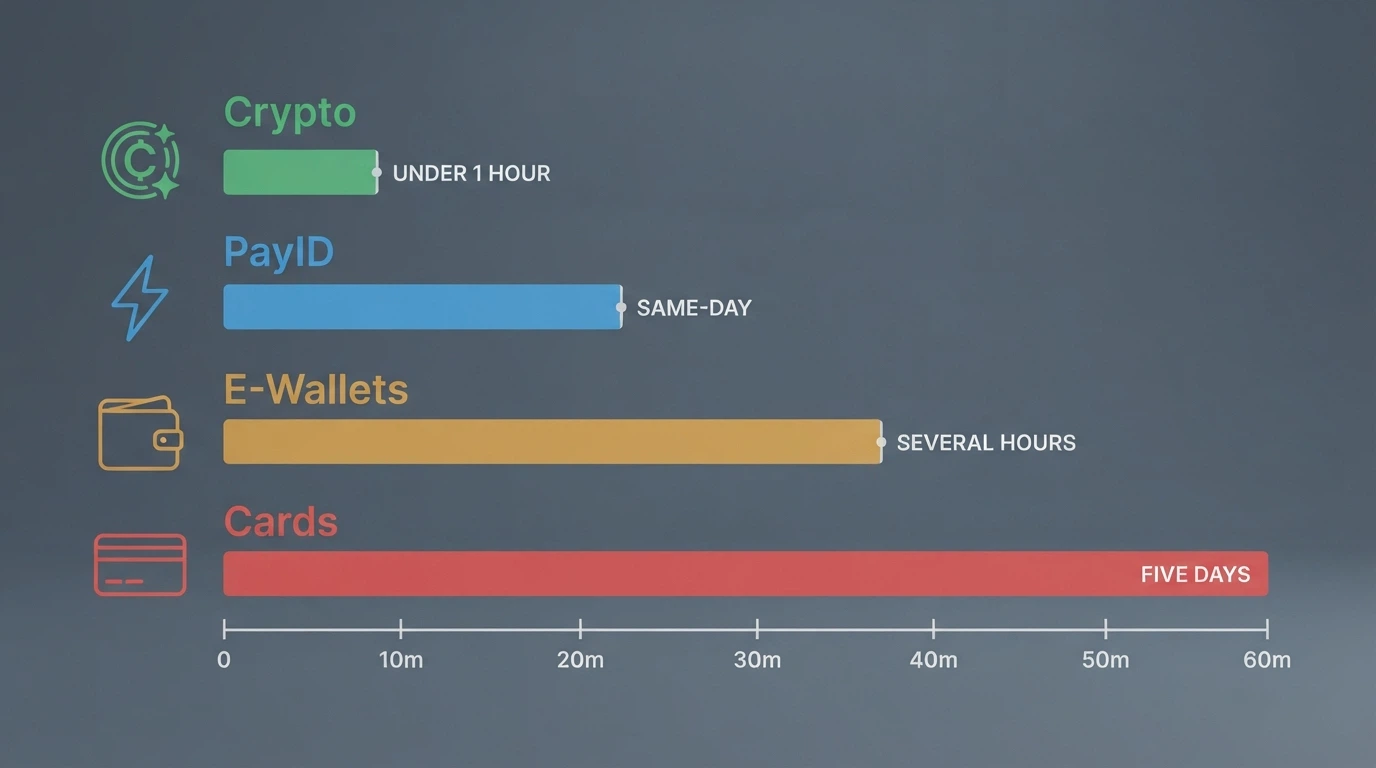
Four rails move money out of an offshore casino into an Australian pocket. Only two of them clear in the same day, and the gap between those two and the slower pair is wide enough that the punter should know which is which before picking a casino — and before picking a deposit method, since most operators require withdrawals through the same rail that funded the account. Same rail out. Same rail in.
| Method | Typical Speed | Minimum Withdrawal | Notes |
|---|---|---|---|
| Crypto | 2–60 min once approved | Varies by coin and operator | USDT (TRC-20/Polygon) 5–30 min, near-zero fees; BTC 20–60 min; ETH 15–45 min with variable gas |
| PayID | <1h best case; 24–48h typical end-to-end | A$10–A$30 | Bank batch window 12–30h; replaces POLi, shut down 30 September 2023 |
| Skrill / Neteller | 1–4h after e-wallet verification | Varies by operator | Requires e-wallet account and verification first |
| Visa / Mastercard | 3–5 business days | Varies by operator | Inherently slower rail for payouts |
PayID: The Local Rail That Replaced POLi
PayID became the default fast-fiat rail for Australian punters when POLi Payments shut down on 30 September 2023. The technology sits inside Australia’s New Payments Platform — every Australian bank account with a mobile number or ABN linked to it can receive a PayID transfer in near-real-time, provided both banks are connected and the receiving window is open.
In practice, the operator processes a withdrawal in 12 to 18 hours, and the receiving bank’s incoming batch window runs 12 to 30 hours. End-to-end, the fastest tested PayID cashouts cleared in under 10 minutes; the slowest took just over 11 hours. The typical claim of ‘PayID in under an hour’ is the optimistic case — a tested midpoint across multiple operators is closer to 24 to 48 hours.
The rail is the Australian punter’s best option for a fast fiat cashout. POLi is gone. PayID replaced it. The rail is Australian, but it is also the rail most exposed to the new payment-blocking authority commencing 1 January 2027, when banks gain express authority to block transactions to illegal gambling operators — a point the legal-reality section of this page returns to.
E-Wallets: Skrill, Neteller and Their Real-World Speeds
Skrill and Neteller each clear in 1 to 4 hours once the e-wallet account itself is verified. The verification step is the first bottleneck, and it adds a day or two if the punter is opening the wallet fresh. The 1 to 4 hour range applies once the wallet is set up; the general e-wallet payout range sits at 1 to 24 hours across operators.
The trade-off is the layer in between. A punter cashing out from a casino to a Skrill wallet and then from Skrill to an Australian bank account pays the wallet’s FX margin on the second hop, plus any fee Skrill or Neteller charges for the AU-bound transfer. Crypto and PayID each clear directly to the punter’s bank in AUD; e-wallets add an extra leg.
The practical fit is the punter who already holds a Skrill or Neteller account, has it verified, and wants the cashout off the casino’s platform quickly. For an Australian punter starting from zero, the wallet setup time erases most of the speed advantage over PayID. Both add an extra leg.
Card Withdrawals: Why Visa and Mastercard Lag Days Behind
Visa and Mastercard withdrawals clear in 3 to 5 business days at offshore operators — the slowest rail in active use and the slowest on this list. The delay is structural: card networks were designed for purchase authorisations, not real-time payouts, and the receiving bank’s settlement window runs a multi-day cycle.
Operators still offer card withdrawals because the punter who deposited by card often expects to withdraw by the same method. The cashout is also exposed to a chargeback mechanism that crypto and e-wallets are not — a punter who disputes a casino transaction through their card issuer has a route that PayID and Bitcoin do not provide. That feature cuts both ways: a casino that suspects a chargeback may decline a withdrawal rather than process it.
The honest read: a punter who has used a card to deposit and is now waiting 3 to 5 business days for the cashout is waiting on the receiving bank’s processing cycle, not on the casino. The label never applied.
What Actually Slows a Withdrawal Down
The bottlenecks between ‘approved’ on the casino side and money in the punter’s account sit in three places. KYC verification — identity, address and sometimes source-of-funds documents — is the biggest single one. Incomplete KYC is the number one cause of withdrawal delay at Australian-facing casinos, and the cause is operator-side: the casino will not release funds until documents are on file.
The operator’s processing queue adds another layer. Most offshore casinos process withdrawals during business hours, and the queue from request to approval runs 12 to 18 hours at PayID-supporting operators. Crypto operators run tighter queues — 10 to 60 minutes is typical — because the cashier is partly automated.
The receiving rail’s settlement window is the third. PayID’s bank batch runs 12 to 30 hours; card networks take 3 to 5 business days. A punter who understands all three can plan around them: upload KYC documents at sign-up, request crypto withdrawals during business hours, and avoid initiating a card cashout on a Friday evening.
The receiving bank’s own filtering sits beyond the operator’s reach. From 1 January 2027, Australian banks gain express authority to block transactions to illegal gambling operators. A PayID or card withdrawal to an offshore casino after that date may be declined at the receiving end, regardless of what the casino’s cashier says. The detail returns below.
Why Your No-Deposit Bonus Winnings Are Harder to Withdraw Than You’d Expect
A no-deposit bonus looks like free money: the casino credits the punter’s account without a deposit, the punter plays, and whatever is left after the wagering requirement is theirs to withdraw. The marketing is half-true. The other half is in the terms, and the terms are where most no-deposit bonus promises collapse into something much smaller than the headline.

The Maths of a 40x Wagering Requirement
The wagering requirement is the multiplier that converts a bonus balance into withdrawable cash. A 40x multiplier on a A$100 bonus means the punter must place A$4,000 in qualifying bets before any of the bonus balance converts to real money.
At the SkyCrown welcome terms of A$1,200 at 40x wagering on the bonus only, the turnover required is A$48,000. Ploughed through pokies at a A$5 per-spin max-bet ceiling and a 5-second spin cadence, that comes to roughly 13 hours and 20 minutes of continuous play — the time cost of clearing the bonus under the stated assumptions. In practice the actual session length depends on variance, and no single outcome is guaranteed.
The maths explains why multipliers above 40x significantly restrict the statistical likelihood of taking home real cash from a no-deposit bonus. The bonus is real. The path is the work. The path to cashing it out is the part that does most of the labour the punter did not budget for.
The Deposit-Before-Withdraw Catch
Most operators will not release no-deposit bonus winnings until the punter has made at least one real-money deposit — a ‘deposit-before-withdraw’ rule with a minimum typically between A$10 and A$30. The reason given by operators is fraud prevention: a stream of no-deposit-only accounts can be used to test strategies or move funds without ever exposing the player to a paying transaction.
The practical effect is that a punter who wins A$80 from a no-deposit bonus cannot withdraw the A$80 until they have deposited at least A$10 to A$30 of their own money and wagered it through. The bonus win is real; the path to bank balance requires a real deposit first.
For a punter who intended to use the no-deposit offer as a way to test the casino without committing cash, the rule means the test has a cost — not the bonus amount, but the minimum deposit the operator requires before the test pays out. The punter who is happy to make that deposit treats the no-deposit offer as an extended trial; the punter who is not is being charged a toll the marketing did not mention. The toll is hidden.
Cashout Caps, Bet Limits and Expiry Clocks
Three terms sit in the small print of almost every no-deposit bonus, and any one of them can wipe out a win that cleared the wagering requirement.
The max cashout cap is the most common, typically A$50 to A$150 — a punter who wins A$500 from free credit may withdraw only A$100. The cap applies to bonus winnings, not to the bonus itself, so it bites at the moment the punter would otherwise see the full amount.
The max bet per spin during wagering usually sits between A$5 and A$10. A single bet above the cap during active wagering can void the bonus and all associated winnings. The cap is there to prevent a punter from placing one large bet that would either clear the wagering in a few spins or blow through the bonus balance entirely.
The expiry window typically runs 7 to 30 days from activation, and any unmet wagering requirement at expiry forfeits the bonus and all winnings from it. A punter who took the bonus on Day 1 and returns on Day 35 finds the balance back at zero.
A frequently missed restriction sits at the excluded-games list. Live casino tables, jackpot pokies and high-RTP titles are often excluded at 0% contribution toward wagering — a spin on a jackpot pokie does not count toward clearing the requirement, and in some cases voids the bonus outright. The list varies by operator and is the part of the terms most often skipped.
The Pokies Worth Playing at an Instant-Payout Casino
The fastest payout in the world is cold comfort if the games behind it are second-rate. The AU-facing offshore market has consolidated around three provider blocks — Pragmatic Play, Hacksaw Gaming and Relax Gaming — and the depth of their catalogues is what separates a credible operator from a clone of one. The provider mix matters.

The Provider Map: Who Supplies the Pokies at These Casinos
Pragmatic Play is the largest single block, with more than 380 pokies across the major AU-facing sites. The catalogue spans high-volatility slots like Gates of Olympus, mid-volatility daily-play titles and the Drops & Wins promotional network that pays out across a fixed prize pool monthly. For a punter browsing a new casino lobby, the Pragmatic Play logo is a reliable indicator that the operator has invested in a credible catalogue. The logo is a signal.
Hacksaw Gaming contributes around 126 titles across the same sites, weighted toward scratchcards, instant-win games and the higher-volatility slots that have grown in popularity since 2023. The studio’s signature is high max-win potential combined with a low base RTP on some titles — a punter should check the game’s published RTP before staking.
Relax Gaming’s contribution sits north of 100 titles, with the Money Train series as the standout. Money Train 4 is the highest max-win pokie in the offshore market at 100,000x stake — a figure that explains both the game’s popularity and the variance a punter signing up to chase it should expect.
The provider mix tells the story. A site carrying Pragmatic Play, Hacksaw and Relax is signalling it is buying at the studio tier; a site carrying only lesser-known providers is signalling it is buying at the white-label tier. The punter who cares about game quality can read the providers list before the welcome bonus.
RTP Ranges and Why They Matter More Than the Theme
Return-to-player percentage is the long-run portion of every dollar wagered that a pokie returns to players. Good pokies sit in the 96% to 97.5% range; below 95%, the operator is skewing the maths against the punter, and the game is doing more for the casino’s margin than for the punter’s entertainment.
Bonanza Megaways, by Big Time Gaming, runs at 96.0% RTP with up to 117,649 ways to win. Gates of Olympus, by Pragmatic Play, runs at 96.50% on the standard build — some operators run 95.50% or 94.50% variants, and the difference is enough to matter across a long session. A punter who checks the game’s information panel before staking can confirm which build is live.
The 1.5 percentage point spread between a 95% and a 97.5% pokie is the difference between the casino keeping A$5 of every A$100 wagered versus A$2.50. Over a session of A$1,000 in wagers, that gap is A$25 — a meaningful sum, and the punter who picks games deliberately captures more of it.
RTP is published by the studio, and the operator cannot legally change it. What the operator can change is which RTP variant of a multi-build game is loaded. Gates of Olympus ships in multiple RTP configurations, and the operator picks which one runs. A punter who checks the in-game information panel before staking knows which version they are playing.
Crypto Is the Fastest Withdrawal Rail — and the One the Law Excludes
Cryptocurrency is the fastest rail at an offshore casino. It is also the rail a licensed Australian wagering operator is prohibited from accepting. Both facts are true at the same time, and the gap between them is the practical signal of whether the casino a punter is looking at is offshore. Both facts point the same way.

Bitcoin, USDT and the Speed Hierarchy
Not all coins clear at the same speed. USDT issued on the TRC-20 (Tron) or Polygon network settles in 5 to 30 minutes with near-zero transaction fees — the speed advantage is structural, because Tron and Polygon process transactions faster than Bitcoin or Ethereum’s base layer. Bitcoin settles in 20 to 60 minutes; the variable is network congestion, not the casino. Ethereum settles in 15 to 45 minutes; the variable is gas fees, which can run high enough that the punter’s cashout costs more in fees than the casino’s queue time saved.
The operator’s own processing time sits on top of the network’s confirmation window. A casino that processes crypto withdrawals in 10 to 20 minutes adds that to the network’s 5 to 30 minute settlement. The total cashout time is the sum — and the punter who picks USDT-TRC20 at a fast operator can clear end-to-end in under an hour.
The fee structure matters at the margin. A punter withdrawing A$500 in BTC at a 60-minute network confirmation pays both the network fee and the casino’s processing fee, if any. A punter withdrawing the same A$500 in USDT-TRC20 pays near-zero in network fees and is at the same time moving through a faster rail. The cashout arrives in more of its nominal value, and faster, than Bitcoin for any punter cashing out at the smaller end of the scale.
Why a Licensed AU Operator Cannot Take Your Crypto
The Interactive Gambling Amendment (Credit and Other Measures) Act 2023 passed Parliament on 6 December 2023 and commenced in full on 11 June 2024. The Act prohibits credit cards, credit-related products and digital currency — cryptocurrency — as payment for online wagering in Australia. An operator that fails to enforce the ban faces penalties of up to A$247,500.
The practical consequence is the cleanest signal on this page. An Australian punter who is asked to deposit by credit card or by cryptocurrency at an online casino is being served by someone outside the Australian rules. The credit card ban and the crypto ban both run in the same direction: they are the markers of an offshore operator, and the offshore operator is the one offering the prohibited product the punter came to find. The ban is the signal.
The licensed alternative is wagering — sports and racing pre-event, lotteries, keno — through NT-licensed bookmakers. The licensed product does not include online casino games. A punter who wants to play pokies online from Australia has, in 2026, only the offshore route — and the offshore route is the one that accepts the deposit methods the licensed route has banned.
The Legal Reality Every Australian Punter Needs to Know
The Interactive Gambling Act 2001 makes it an offence to provide online casino games, online pokies or in-play sports betting to a person in Australia. There is no licence for online casino anywhere in the country — not federally, not in any state or territory. Every operator named on this page is offshore. The Interactive Gambling Amendment Act 2017 closed the loopholes those operators had used and gave the ACMA enforcement and site-blocking powers.

KYC and the No-Verification Trade-Off
KYC — Know Your Customer verification — is the identity, address and source-of-funds check that licensed operators are required to perform and that offshore operators perform inconsistently. At the licensed end of the market, KYC is mandatory at sign-up; at the offshore end, KYC is often deferred until the first withdrawal request, and incomplete KYC is the single biggest cause of withdrawal delay at Australian-facing casinos.
The ‘no verification’ pitch is the marketing version of this gap. An offshore casino advertising no KYC is describing a site that lets the punter deposit and play without uploading ID documents. The trade-off is speed against security — and when the operator has no licence and no Australian regulator, the punter has no recourse if the cashout stalls or the win is voided.
The licensed alternative is the deposit-limit and activity-statement regime that comes with a state or territory licence. The punter who wants both speed and recourse has to choose; the offshore route offers the first at the cost of the second. The punter chooses.
The 2026 Reform: What Changes on 1 January 2027
The Interactive Gambling Amendment (Gambling Reform) Bill 2026 passed Parliament on 19 August 2026. Its measures commence 1 January 2027 — passed but not yet in force in the year this page is published. The reform is the most significant change to the IGA since the 2017 amendment.
The advertising restrictions commence at the same date. No more than three wagering advertisements per hour between 6:00 am and 8:30 pm. No wagering advertising from 15 minutes before a live sporting event until 5 minutes after it ends. Radio ads barred during school times. Broadcasting sporting odds banned outright. Online wagering ads only to logged-in, age-confirmed users with opt-out. Athletes, celebrities and influencers barred from promoting wagering products.
The inducement restrictions run alongside. Direct marketing of inducements is prohibited for 14 days after a customer signs up, for three months after a person deregisters from BetStop, and indefinitely for customers identified as at risk of gambling-related harm. Banks and payment providers gain express authority to block transactions to illegal gambling operators from the same date.
The reform changes the landscape. The practical consequence is that the offshore casino market in 2026 may not be the same market in 2027. A PayID withdrawal to an offshore casino shortly after 1 January 2027 may be declined at the bank. A punter who relies on a particular operator today should expect the operator’s accessibility to narrow over the next twelve months.
What Offshore Really Means for Your Money
The IGA prohibits the provider, not the player. The individual punter is not prosecuted for using an offshore casino. What the punter gives up by using one is the consumer protection framework that licensed wagering comes with.
There is no Australian complaints process if the operator refuses a withdrawal. There is no BetStop coverage, so a self-exclusion from BetStop does not bind an offshore site and the punter can keep depositing. The ACMA can — and has, in 1,564 cases since November 2019 — order Australian ISPs to block the operator’s domain, and the punter’s balance on the blocked site may not be retrievable. The site can withdraw from the Australian market, as 225 services have done since the 2017 amendment, with whatever funds the punter had on account at the moment of withdrawal.
There is no recourse. The honest framing: an offshore casino is a counterparty without an Australian regulator. The punter trusts the operator to pay out because the operator’s business model depends on paying out — and that is the entire enforcement mechanism. The licensed Australian wagering alternative carries deposit limits, activity statements and BetStop; the offshore alternative carries none of these. The punter is not prosecuted. The punter is not protected.
Staying in Control When the Casino Operates Outside Australian Rules
The tools that exist for an Australian gambler in trouble were built for the licensed market. They work. They do not, however, reach every casino a punter can deposit at — and the gap is the one most worth understanding.

BetStop’s Offshore Blind Spot
BetStop — the National Self-Exclusion Register — went live in August 2023. As at 31 July 2026, it recorded 67,480 registrations, with 41,290 exclusions still active. More than 60% of everyone who ever registered is still on the list. 78% of registrants were under 40, and 38% chose lifetime exclusion.
BetStop binds Australian-licensed wagering services only. An offshore casino is not connected to the register and will keep accepting a self-excluded person’s money. A punter who has registered with BetStop and then deposits at an offshore casino has stepped outside the protection the registration provides.
The gap is the harm. The gap matters most for the punter who registered at a moment of financial or emotional stress. BetStop is designed to give that person breathing room — to remove the impulse to deposit with one click. An offshore casino removes the breathing room because the register does not reach it. The punter who knows this gap can plan around it; the punter who does not is the one the gap was built to expose.
Practical Tools and Where to Get Help
The help infrastructure that exists for Australian gamblers works regardless of where the casino is licensed. The National Gambling Helpline — 1800 858 858 — is free, confidential and staffed 24 hours a day, with online chat and email support through Gambling Help Online at gamblinghelponline.org.au.
Gamblers Anonymous Australia runs peer support meetings nationwide. Lifeline Australia, at 13 11 14, is the crisis support line for any Australian in distress — gambling-specific or otherwise. Beyond Blue, at 1300 22 4636, is the mental health support line. The National Debt Helpline, at 1800 007 007, provides financial counselling specifically for gambling-related debt.
About 2.1% of Australian adults — roughly 430,000 people — experience problem gambling. The Australian Institute of Health and Welfare put high-risk gambling at 1.8% in 2022. The numbers are stable across years of measurement, which is itself a signal: the population of Australians in trouble from gambling is not shrinking, and the help lines above are not optional extras. The numbers are stable. The lines are not optional.
For a punter who plays offshore, the practical tools start at the operator’s own cashier. Setting a personal deposit limit at sign-up — and treating it as a hard ceiling — is the closest the offshore experience gets to the licensed regime’s deposit-limit framework. A punter who keeps a written record of sessions, who reads the bonus terms before claiming, and who knows the BetStop number by heart has done the work the offshore operator will not do for them.
How We Evaluated and Ranked These Casinos
The ranking on this page rests on three layers of source data: tested payout speeds where they were independently published in Q2 2026, licence verification against the Curacao GCB register, and the operator’s own published terms for everything else.
Tested payout data came from independent published sources covering crypto, PayID and e-wallet rails. Where the same operator was tested multiple times, the median was used. Where no independent test was available, the operator’s own claimed speed was used, with a note in the table. Two operators in the ranking — Stake and Royal Reels — could not be sourced for specific tested speeds this run; the table records this rather than filling the cell with the operator’s marketing copy.
Licence verification was conducted against the Curacao GCB register. The Curacao GCB restructured its licensing framework in late 2025; operators that previously held sub-licences through master holders (Antillephone NV, Gaming Curaçao) now hold direct B2C licences from the GCB. Three operators in the ranking — SkyCrown (OGL/2023/176/0095), Ricky Casino (8048/JAZ) and Royal Reels — were checked against this register; Neospin’s licence attribution conflicted in source materials (some listings name OGL/2023/176/0095, others name the Tobique Gaming Commission) and the table reflects the conflict rather than picking one.
Operator selection was constrained by AU market presence and a tested or verifiable payout speed. The ten operators named are the ten this review could verify at that standard. The set is not the entire offshore market; it is the operators who cleared the verification bar for this page’s specific topic — instant withdrawals for Australian-facing punters. The ACMA’s blocked-site list and the BetStop register were used as cross-checks; neither list is exhaustive, and an operator’s absence from either is not, by itself, evidence of compliance.
No weightings were invented. No percentage score was assigned to speed, bonus size or game library. No operator was ranked by a composite score this page does not show. The ordering in the ranking is by tested payout speed, with ties broken by market share. The table’s empty cells are empty because the source material did not carry the figure; this page is not the place to guess.
Your Move: What an Honest Look at Instant-Withdrawal Casinos Means for Your Next Deposit
This page is built on a single premise: an Australian punter choosing where to deposit deserves to know the gap between what a casino promises and what an Australian punter actually receives.

That gap runs in two directions. On the speed side, ‘instant’ at an offshore casino means the request enters the queue instantly; what arrives in the punter’s account depends on the rail they picked and the queue it lands in. Crypto clears in under an hour at the best operators; PayID runs same-day at the same operators and 24 to 48 hours at the rest; cards take 3 to 5 business days regardless. The label is the same; the experience is not.
On the protection side, the gap runs wider. An offshore casino sits outside the IGA framework, outside BetStop’s coverage, outside the ACMA’s complaints process and outside the deposit-limit regime the licensed market offers. The crypto and credit card bans that commenced on 11 June 2024 are the cleanest signal of which side of the framework an operator sits on — the licensed side does not accept them, the offshore side does. The reform that commences 1 January 2027 narrows the offshore route further, giving banks the authority to block transactions to illegal gambling operators from that date.
The pages this page competed with in the search results presented offshore casinos as viable Australian options. They named the welcome bonuses, listed the payout speeds and stopped there. The legal framework got a mention at the foot of the page, if it appeared at all. The reader left with a shortlist of operators and no sense of what those operators had been exempted from in order to take their deposit.
This page does not give the reader a shortlist. It gives the reader the criteria. Tested payout speeds are in the table; the licence is named where verified; the bonus terms are stated where the source material carried them and left blank where it did not. The criteria are on the page. The punter who reads the criteria can build their own shortlist — and the punter who reads the legal section can do it knowing what the offshore trade-off actually costs them.
The single most useful thing a punter can do, before the next deposit, is read the bonus terms before claiming and confirm the KYC documents are on file at sign-up rather than at withdrawal. Both moves take a few minutes; both remove the two largest causes of withdrawal delay the data on this page identifies. Neither is unique to this page, but the data on this page is the reason both moves are worth taking seriously.
The deposit is the punter’s. The protection framework is not. That is the line.
Frequently Asked Questions
What is BetStop, and does it cover offshore casino sites?
BetStop is Australia’s National Self-Exclusion Register, launched in August 2023. By 31 July 2026 it recorded 67,480 registrations with 41,290 still active. The register binds Australian-licensed wagering services only — offshore casinos are not connected, and a self-excluded person can still deposit at one.
Do I need to verify my identity before I can withdraw?
Yes, at licensed Australian wagering operators. At offshore casinos, KYC is often deferred until the first withdrawal request, and incomplete KYC is the single biggest cause of withdrawal delay. A punter who uploads ID documents at sign-up — not at cashout — removes that delay entirely.
Are online casino winnings taxed in Australia?
No. Betting and gambling winnings are not assessable income under section 6-5 of the ITAA 1997, and losses are not deductible under section 8-1 — unless the person is carrying on a business of betting or gambling. The ATO treats occasional recreational play as tax-neutral.
What is the difference between a licensed Australian wagering site and an offshore casino?
A licensed Australian wagering site holds a state or territory licence — typically NT through the NTRWC — for pre-event betting on sport and racing, lotteries and keno. Online casino games are prohibited under the IGA. Offshore casinos offer the prohibited product and sit outside the Australian regulatory framework entirely.
How long does a PayID withdrawal take compared to crypto?
Crypto clears in 2 to 60 minutes once approved, with USDT on TRC-20 or Polygon fastest at 5 to 30 minutes. PayID can clear in under an hour at the best operators but typically settles in 24 to 48 hours — 12 to 18 hours of operator processing plus a 12 to 30-hour bank batch.
What happens if an offshore casino refuses to pay out my winnings?
The punter has no Australian recourse. The ACMA can order the site blocked at ISPs but cannot compel a payout. The operator is governed by its offshore licence — Curacao in most cases on this list — and the punter’s only protection is the operator’s commercial incentive to pay, not a regulatory backstop.
Mobile and Site Access: Does the Platform Change the Payout?
The honest answer is no, with one small caveat. The processing pipeline behind an offshore casino withdrawal runs on the operator’s server, not on the device that initiated the request. Whether the punter tapped ‘withdraw’ in a mobile browser, a desktop Chrome tab or a downloaded app, the casino’s cashier receives the same instruction and queues it the same way.
What does differ is friction. App-based cashier flows tend to be shorter — fewer taps, fewer confirmation screens — but the time saved is seconds, not hours. The verification step happens regardless of device, and that is where the bulk of any delay actually lives. A punter using a mobile browser who has uploaded their ID documents in advance will not be measurably slower than an app user who has not, or vice versa.
Where mobile does matter is the moment after a win. A punter playing live on a phone who decides to cash out mid-session cannot rely on app-based speed over browser-based speed. Both routes hit the same queue. The platform decision is one of taste, not throughput.