
$5 Minimum Deposit Pokies in Australia — What Five Dollars Actually Buys You
Five dollars is the cheapest real-money entry point to online pokies an Australian player can find, and it is also the entry point that hides the most uncomfortable facts about this market. The Interactive Gambling Act 2001 makes it an offence to provide online casino games to anyone in Australia, so every site that accepts your $5 is doing so from outside the country. That one fact shapes every other decision a player makes — the payment method, the welcome offer, the withdrawal, and the moment something goes wrong.
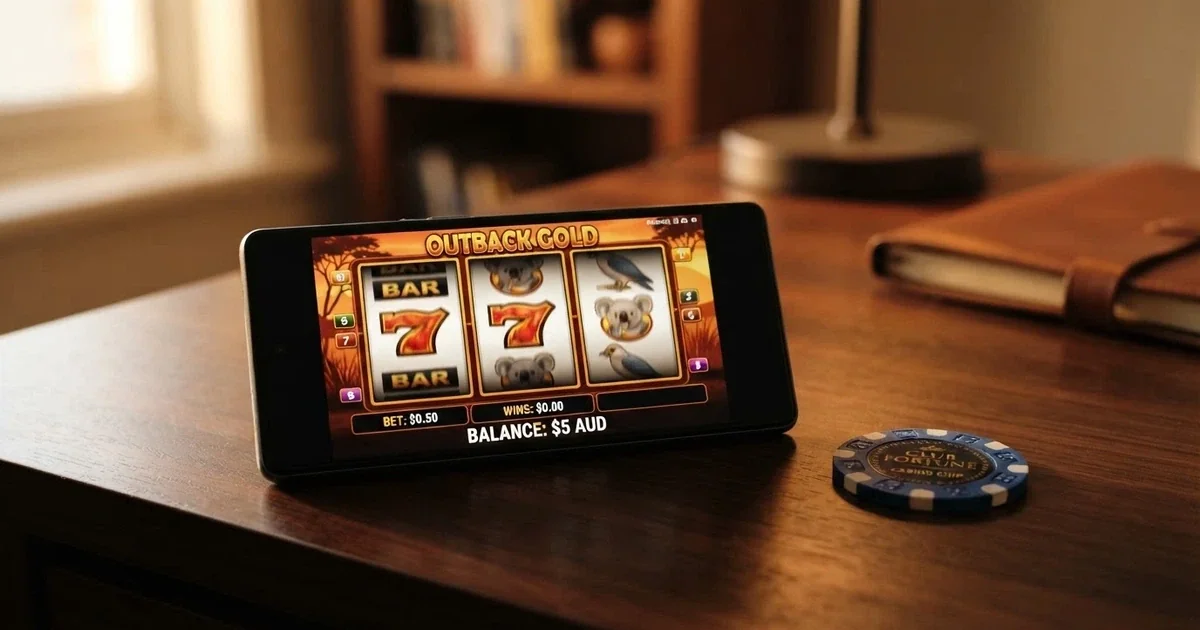
This page is built for the reader who has typed “$5 deposit pokies Australia” into a search bar and wants to know what they will actually find. It walks through what $5 buys in real terms, which payment methods move that money without breaking Australian rules, how ten offshore operators stack up against each other on the traffic they pull from Australian players, and the legal and consumer-protection gaps that the marketing never mentions. Where a figure could not be verified for a specific brand this round — bonus terms, wagering multipliers, free-spin counts — the page says so plainly rather than inventing a number.
Currency stamp: Current as of 3 November 2026, checked against the Australian Communications and Media Authority (ACMA) framework, ACMA BetStop statistics, the Northern Territory Racing and Wagering Commission register, and Roy Morgan’s Gambling Harm Index.
Table of Contents
- What a $5 Minimum Deposit Actually Gets You at Australian Online Pokies
- Getting Your $5 onto the Reels: Payment Methods That Work from Australia
- 10 Offshore Pokies Sites That Accept a $5 Deposit — Compared
- Playing $5 Deposit Pokies on Your Mobile in Australia
- New $5 Deposit Pokies Sites and First-Deposit Offers in 2026
- The Hard Truth: Why Every $5 Deposit Pokies Site You Visit Is Unlicensed
- Gambling Safely When the House Doesn’t Answer to Australian Law
- How We Selected and Ranked These $5 Deposit Pokies Sites
- What to Actually Do With Your $5 — and What to Do Instead
- Frequently Asked Questions
What a $5 Minimum Deposit Actually Gets You at Australian Online Pokies
The phrase “$5 minimum deposit” sits at the intersection of two very different things — what an operator advertises on its homepage and what the cashier page actually allows. The two are not always the same, and the gap between them is the first thing an Australian player should check before funding an account. Not every Australian-facing pokies site offers a $5 minimum, even when its marketing suggests it does. The cashier page, not the banner, is the source of truth.
Five dollars is also a small enough amount that the welcome offer, not the deposit itself, decides what your balance actually plays. At the low end of the deposit scale, the bonus is the entire session. A $5 deposit with no promotional credit gives a balance that disappears quickly at standard spin stakes — research suggests five dollars may only secure somewhere between ten and twenty free spins at the very bottom of the welcome-offer ladder. That is a short evening for a player who treats the offer as a casual look at the site rather than a serious bankroll.
Australia’s terminology matters too. Australians call them pokies, never slots — the search query itself, the on-site category labels, the colloquial language of the country’s gambling culture all use the local word. Offshore sites rebrand their “slots” tabs as “pokies” to capture Australian search traffic, but the games underneath are the same international titles, run on the same random number generators, governed by the same house edge that would apply to a European or Canadian player. The product is global; the language is Australian.
The $5 deposit threshold — why it exists and who it is for
Operators set a $5 minimum because it widens the funnel. A player who will not stake $20 may still stake $5, and a $5 deposit is cheap enough to feel like a test rather than a commitment. The economics on the operator side are simple: payment processing costs and bonus liabilities are roughly the same whether the deposit is $5 or $50, but the player pool at the lower threshold is many times larger.
For the player, the appeal is risk control. A $5 deposit caps the absolute loss on the first session, and that ceiling is real in a way higher deposits are not. It also means the welcome offer, if claimed, must be cleared on a bankroll small enough that the wagering requirement dominates the experience. That is the trade-off: low entry price, low ceiling on what the bonus can grow into, and the same house edge the high-roller faces.
The profile is the risk-conscious casual. Someone who wants to see what an offshore pokies site looks like without committing serious money, often driven by curiosity about a specific game or by a welcome offer advertised on social media. The reader who treats five dollars as entertainment money, not investment money, is the one the threshold was built for.
Real-money pokies for five dollars — what your balance actually plays
Five dollars at a typical minimum-spin stake buys a short session. The exact spin count depends on the title and the stake a player chooses, and research this round did not surface a per-spin stake value that could anchor a calculation. What it does carry is the free-spin estimate — five dollars may only return ten or twenty free spins at the bottom of the welcome ladder, which is itself the clearest sign of how compressed the offer is at this deposit level.
The more important variable is the welcome offer, not the deposit size. A site that doubles a $5 deposit to $10 changes the session length by a factor of two; a site that returns twenty free spins at a low per-spin value may extend the session further without inflating the cash balance. Either way, the bankroll is small enough that volatility dominates outcomes — a single bonus feature can either double or wipe the balance in two spins.
What this means for a player choosing between sites: the deposit size is not the decision. The welcome offer, the wagering requirement attached to it, the maximum cashout cap, and the validity window for clearing the bonus are the decision. A $5 deposit to a site with a generous match offers a clearer path to value than one with a stingy bonus.
Pokies or slots — what Australians call them and why it matters
“Pokies” is the Australian English term for what the rest of the world calls slots, fruit machines, or one-armed bandits. The word is older than the international “slot”, traces back to the poker-style machine games that dominated Australian pubs and clubs through the twentieth century, and is now the everyday name for the same machine wherever it appears — at the local RSL, in a Crown casino, or on a phone screen.
Offshore sites that target Australian players know this. They rebrand their “Slots” tab as “Pokies”, stock their library with the international titles Australians actually play, and tune their bonus terms to the AU market’s expectations. The desire to find “pokies” is the same as the desire for “slots” elsewhere — a player simply wants to find a real-money spinning-reel game they can play now.
The distinction matters less for the game itself than for the surrounding ecosystem. “Pokies” carries Australian cultural weight — the local pub, the TAB, the multi, the punters’ vernacular — that offshore operators borrow to feel familiar. The familiarity is branding, not regulation. The site accepting your $5 is still offshore, regardless of what it calls its games.
Getting Your $5 onto the Reels: Payment Methods That Work from Australia
The payment method is where the offshore nature of a $5 pokies deposit becomes impossible to ignore. Australia banned credit cards and digital currency for online wagering payments from 11 June 2024, with penalties of up to $247,500 for operators that fail to enforce the ban. A site still asking an Australian player for a credit card number or a crypto wallet address is, by that fact alone, operating outside Australian rules. The payment method is the tell.
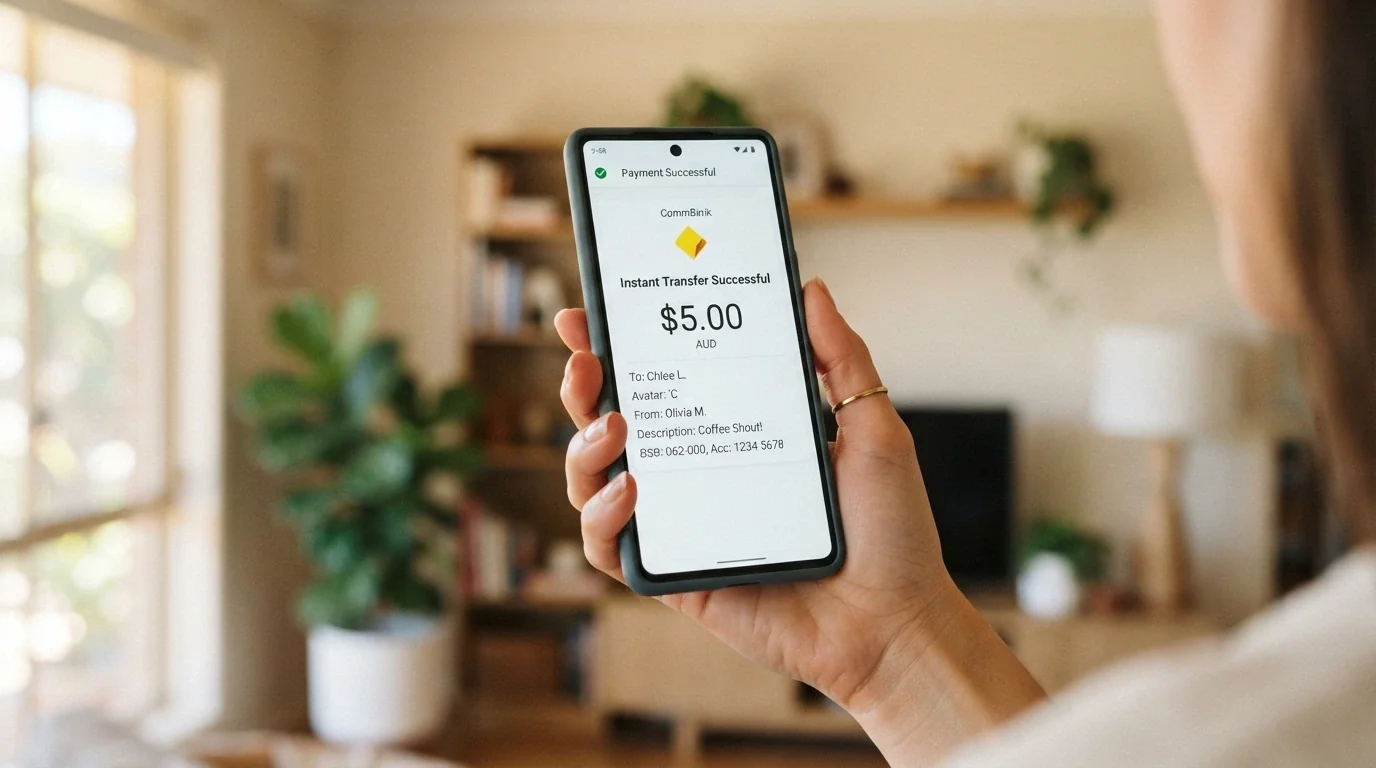
What works from an Australian bank account is narrower than the marketing suggests. PayID is the fastest domestic method — it routes through the New Payments Platform and Osko, moves money in seconds, and is supported by every major Australian bank. Neosurf vouchers, BPAY, and direct bank transfer cover players who want a layer of separation between their everyday account and the deposit. Each method has trade-offs in speed, traceability, and whether it can also be used to withdraw winnings.
What a player should do before funding: check the cashier page for the actual minimum deposit, confirm which methods are listed for both deposit and withdrawal, and treat any site still offering credit card or crypto as a signal it sits outside the framework the rest of the page assumes.
Minimum-deposit limits — $5 is not a given at every site
The $5 floor is a marketing promise more than a market constant. Some offshore operators set their minimum at $10, $20, or $30 — often without surfacing that fact anywhere except the cashier page after sign-up. The welcome offer may carry a higher minimum deposit than the headline figure suggests, so a site advertising “$5 deposits” may still require $20 to unlock the bonus. The cashier page, not the homepage, is the figure to trust.
This is not a small distinction. A player who funds $5 expecting a welcome bonus and finds the bonus gated at $20 has just lost the welcome offer and is playing on raw deposit only. The check is simple: open the cashier, look for the minimum deposit line on the chosen method, and confirm whether it matches the figure the welcome-offer terms state. If the two disagree, the higher figure wins.
PayID — the fastest way to move $5 to a pokies account
PayID is Australia’s instant-transfer rail. It links a phone number, email address or ABN to a bank account, and the receiving institution receives the funds within seconds through the Osko service. For a $5 deposit to an offshore pokies site, it is the fastest, cheapest, and most familiar option an Australian player has — no card details entered, no third-party voucher purchased, no crypto wallet configured.
Skycrown, one of the operators in the comparison below, runs same-day PayID withdrawals through this same rail. The deposit and the payout both move through Osko, which means the same speed that brought the money in brings it back out — when the operator permits it. Research did not confirm PayID availability across every operator in the comparison this round, so a player should treat PayID as a feature to verify on the cashier page of the specific site they choose.
The limits on PayID are the same as the limits on the underlying bank account. Some banks cap individual Osko transactions at $1,000 and daily totals at $10,000, which is well above what a $5-deposit session needs. The constraint that matters is on the receiving side: whether the offshore operator has wired its cashier to recognise PayID at all.
Credit cards, crypto and the 11 June 2024 payment ban
The Interactive Gambling Amendment (Credit and Other Measures) Act 2023 took effect on 11 June 2024. From that date, Australian-licensed operators are barred from accepting credit cards, credit-related products, and digital currency as payment for online wagering. The penalty for an operator that fails to enforce the ban runs up to $247,500 per breach.
The ban applies to Australian-licensed operators — wagering services holding Northern Territory or state licences. Offshore casinos are not within its reach. That is the practical consequence a $5-deposit player faces: the ban describes what a properly licensed operator does, and any offshore site accepting credit card or crypto is, by definition, not one of those operators. The payment method is itself a tell.
A player who lands on a site asking for a Visa deposit, a Mastercard deposit, or a Bitcoin/Ethereum/USDT wallet transfer has been told everything needed to know about where the operator sits. There is no legitimate offshore pokies site that takes Australian credit cards — there is only an offshore site that does.
Neosurf, BPAY and other deposit methods that still work
Neosurf is a prepaid voucher system sold at Australian retail outlets. The player buys a voucher for a fixed value — $5, $10, $25, $50, $100 — and redeems the 16-digit code at the cashier. The deposit is anonymous in the sense that it does not require a bank account or card to fund, though most licensed sites still demand identity verification before a withdrawal. BPAY works through the bill-payment infrastructure of Australian banks, drawing from the player’s everyday account and reaching the operator through the BPAY scheme.
Both methods sit in a middle ground. They are not credit, they are not crypto, they are not blocked by the 2024 ban — but they are not instant either. Neosurf is fast once the voucher is in hand; BPAY clears through the banking system and may take a working day or more. Neither has the same friction-free return path as PayID.
A player who cannot or will not use PayID has a few options. Direct bank transfer from an Australian account remains widely accepted at offshore sites, though it is slower than PayID and may carry transfer fees. The right method depends on whether the player values speed on the way in, speed on the way out, or distance between the deposit account and the gambling site.
10 Offshore Pokies Sites That Accept a $5 Deposit — Compared
Every site in the table below is offshore. None holds an Australian licence, because no licence for online casino exists anywhere in the country. The “Licence Status” column describes the offshore framework the operator sits inside — typically Curaçao — and the market-share figure is the share of Australian tracked traffic each operator pulls through the BLASK measurement system. The ordering reflects that traffic share, not a quality judgement: this page ranks by how visible each operator is to Australian players, and the reader is left to weigh that visibility against everything else this page covers.

| Operator | AU Licence Status | AU Market Share |
|---|---|---|
| Rocket Play | Offshore casino, no AU licence | 9.4% |
| Skycrown | Offshore casino, Curaçao licence, no AU licence | 8.55% |
| Royal Reels | Offshore casino, no AU licence | 2.51% |
| WinSpirit | Offshore casino, no AU licence | 1.55% |
| Stake | Offshore casino, no AU licence | 1.28% |
| Rainbet | Offshore casino, no AU licence | 1.28% |
| Scream Casino | Offshore casino, no AU licence | 0.99% |
| FairGO | Offshore casino, no AU licence | 0.8% |
| Bizzo Casino | Offshore casino, no AU licence | 0.57% |
| Rocket Casino | Offshore casino, no AU licence | 0.57% |
The table carries two columns because those are the columns research could fill. Research for this article did not confirm welcome-bonus terms (wagering multipliers, maximum cashout caps, or validity windows) or free-spin allocations for the operators listed. The operator sweep queries could not be executed due to the WebSearch budget exhaustion after the general round’s transport failures. As a result, promotional specifics for these sites remain unconfirmed. The reader who needs to know what a specific operator offers on a $5 deposit must verify these terms on the operator’s own site, and should treat all promotional claims with scepticism.
Rocket Play
Rocket Play sits at the top of the Australian tracked-traffic ranking with a 9.4% share, the largest share among offshore operators reaching AU players. The figure is a measure of how many Australian visitors land on the site, not a measure of quality — it is the popularity of a brand that, like every other entry in this comparison, has no Australian licence.
What could be verified this round: the offshore status, the absence of an Australian licence, the market-share figure. What could not: the bonus terms attached to a $5 deposit, the wagering multiplier on those terms, the free-spin allocation, the game-provider list. Those gaps are not minor. A reader considering Rocket Play cannot, from this page alone, know what the welcome offer is worth, how many times it must be played through, or which pokies contribute to the wagering requirement. Verification must happen on the operator’s platform.
Skycrown
Skycrown is the operator with the most confirmed detail in this comparison. It holds a Curaçao licence, offers a pokies library of more than 2,000 titles, and runs same-day PayID withdrawals through the Australian instant-transfer rail. The 8.55% market share places it second among offshore operators reaching AU players.
For a $5-deposit Australian player, Skycrown’s PayID payout speed is the most consequential verified fact. A player who funds through PayID and wins something worth withdrawing gets the money back through the same rail, often within the same day. Most offshore pokies sites route withdrawals through bank transfer or cryptocurrency, both of which are slower or riskier. PayID is the exception, and Skycrown is the operator where it is most clearly established.
What remains unknown: bonus terms, wagering multipliers, free-spin counts. The gap is the same as for Rocket Play — the welcome offer is the biggest determinant of what $5 actually plays for, and research did not confirm it for any operator this round.
Royal Reels
Royal Reels takes 2.51% of the Australian tracked traffic share. The name carries an Australian ring to it — “Royal Reels” sounds like a pub or club loyalty program — but the operator is offshore and unlicensed in Australia. The familiarity of the name is branding, not a guarantee.
A $5-deposit player landing on Royal Reels should treat it as an unverified brand. The market-share figure confirms Australians use it; nothing else is confirmed. Bonus terms, wagering requirements, payout times, and game-provider lists were not refreshed this round. The verification work falls to the player.
WinSpirit
WinSpirit sits at 1.55% of Australian tracked traffic — mid-tier by this comparison’s measure, above several smaller brands but well behind the two leaders. The name and the brand identity suggest a generalist offshore casino, not an Australian-specific product, and the offshore status is the same as every entry on this list.
The information gaps are the same gaps. Welcome-offer terms, wagering multipliers, free-spin counts, and game-provider details were not confirmed. A player who wants to know what their $5 will buy on WinSpirit must visit the operator’s own promotions page and read the fine print — and should treat what they find there with the same scepticism this page applies to every figure in this comparison.
Stake
Stake is the globally recognised name in this comparison. Its 1.28% Australian market share understates its profile — Stake sponsors Formula 1, partners with content creators, and operates one of the more visible crypto-friendly casino brands worldwide. The Australian market share is smaller than Rocket Play’s or Skycrown’s because the brand’s gravity is international.
For Australian players, the relevant facts are unchanged. Stake is offshore, holds no Australian licence, and operates outside the Interactive Gambling Act’s framework. The crypto-friendly positioning that drives its global profile is the same positioning that puts it outside Australian rules — the 11 June 2024 ban on digital currency for online wagering applies to Australian-licensed operators, and Stake is not one. Bonus terms and game-provider details for a $5-deposit Australian player were not confirmed this round.
FairGO
FairGO targets Australian players in its name and branding. The “GO” suffix, the green-and-gold colour palette on most of its marketing, and the Australian-flagged promos all read as a domestic-facing product. The market-share figure — 0.8% of Australian tracked traffic — confirms Australians do find it.
The reality behind the branding is the same as for every other entry. FairGO is offshore, holds no Australian licence, and is governed by whatever overseas jurisdiction issued its operating permit. The Australian branding is a marketing choice, not a regulatory one. Check the operator’s own terms page for confirmation of bonus and payment specifics.
Bizzo Casino
Bizzo Casino takes 0.57% of Australian tracked traffic, near the bottom of this comparison. The name does not carry Australian-specific branding, and the brand’s profile is that of a generalist offshore casino reaching multiple markets. The lower market share means fewer Australian players use it, but it does not mean the operator is less risky — the offshore status, the absence of an Australian licence, and the unverified bonus terms apply equally.
A $5 deposit at Bizzo Casino carries the same uncertainty as at any other entry. The minimum deposit, bonus unlock requirements, and withdrawal policies vary by site, so players should consult the cashier directly.
Rainbet
Rainbet holds 1.28% of Australian tracked traffic, identical to Stake’s share in this comparison. The two operators occupy different niches within the offshore space — Rainbet’s positioning is less globally visible, less crypto-tied, less brand-led than Stake’s — but the regulatory status is the same. Offshore, no Australian licence, and no Australian consumer protection.
Bonus terms, wagering multipliers, free-spin counts, and game-provider lists were not confirmed for Rainbet this round. It remains an unverified platform that warrants a close look at the operator’s own terms before any money moves.
Scream Casino
Scream Casino holds 0.99% of Australian tracked traffic — a niche position, below the mid-tier brands but above the smallest entries. The name suggests a thematic product, and thematic offshore casinos often run tighter bonus terms than the generalist brands do. None of that could be confirmed this round.
A $5-deposit player landing on Scream Casino faces the same gaps as a player at any other entry. Offshore, unlicensed in Australia, bonus terms unverified. The final decision rests with the player upon reviewing the operator’s own platform.
Rocket Casino
Rocket Casino takes 0.57% of Australian tracked traffic, the smallest share in this comparison. The name overlaps with Rocket Play at the top of the ranking — a coincidence of branding rather than a corporate connection — and the position at the bottom of the table reflects a smaller pool of Australian visitors, not a judgement about the brand.
The verification gaps are the same gaps. The offshore status, the absence of an Australian licence, and the unverified bonus terms apply. For a $5-deposit player, the smaller market share means fewer Australian reviews, fewer community discussions, and a thinner information base to draw on before funding.
Playing $5 Deposit Pokies on Your Mobile in Australia
A mobile browser is where most Australian players actually meet these sites. The offshore pokies space is overwhelmingly browser-based — no app to download, no App Store approval required, no Google Play policy to satisfy. The player opens Safari or Chrome, types the URL, and the games load. The experience is the same game running on the same random number generator as the desktop version, presented in a responsive layout that fits a phone screen.

The $5 deposit process on a phone is identical to the deposit process on a desktop. PayID works through the banking app, Neosurf works through the same voucher redemption flow, BPAY works through the same bill-payment interface. The cashier page is mobile-formatted, the bonus terms are mobile-readable, and the welcome-offer claim is the same tap to confirm. What changes is the screen size and the muscle memory, not the substance.
The legal and consumer-protection gaps are also unchanged. A mobile browser does not give the site an Australian licence, does not bring the player under BetStop coverage, and does not create a path to ACMA complaint resolution. The phone form factor makes the offshore casino feel more like an app than a website, but it remains an offshore casino.
Mobile browser pokies — what a $5 deposit looks like on a phone
The practical experience is straightforward. The player funds the account through the mobile cashier, claims the welcome offer if the terms suit, and plays pokies through the mobile browser. Game performance is dominated by the phone’s processor and the site’s HTML5 game engine rather than by any download. Most modern pokies titles run without lag on a mid-range phone released in the last three years.
What to watch for on mobile: the cashier page may list a different set of payment methods than the desktop version, sometimes because the operator’s payment partner has mobile-only restrictions. PayID tends to be present on both. Neosurf and BPAY tend to be present on both as well. Credit card and crypto are also present on both — and still signal an offshore operator regardless of the device.
Research did not surface mobile-specific terms for any of the ten operators in this comparison. A $5-deposit player on a phone should expect the same bonus terms as a desktop player, the same wagering requirements, and the same withdrawal process.
New $5 Deposit Pokies Sites and First-Deposit Offers in 2026
New offshore casinos appear regularly targeting Australian players. The market is fluid, and the BLASK data behind this comparison captures a snapshot — operators rise and fall in the tracked-traffic ranking, mirror domains appear when a primary domain is blocked, and fresh brands enter with welcome offers pitched at exactly the kind of $5-deposit player this page addresses. The turnover is fast enough that a comparison written twelve months ago is already partly out of date.
A new offshore casino is also the operator most in need of independent verification. The longer-established brands in this comparison have public review histories, regulatory records, and payout patterns the player can research. A new brand has none of that. Its welcome offer is unverified, its licence status is unverified, and its withdrawal reliability is unverified. The low entry price — $5 — does not change the verification need; it only reduces the financial exposure if the verification fails.
First-deposit deals for new players — what to check before you claim
A welcome offer at the $5 deposit level is typically small in absolute terms — a modest match percentage, a handful of free spins, or a small bonus credit. The headline number is rarely the whole story. The wagering requirement, the maximum cashout cap, and the validity window together decide what the offer is actually worth, and those three terms are where most of the marketing pressure hides.
A wagering requirement of 30x to 50x on a small bonus credit is the industry norm at this deposit level. A maximum cashout cap on free-spin winnings — often capped at a few times the bonus value — is also common. A validity window of seven to thirty days gives the player that long to clear the wagering requirement before the bonus and any winnings tied to it expire. None of these terms is wrong by itself, but together they describe an offer whose headline value overstates what the player actually clears.
Research did not confirm welcome-bonus terms for any operator in this comparison. A $5-deposit player considering a welcome offer should open the operator’s promotions page, read the fine print for the wagering multiplier, the maximum cashout, and the validity window, and decide whether those terms suit their playing pattern before committing the deposit.
The Hard Truth: Why Every $5 Deposit Pokies Site You Visit Is Unlicensed
Every site in this comparison is unlicensed in Australia. Not “minimally regulated” or “lightly regulated” — unlicensed, because no licence for the product they offer exists. The Interactive Gambling Act 2001 makes it an offence to provide online casino games, online pokies, and in-play betting to a person in Australia. The provision is banned. The provider is targeted. The site is offshore.
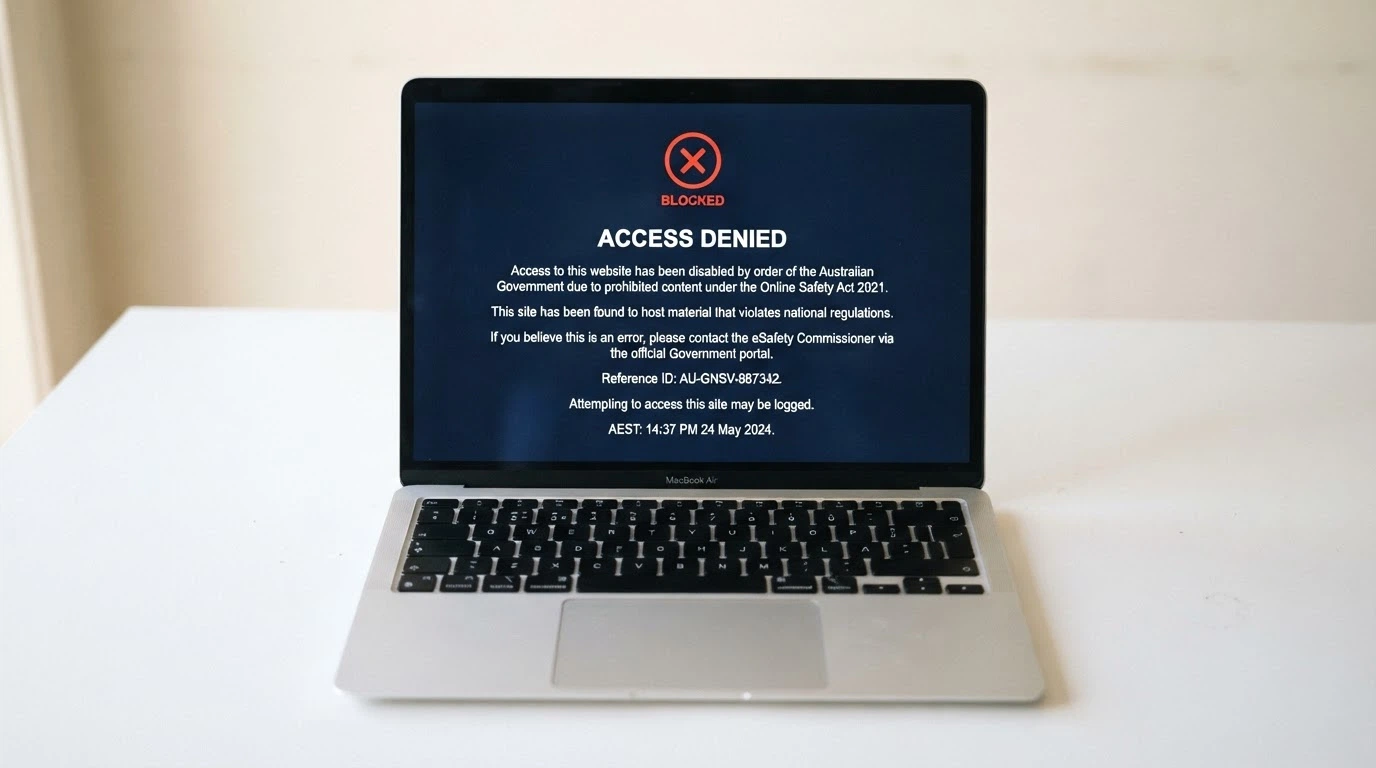
The comparison below makes the practical consequence visible. A licensed Australian wagering operator sits inside a framework of consumer protection, dispute resolution, and self-exclusion coverage. An offshore casino sits outside that framework entirely. The columns on the right are the protections a player gives up by depositing offshore; the columns on the left are what the same protections look like under Australian law.
| Protection | Licensed AU Wagering Operator | Offshore Casino (No AU Licence) |
|---|---|---|
| Australian consumer law recourse | Yes | No |
| ACMA complaint resolution | Yes | No |
| BetStop coverage | Yes | No |
| Credit card and crypto payments | Banned since 11 June 2024 | Often accepted — a signal of offshore status |
| Guaranteed payout of winnings | Yes, under licence conditions | No guarantee |
| Self-exclusion enforcement | Required across all AU wagering services | Not connected to BetStop |
| Federal penalty for operator breach | Yes, through ACMA | No AU regulator can act |
The IGA prohibition — no licence exists for online casino in Australia
The Interactive Gambling Act 2001 is the central fact. It makes it an offence for a provider to supply online casino games, online pokies, or in-play sports betting to a person physically in Australia. The offence is not a fine — it is a criminal provision, enforced by ACMA, with site-blocking powers added in 2017. There is no licence for online casino in Australia. Not federally, not in any state or territory. The product is prohibited at the source.

What IS licensed in Australia is wagering on races and sport placed before the event begins, lotteries, and keno. The Northern Territory Racing and Wagering Commission — administered through Licensing NT — is the de facto national licensor for online wagering, and the major Australian bookmakers hold NT licences running for terms of up to twenty years. Those operators offer sports and racing, not casino games. The licensed path is real, but it does not include online pokies.
The minimum age for any commercial gambling in Australia is 18. That applies whether the operator is licensed in Australia or operating offshore, but the offshore operator has no Australian regulator to enforce it.
The 2026 reforms — what changes on 1 January 2027
The Interactive Gambling Amendment (Gambling Reform) Bill 2026 passed Parliament on 19 August 2026 and its measures commence on 1 January 2027. The reforms are law with a start date. Three changes matter for any reader of this page. First, broadcast wagering advertising is capped at three ads per hour between 6:00 am and 8:30 pm, with a live-sport blackout running from fifteen minutes before to five minutes after live sporting events. Second, athletes, celebrities and influencers are barred from promoting wagering products. Third, banks and payment providers gain express authority to block transactions to illegal gambling operators. The transaction-blocking power is the reform most likely to reshape the offshore pokies experience — Australian banks may decline or reverse transfers to operators they identify as illegal gambling sites. The reforms target the licensed market — the advertising caps apply to Australian broadcasters, the influencer ban applies in Australia, the transaction-blocking power sits with Australian banks. Offshore pokies sites sit outside all three mechanisms directly.
What you lose when the operator answers to a Curaçao mailbox instead of Australian law
A licensed Australian wagering operator is bound by Australian consumer law, accountable to ACMA for compliance, and required to honour BetStop self-exclusions. An offshore casino is bound by whatever regime issued its operating permit — typically Curaçao — and accountable to no Australian authority. The player who deposits at an offshore site has no Australian consumer protection, no ACMA complaint resolution, no BetStop coverage, and no guaranteed recourse if the operator refuses a withdrawal.
The risk of site-blocking is the most visible consequence. ACMA has the power to request that Australian ISPs block access to illegal gambling sites, and the blocklist grows every quarter. A player whose funds are on balance with a site that gets blocked may lose access to the account through the Australian internet path — though the operator typically continues to operate through mirror domains and alternative URLs. The funds are not destroyed by a block; access is, which is a different and worse problem if the player cannot reach the cashier to withdraw.
The credit-card and crypto payment ban from 11 June 2024 is itself a signal. An Australian-licensed operator cannot accept those payment methods. An offshore casino that does accept them is, by definition, outside the framework the licensed alternative sits inside. The payment method is the tell.
ACMA enforcement — 1,564 sites blocked and counting
ACMA has had 1,564 illegal gambling and affiliate websites blocked by Australian ISPs since November 2019. More than 225 illegal services have withdrawn from the Australian market entirely since enforcement was strengthened in 2017. The scale of enforcement is real, but the market is fluid — operators circumvent blocks with mirror domains, new brands replace blocked ones, and the blocklist is a permanent game of catch-up rather than a definitive closure.
The practical effect for a $5-deposit player is mixed. ACMA enforcement makes the offshore space harder to find through Australian search results and harder to reach through Australian ISPs, but it does not eliminate the offshore market. The mirror domain is the most common workaround, and the most common experience of a player whose preferred site has been blocked is a brief interruption followed by a redirect to a new URL.
Gambling Safely When the House Doesn’t Answer to Australian Law
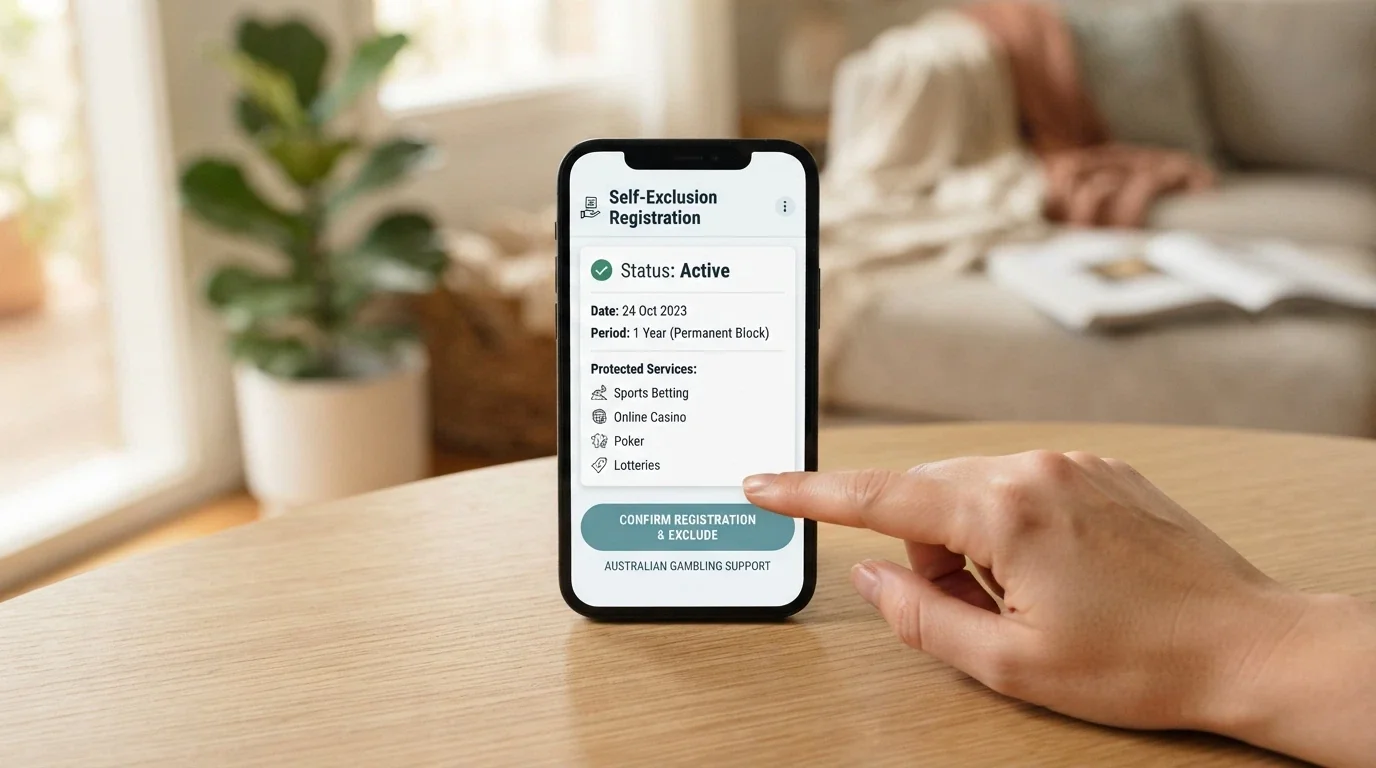
The responsible gambling infrastructure in Australia is built for licensed operators. BetStop covers every Australian-licensed wagering service and exactly zero offshore casinos. The National Gambling Helpline is staffed 24/7, free, confidential, and reachable on 1800 858 858. Gambling Help Online runs the chat and counselling service at gamblinghelponline.org.au. These are the tools an Australian player should use, regardless of where they choose to play — but they are designed to operate alongside the licensed market, and they cannot reach into the offshore space.
The harm data makes the case for these tools clearer than the marketing does. Roy Morgan’s March 2026 research found 15.1% of Australian adults — about 3.32 million people — were experiencing some level of gambling harm, either from their own gambling or from someone else’s. The same research found 13.0% of the population — 2,857,000 people — were experiencing harm from their own gambling. The Australian Institute of Health and Welfare estimated problem gambling at about 2.1% of adults — roughly 430,000 people — with high-risk gambling at 1.8% in 2022.
Only 8% to 15% of people experiencing gambling problems seek formal treatment. That figure is the single most important number on this page — it is the gap between the people who could use help and the people who actually reach it. A reader who recognises themselves in the harm prevalence data has a clear next step, and that next step costs nothing.
BetStop won’t protect you here — the self-exclusion gap every Australian should know
BetStop is the National Self-Exclusion Register. It launched on 21 August 2023, and to the end of Q3 FY 2025–2026, 59,830 people had registered. As of 31 March 2026, 37,247 people held active exclusions. BetStop binds every Australian-licensed wagering service — sports books, race bookmakers, keno and lottery operators. A person registered with BetStop cannot deposit, bet, or open a new account with any of those operators.
An offshore casino is not connected to BetStop. Self-exclusion from Australian-licensed wagering does not extend to offshore pokies sites, which are not within the register’s reach. A person who has registered with BetStop because gambling has stopped feeling like a choice can still deposit $5 at any of the operators in this comparison. The register covers the licensed market; the offshore market sits outside it. That gap is the one fact no competitor page covering $5 deposit pokies surfaces, and it is the one fact most worth a reader’s attention if gambling has become a concern.
Gambling harm in Australia — the numbers behind the low-deposit appeal
The marketing of a $5 deposit is built around safety. Five dollars feels like a controllable amount, a low ceiling on what could go wrong, a small commitment compared to a $50 or $100 first deposit. The harm data suggests a more complicated picture.
The 15.1% of Australian adults experiencing some level of gambling harm is the headline figure from Roy Morgan’s March 2026 research. Within that figure, 13.0% are experiencing harm from their own gambling — the rest are affected others, partners and family members whose lives are shaped by someone else’s play. NSW data from 2024 found 0.9% of adults in the high-risk category on the PGSI scale, 3.1% moderate-risk, and 6.7% low-risk, totalling 4.0% moderate- to high-risk. One in five NSW residents reported some form of gambling harm.
Gambling participation has risen from 57% in 2019 to 65% in 2024. The state-level leaders are Queensland at 70.2%, Western Australia at 69.6%, and South Australia at 67.9%. The rise in participation is not a rise in problem gambling, but it is a rise in the pool of Australians who are exposed to the risks the data describes. Even with a small deposit, these market realities and personal risks apply.
Where to get help — free, 24/7, confidential and Australian
- National Gambling Helpline: 1800 858 858 — free, confidential, 24/7, with online chat and counselling through Gambling Help Online at gamblinghelponline.org.au.
- BetStop — National Self-Exclusion Register — register at betstop.gov.au to exclude from every Australian-licensed wagering service. Offshore casinos are not connected; the register covers the licensed market.
- Gambling Help Online — self-assessment quiz, information, and online counselling at gamblinghelponline.org.au.
Only 13.5% of moderate-to-high-risk gamblers in NSW sought help. Only 8% to 15% of people experiencing gambling problems nationally seek formal treatment. Fewer than 8% of affected others contact a general practice for gambling-related concerns. The gap between the people who could use these services and the people who reach them is the most important gap on this page, and the 24/7 helpline is the first call to make.
How We Selected and Ranked These $5 Deposit Pokies Sites
The ranking above is ordered by Australian tracked-traffic market share from BLASK data, not by quality, bonus value, or feature comparison. The market-share figure is the most objective measure of how visible each operator is to Australian players; it does not speak to whether the operator is a good place to deposit.
Every operator in the comparison was checked against the Interactive Gambling Act 2001 framework administered by ACMA. None holds an Australian licence, because no such licence can exist for the product they offer. The licence-status column describes the offshore framework the operator sits inside — typically Curaçao — and the reader should treat that framework as a different regime from the Australian one, with different rules, different protections, and different enforcement.
Bonus terms, wagering multipliers, free-spin counts, and game-provider lists were not confirmed for any operator this round. The operator sweep queries that would have surfaced those figures could not be completed due to the research budget consumed by transport failures earlier in the run. The reader who needs to know what a specific operator offers on a $5 deposit must verify those terms on the operator’s own site — and should treat them with the same scepticism this page applies to every figure on it.
The ranking does not synthesise qualitative judgements into a composite score. No weighting has been applied to bonus generosity, payout speed, game-library size, or player-experience reports. The market-share ordering is the ordering; everything else in each operator’s write-up is what could be verified independently of the sweep, and what could not be verified is marked as such.
What to Actually Do With Your $5 — and What to Do Instead
The verdict on a $5 deposit at an offshore pokies site is the same as the verdict on a $50 deposit at the same site. The deposit size changes the financial exposure; it does not change the legal status, the consumer-protection gap, the absence of BetStop coverage, or the offshore jurisdiction. A $5 deposit is the cheapest way to find out what these sites look like, and it is also the cheapest way to lose money at them — the same house edge applies, the same wagering requirements apply, and the same withdrawal risks apply.
The case for depositing $5 anyway is the case for any offshore casino: the player has decided the game’s appeal outweighs the legal and consumer-protection gaps, and a $5 deposit caps the absolute loss on a single session. That is a legitimate decision, but it should be made with eyes open. The site is offshore. The licence is not Australian. The payment method that does not break Australian rules is the one that also takes longer to move money. The withdrawal is not guaranteed by any Australian regulator. ACMA can block the site. BetStop will not protect the player if gambling stops feeling like a choice.
The stronger case is the one that does not involve an offshore casino at all. The licensed Australian wagering market offers sports and racing through NT-licensed operators, and that market sits inside a framework of consumer protection, dispute resolution, and self-exclusion coverage the offshore space cannot match. The licensed alternative is not online pokies — that product is banned — but it is a regulated path for an Australian who wants to place a wager without giving up the protections Australian law provides.
If gambling has stopped feeling like a choice — if a $5 deposit is no longer entertainment money but money that should have gone elsewhere — the next call is 1800 858 858. The National Gambling Helpline is free, confidential, and staffed 24 hours a day, seven days a week. The number works from any Australian phone. Save it before depositing a single dollar at any site in this comparison, and call it if the question of whether to keep playing has become a question that needs answering.
Frequently Asked Questions
Is it legal to play $5 deposit pokies in Australia?
The Interactive Gambling Act 2001 makes it an offence to provide online pokies to Australians, so every site accepting your $5 is offshore and unlicensed in Australia. The individual player is not prosecuted — the Act targets the provider — but no Australian consumer protection, no ACMA complaint resolution and no BetStop coverage apply to offshore pokies. The product is prohibited; the player is not.
Can I get a welcome bonus with a $5 minimum deposit?
Most offshore pokies sites advertise a welcome offer that activates on a first deposit, and the minimum deposit to unlock the bonus is often the headline minimum — though not always. Wagering requirements, maximum cashout caps and validity windows shape the offer’s real value, and those terms were not verified for any operator in this comparison. Read the operator’s promotions page before funding.
What is the minimum deposit for online pokies in Australia?
There is no Australian-licensed minimum because online pokies are prohibited in Australia. Offshore operators set their own minimums, and $5 is a marketing figure rather than a market constant. The cashier page is the source of truth — not every site that advertises $5 actually accepts $5, and some sites gate the welcome bonus above the deposit minimum.
Does BetStop cover offshore pokies sites that accept $5 deposits?
No. BetStop, the National Self-Exclusion Register, binds Australian-licensed wagering services only. Offshore pokies sites are not connected to the register and will keep accepting deposits from a self-excluded person. The register is one of the strongest protections in the Australian framework, and it stops at the licensed border.
What happens if an offshore casino refuses my withdrawal after a $5 deposit?
The offshore casino is not bound by Australian consumer law, ACMA cannot act on the player’s behalf, and the Curaçao regulator the operator sits under has a limited enforcement record for individual withdrawal disputes. The practical recourse is the payment method used — a chargeback through the bank or card issuer is sometimes possible, but not guaranteed. The risk of a refused withdrawal is the single clearest reason to prefer a licensed operator wherever the licensed alternative exists.