
Australia’s “Newest” Online Casinos Are Offshore — The Reality in 2026
Verified against ACMA, the Interactive Gambling Act 2001, and the National Self-Exclusion Register as of 16 October 2026.
The phrase “newest online casino no deposit bonus” sounds like an open door to something fresh — a recently launched site, a generous offer, a chance to play before paying. For an Australian player in 2026, that door opens onto the same room it has opened onto for years. Every online casino that accepts Australian players is offshore, unlicensed, and outside Australian law. The word “newest” does not change any of that. The phrase “no deposit bonus” does not change any of that either — it just describes the bait.

This page works through what that means in practice: the legal position, the maths behind a no-deposit offer, the pokies most of those bonuses are locked to, the deposit routes, the protection gap, and what an Australian player actually keeps if they win. It also names the ten offshore brands that hold real Australian traffic share, because the choice facing readers is not between licensed and unlicensed — it is between unlicensed operators with verified complaints against them and unlicensed operators with fresh domain names.
The conclusion in one line: the bonus is a marketing cost, not a gift, and the offshore operator is a counterparty, not a regulated service. Both points are worked out below.
Table of Contents
- Australia’s Newest Online Casinos Aren’t Licensed — Here’s What That Means
- New Casino, Same Offshore Reality: What “Just Launched” Means for Australians
- Why Your No-Deposit Bonus Costs More Than It Gives
- The Pokies Behind the Bonus: What You’re Really Playing
- PayID Won’t Protect You: How Deposits Reach Offshore Casinos
- Mobile Casinos: The Same Sites, Just in Your Pocket
- Real Money, Real Risk: Playing for AUD at Unlicensed Casinos
- The Law: Why No Licensed Online Casino Exists in Australia
- Responsible Gambling When the Safety Net Has a Hole
- How We Evaluated These Casinos
- Your Move: What to Do About No-Deposit Casino Bonuses in Australia
- Frequently Asked Questions
Australia’s Newest Online Casinos Aren’t Licensed — Here’s What That Means
A search for “newest online casinos no deposit bonus Australia” returns a familiar shape: listicle pages, comparison tables, banner ads for free spins and free chips, and a small handful of “honest review” sites that still treat Australian casino play as if it were a licensed market. The pages look interchangeable. The casino names rotate. The bonus structures repeat. Underneath that churn, the legal position has not moved since the Interactive Gambling Act 2001 made online casino an offence for the provider, and a 2017 amendment closed the loopholes that had let offshore operators route around it.
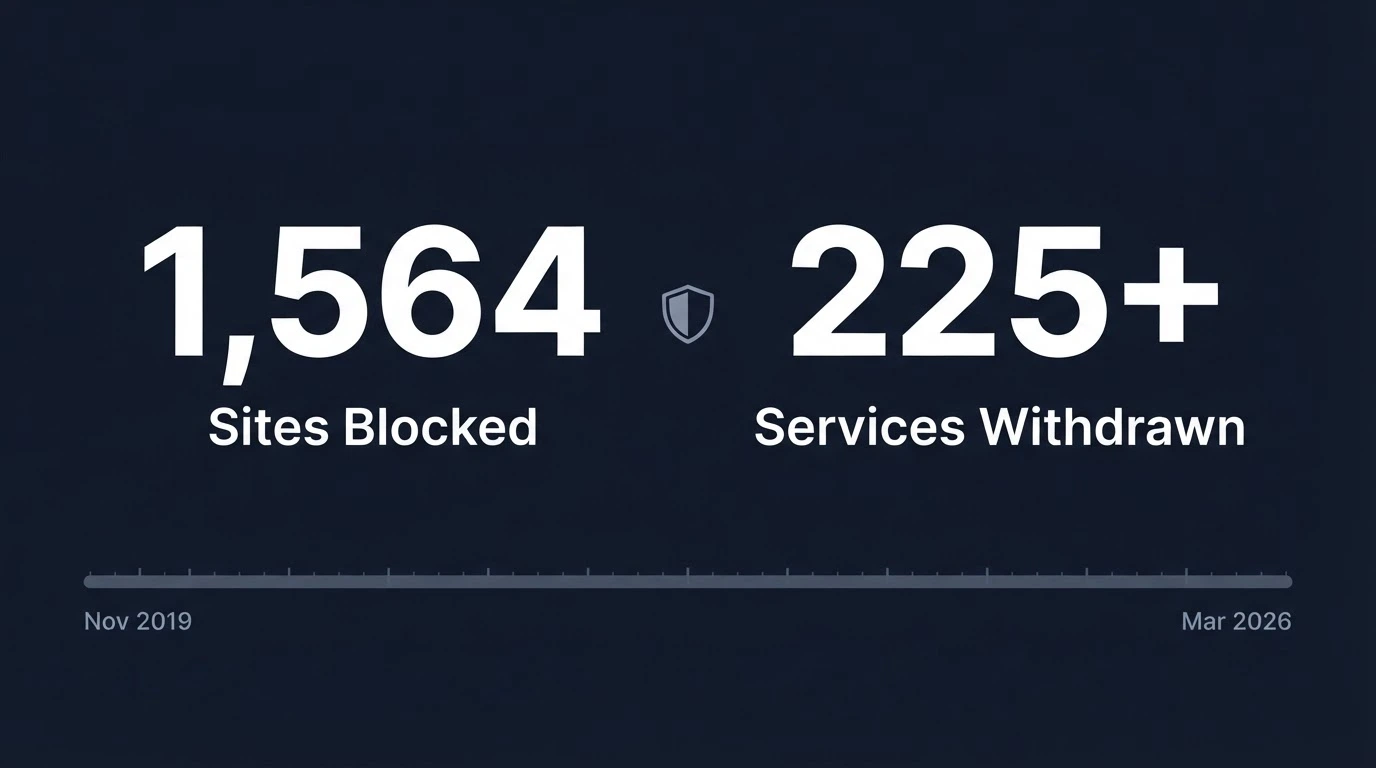
There is no licence for online casino anywhere in Australia. Not federally, not in any state or territory. The Australian Communications and Media Authority does not maintain a whitelist of licensed online casinos, because there is no such category. ACMA maintains a blocklist of illegal sites — the number stood at 1,564 websites blocked since November 2019 as of March 2026, and 225-plus services have withdrawn from the Australian market since 2017. Those figures measure the size of the offshore flood. They do not describe a licensed industry underneath it.
So the operators an Australian reaches through a search for the “newest” are not new in any meaningful regulatory sense. They are new domain names running the same offshore business model that has targeted Australia for two decades. The launch date changes the marketing page; it does not change the licence status, the dispute resolution, the deposit protection, or the self-exclusion coverage. None of those exist for the offshore product.
The Offshore-Only Reality for Australian Players
The Interactive Gambling Act 2001 makes it an offence to provide online casino games, online pokies, or in-play sports betting to a person physically in Australia. The offence is on the provider, not the player — Australians are not prosecuted for opening an account, depositing money, or playing pokies at an offshore site. But the legal position of the player is thin in a way that matters. There is no Australian consumer protection framework that reaches an offshore casino. There is no ACMA complaint resolution for money recovery. There is no Australian Dispute Resolution scheme binding the operator. There is no statutory guarantee that a withdrawal will be honoured. There is no deposit insurance. There is no self-exclusion coverage.
What is licensed is a different product: wagering on races and sport placed before the event starts (licensed by state and territory regulators, predominantly via the Northern Territory Racing and Wagering Commission and Licensing NT), lotteries and keno, and land-based casinos. None of those licences extend to an offshore casino website. The wagering licence a brand might display in its footer is a wagering licence; it does not cover the casino product. The two are different product categories under Australian law, and conflating them is the marketing move that makes an offshore casino look safer than it is.
Practically, “offshore” means the operator is incorporated outside Australia, holds whatever licence its home jurisdiction issues (commonly Curaçao, sometimes Malta, occasionally Kahnawake), and is reachable from Australia only because Australian internet service providers have not yet been ordered to block it. ACMA can and does issue such blocking orders, but a block applies to a specific URL — the operator simply registers a new domain, re-uploads the site, and the player reaches it again. The 1,564 blocked sites are not a wall; they are a sluice gate with new water flowing past it every week.
What “Newest” Actually Delivers: More of the Same Risk
The “newest” modifier in a search query is a freshness signal the offshore market is happy to sell. New domains cost a few dollars. A new skin over an old platform costs an afternoon. The same operator that ran Caswino Australia in can launch Caswino-2, Caswino-AU, Caswino-Reels in 2026 and present each as a “newly launched” casino to a searcher who has never heard of any of them.
That churning is the point. Five minutes on Reddit, Trustpilot or Quora reading about online casinos in Australia returns a recognisable shape of complaint: a player deposited, played, met the wagering requirements, requested a withdrawal, and was met with an account review that ran past the bonus validity window — at which point the bonus and the winnings were voided. Or a player won on a no-deposit bonus, hit the max cashout, and was told the verification deposit required to enable withdrawal was non-refundable. Or the player self-excluded via BetStop, then found that none of the offshore casinos they had been using honoured the exclusion — because BetStop is a register of licensed Australian wagering providers, and an offshore casino is not on it.
Those stories are not edge cases. They are the recurring shape of a market where the operator holds every advantage and the player holds almost none. The newness of the domain does not change the contract.
New Casino, Same Offshore Reality: What “Just Launched” Means for Australians
“Just launched” is the affiliate-listicle phrase of choice for offshore casinos entering the Australian market. It implies a fresh product, a fresh team, fresh terms, fresh reliability. What it almost always signals is a fresh domain running an existing platform under a new name.
The launch claims themselves are hard to verify. Some operators carry an “established” date in their footer that predates the domain registration. Some list a year that does not match corporate filings in any public registry. Some operate without any corporate disclosure at all — the only “about” page is a sentence about the platform provider and a licensing badge from a regulator that has no enforcement reach into Australia. The reader cannot check the launch claim without tools that a reader does not typically have. That asymmetry is itself part of the marketing.
Casino Sites vs Casino Operators: What the Difference Means
A single offshore operator commonly runs several casino sites at once. The sites share a platform (Realtime Gaming is the dominant supplier in this market), share a cashier, share a back office, and often share a bonus structure with minor naming changes. The site the reader reaches today may be one of three, six, or a dozen sibling sites operated by the same company under different brand names. The newest site is the freshest skin; the operator behind it is the same counterparty the reader might already have an account with under a different label.
This is the white-label model, and it is how most AU-facing offshore casinos are structured. The operator licenses a platform, builds a brand on top of it, and acquires players through affiliate traffic. When one brand accumulates complaints, the operator simply launches a new one. When ACMA blocks one domain, the operator parks the player base at another. The site-level newness is real, but it is the kind of newness that exists precisely to outrun the consequences of being old.
Identifying the underlying operator requires looking at the platform provider’s client list, the corporate filings in the operator’s home jurisdiction, the cashier’s payment processor identifiers, and the player terms cross-referenced against other sites. None of that is visible from the homepage. For the Australian player, the practical upshot is that a brand-name check on a comparison site does not constitute due diligence on the counterparty — it only checks the brand.
Why Your No-Deposit Bonus Costs More Than It Gives
No-deposit bonuses at offshore casinos come in three rough shapes — free spins on a named pokie, free chip or free credit added to a new account, and a sign-up “bonus” that turns out to require a verification deposit. Each shape carries the same underlying structure: the bonus is small, the wagering requirement is heavy, the cashout ceiling is tight, and the time window is short. The expected-loss arithmetic makes the bonus net-negative for most players most of the time. The arithmetic is the marketing’s worst enemy, which is why it does not appear on the offer page.

The ten operators below hold the largest AU player share for casino products in the market data available to this analysis. Every one of them is offshore, and every one of them sits outside Australian law. The market-share ranking is traffic data only — it does not indicate licensing, safety, or fairness, and it does not earn any operator a recommendation. The column “Licence Status” is the same for every row, because there is no row it could differ in.
| Operator | Licence Status |
|---|---|
| Rocket Play | Offshore — no AU licence |
| Skycrown | Offshore — no AU licence |
| Royal Reels | Offshore — no AU licence |
| WinSpirit | Offshore — no AU licence |
| Stake | Offshore — no AU licence |
| Rainbet | Offshore — no AU licence |
| Scream Casino | Offshore — no AU licence |
| FairGO | Offshore — no AU licence |
| Bizzo Casino | Offshore — no AU licence |
| Rocket Casino | Offshore — no AU licence |
The repetition is the message: there is no licensed alternative to be lost in the ranking. AU players searching for “newest” land on offshore sites because that is the only category that exists for the product they want to buy.
How No-Deposit Bonuses Actually Work at Offshore Casinos
The mechanics of a no-deposit bonus run through a fixed chain. First, account creation: name, email, password, sometimes a phone number. Second, account verification: email confirmation, sometimes SMS confirmation, sometimes document upload — the document upload is often the moment the no-deposit becomes a “verification deposit,” because the operator refuses to credit the bonus until a small deposit has been made and reversed or processed. Third, bonus credit: the free spins are activated, the free chip lands in the balance, the bonus appears as playable cash with terms attached. Fourth, playthrough: every spin or chip-bet counts toward the wagering requirement, with eligible games restricted and excluded games listing the popular high-RTP titles the operator does not want players using the bonus on. Fifth, withdrawal request: a max-cashout cap is applied, KYC documentation is requested again, a withdrawal review begins, and the player waits to find out whether the operator will pay.
Each step has a failure mode that benefits the operator. Account verification can stall. Eligible games can be restricted to a handful of low-RTP slots. Wagering contributions can be 100% on slots and 0% on table games. The withdrawal review can stretch past the bonus validity window, at which point the operator voids the bonus and the winnings. None of these failure modes is hidden — they sit in the terms and conditions. They are simply out of view of a player who has been told the bonus is free.
The table below summarises the three offer shapes and the typical terms attached to each in the AU-facing offshore market. The wagering range, the cashout range, and the validity window are where the offer’s real cost lives.
| Offer Type | Wagering Range | Max Cashout Range | Typical Validity |
|---|---|---|---|
| Free spins | 40x–60x on winnings | A$50–A$150 | 24–72 hours |
| Free chip / free credit | 25x–50x | A$50–A$150 | 48–72 hours |
| Sign-up bonus | 40x–60x | A$50–A$150 | 24–72 hours |
The wagering range is the multiplier applied to winnings from the bonus — a 50x multiple on a A$10 win means A$500 of turnover before a cent can be withdrawn. The cashout ceiling is the maximum amount the operator will pay out from the bonus, regardless of how much the player wins. The validity window is the time the player has to clear the wagering requirement before the bonus expires. Each of those numbers works against the player.
Wagering Requirements: The 40x–60x Wall
A wagering requirement — also called a playthrough requirement or turnover requirement — is the operator’s instruction that the bonus winnings must be re-bet a stated number of times before they can be withdrawn. A 50x wagering requirement on a A$10 win means A$500 of slot turnover. The win itself is A$10. The amount the player has to put through the casino’s games before the A$10 becomes withdrawable is fifty times larger than the win.
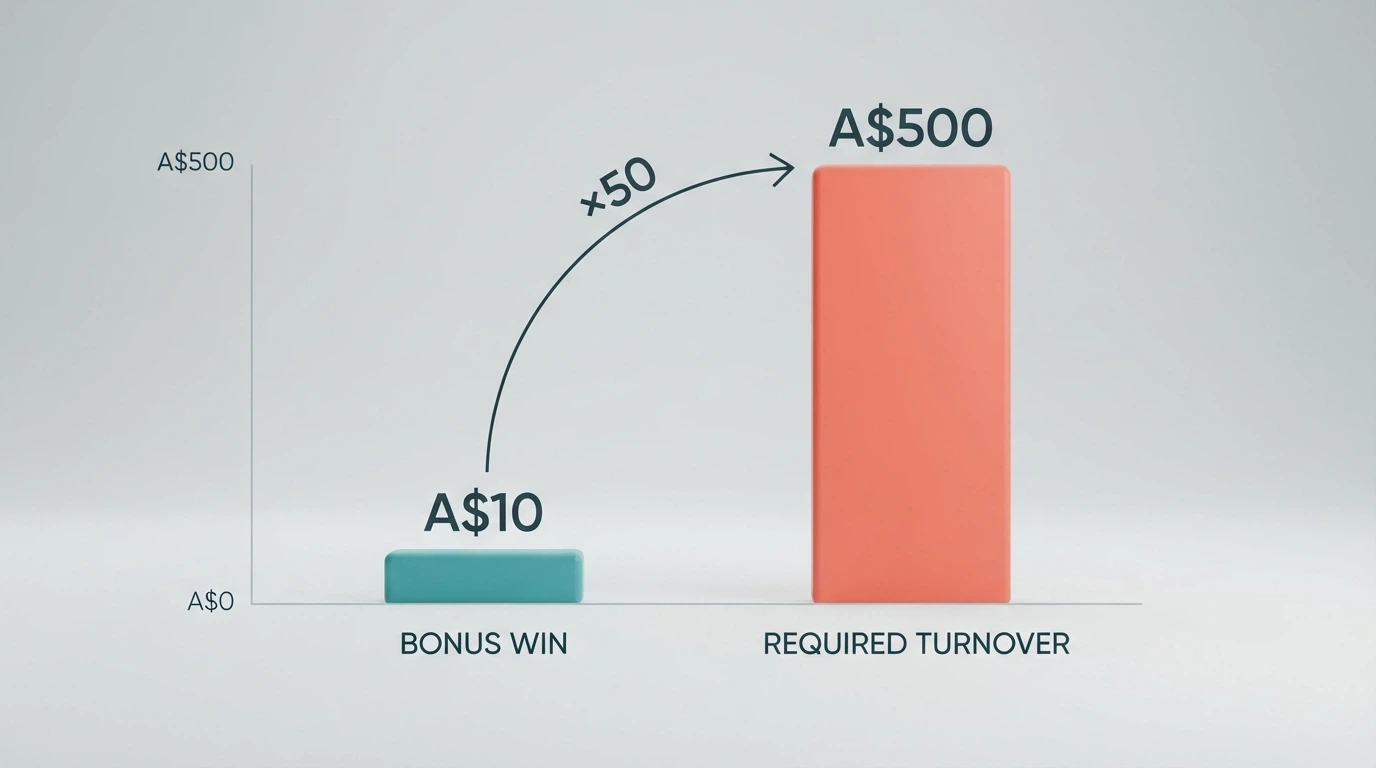
The industry standard in the AU-facing offshore market sits at 50x, with a range from 40x at the lenient end to 60x at the strict end. To put that in perspective: a “gift” of 20 free spins carrying a 40x–60x playthrough on any winnings means a player who wins A$10 from those spins may have to wager A$400 to A$600 before they can withdraw a cent. Most players do not clear that wall. The bonus expires first, or the bankroll runs out first, or the player simply does not realise how steep the requirement is until the withdrawal button is greyed out and the support agent explains.
A 50x multiple is not unusual for no-deposit offers. It is also not generous — it is the standard rate that operators have settled on as the level that maximises the chance the player loses the bonus before clearing it. The wagering multiple is the price of admission to the withdrawal queue, and the queue itself has another gate.
Cashout Caps: The Fine Print That Shrinks Your Win
The max-cashout cap is the second gate. Most no-deposit bonuses in the AU-facing offshore market cap withdrawals at A$50 to A$150, regardless of how much the player wins. A player who runs a A$10 bonus to a A$300 balance, clears the wagering requirement, and requests withdrawal will be paid A$100 — and the remaining A$200 will be voided. The terms typically describe this as a “maximum withdrawal from no-deposit bonuses” or a “cashout limit.”
The cap is what makes the wagering wall pointlessly steep in most cases. A player who wins A$100 from a no-deposit bonus cannot withdraw more than A$100 anyway, so the 50x wagering requirement on that A$100 — A$5,000 of turnover — exists less to protect the operator from a large payout and more to ensure most players never reach the cap at all. The wall and the cap work together: the wall filters out players who would have won a small amount and stopped, and the cap ensures the player who does clear the wall cannot walk away with more than a small amount.
The headline on the offer page is the size of the bonus — “A$100 no deposit bonus” or “100 free spins” — not the cap. The cap lives in the terms. The terms are reached by scrolling past the bonus banner, past the deposit buttons, past the cashier, into the small print that the offer page is designed to make the player skip.
Free Spins, Free Chips and Sign-Up Credit: The Offer Landscape
Free spins are the most common shape. The offer names a count (20, 30, 50, 100) and a spin value (usually A$0.10 to A$0.25), and locks the spins to a single pokie or a short list of pokies. Wagering requirements apply to winnings, not to the bonus value itself. A 20-free-spin offer at A$0.25 per spin is worth a maximum A$5 in playable value, but the actual value to the player is the winnings after the spin cost has been recovered. Caswino awards 20 free spins on account verification, with 50x wagering and a 24-hour validity window. Slots Gallery offers 30x wagering on free-spins winnings with a 72-hour window. Both are real offers from operators in the AU-facing market, and both illustrate how steep the terms can be even before the cashout cap is applied.
Free chips and free credit are the second shape. The offer credits a fixed AUD amount to the new account — typically in the A$10 to A$50 range — with a wagering requirement applied to the bonus or to the bonus plus deposit. Aus96 credits A$23 in free credit for new accounts, with a wagering range of 25x to 50x. The free credit is the closer cousin to a deposit bonus; the no-deposit label is the only thing that distinguishes them, and the label disappears when the verification deposit arrives.
Sign-up bonuses are the third shape, and the most loosely defined. Some are genuinely no-deposit — credit on registration, no payment method required. Most are not. The “sign-up bonus” headline often conceals a verification deposit of A$10 to A$20 that the operator will not credit the bonus without. The deposit is small, the payment method is now on file, and the player has moved from “no deposit” to “deposit” without the headline changing. From that point forward, the player is on a deposit-bonus track — wagering requirements, game restrictions, max-cashout caps — with the verification deposit as the entry ticket.
Each shape has the same economic structure: a small headline number, a heavy multiplier, a tight cashout ceiling, a short window. The arithmetic does not care which shape the offer takes.
What a A$23 No-Deposit Bonus Actually Costs
Take the Aus96 free-credit offer as the worked example, because it is concrete and the terms are public. A new account receives A$23 in free credit with a 25x–50x wagering requirement. The industry standard is 50x, so the player is looking at A$23 multiplied by 50, which is A$1,150 in required turnover before any winnings become withdrawable. The bonus is typically locked to a single pokie or a short list, and the most common target in the AU-facing market is Oz Golden Trail, which carries an RTP of 95%. At 95% RTP, every A$100 returned to the player costs the bonus pool A$100 minus the house edge of 5%. Across A$1,150 of turnover, the expected house take is A$57.50.
So the arithmetic is this: a no-deposit bonus labelled A$23 carries an expected cost to the player of about A$57.50 to clear. The player is paying more than twice the headline bonus amount on average before the wagering requirement is met. If the player also hits the max-cashout cap — typically A$50 to A$150 for no-deposit offers — then any winnings above the cap are voided, and the player’s expected loss remains in the same range whether the underlying luck is good or bad. The bonus is “free” the way a gym membership with a A$50 joining fee, a A$200 cancellation fee, and a two-year lock-in is “free”: the headline is the entry, the contract is the cost.
That cost is a statistical estimate across many spins under the stated assumptions. It is not a guaranteed loss for any individual player — a single player can win, can lose less than the expected amount, can clear the requirement and hit the cashout cap. But across all players who claim the bonus, A$57.50 per A$23 credited is the average cost. That is what the operator has priced into the offer, and that is what the terms are designed to deliver.
The Ten Operators Holding AU Casino Traffic
The list below names the ten brands with the largest AU player share in the available market data. They are presented in ranked order. None of them holds an Australian online casino licence — none can, because no such licence exists. The descriptions below are written from market positioning only; specific bonus terms, game providers, and per-operator data could not be verified on a live search sweep during this analysis, so no wagering multiple, RTP, payout time, or bonus structure is stated at the brand level. Where the market share is large enough to comment on, the comment is qualitative.
Rocket Play
Rocket Play is one of the larger AU-facing offshore brands in the available traffic data, with a position built on a wide pokie catalogue and a steady cadence of reload-style promotions aimed at returning players. The casino runs on a familiar RTG-style platform, and the marketing leans on the breadth of its game library more than on the generosity of its headline bonus. For an Australian player weighing it against the rest of the offshore field, the brand’s distinguishing feature is its familiarity — it is the kind of operator a returning AU punter has heard of and can describe in a sentence. That familiarity is not a licence, and it does not change the offshore status, but it does mean the operator’s complaints history is searchable in a way that a freshly minted domain’s is not. The verdict: known quantity, same offshore contract as the rest of the field.
Skycrown
Skycrown sits high in the AU-facing offshore rankings on the strength of a polished site presentation and a broad payment-method list that includes the methods an Australian player expects to see — debit cards, e-wallets, and crypto. The casino positions itself as a premium brand within the offshore tier, with a design language closer to a European-licensed operator than to a basic RTG skin. The polish is real. The offshore status is the same. A player who chooses Skycrown over a less polished operator is choosing a presentation difference, not a regulatory one. The verdict: the better-looking offshore option is still offshore.
Royal Reels
Royal Reels targets the AU market directly — AUD in the cashier, AU-friendly payment methods, and a “reels” branding that sits closer to the Australian vernacular than the international vocabulary most offshore casinos default to. The market position is a comfortable middle of the offshore ranking: large enough to have an established complaints footprint on affiliate review sites and consumer forums, not so large that the complaints are concentrated in a single recurring failure mode. The AU-facing branding reads as intent rather than as licensing, and the player should read it the same way. The verdict: AU-tailored does not mean AU-licensed.
WinSpirit
WinSpirit runs a smaller AU footprint than the operators higher in the ranking, with a market position that leans on a more aggressive promotional cadence — frequent reload bonuses, free-spin drops, and tournament entries that keep the AU-facing affiliate pages supplied with content. The bonus density is a feature for the operator’s marketing funnel and a hazard for the player: every additional promotion is another set of terms to read, another wagering requirement to weigh, another max-cashout ceiling to factor in. The denser the promotion calendar, the more time the player will spend inside the bonus structure and the less time outside it. The verdict: high promotion density is a marketing asset for the operator, not a player advantage.
Stake
Stake is the largest operator by raw traffic in many international rankings and holds a meaningful AU share despite not targeting Australia directly. Its market position is built on a sportsbook-and-casino hybrid model with a heavy emphasis on crypto and on a brand that has invested heavily in sponsorship and affiliate reach. The crypto angle is worth flagging: from 11 June 2024, credit cards and digital currency are banned as payment for online wagering in Australia. Crypto deposits from an Australian bank to an offshore casino remain technically possible, but the operator and the player are operating outside the spirit of the credit-and-crypto ban that the Australian Parliament wrote into law for licensed wagering. The verdict: a global brand with a global offshore footprint — the AU market is one of many, not a regulated home.
Rainbet
Rainbet is a smaller AU-facing brand, with a market position that has historically appealed to the crypto-native end of the player base and a site presentation that reflects that. The game library tends toward the narrower end of the AU offshore market, and the promotional calendar is lighter than the operators higher in the ranking. The thinner offering reads as a less polished product, but the smaller scale also means a smaller complaint footprint on forums and review sites. Neither characteristic is a regulatory one. The verdict: smaller offshore brands carry less complaint surface, but they also carry less recourse when something goes wrong.
Scream Casino
Scream Casino markets itself with a louder brand identity than most AU-facing offshore operators — themed promotions, a heavier use of bonus codes in the affiliate space, and a player-acquisition style aimed at the slots-only audience. The market position is mid-tier, with enough AU traffic to surface in the rankings but not enough to dominate the consumer-comparison discussions. The louder branding is a marketing decision, not a regulatory one, and a louder bonus page does not move the offshore status. The verdict: themed branding is a presentation choice; the underlying licence gap is unchanged.
FairGO
FairGO has one of the longer histories of any AU-facing offshore brand in the rankings, with a market position built on a RTG-only game catalogue and a deliberate AU-tailoring that runs deeper than the average offshore operator — AUD throughout, AU-friendly support hours, and a long-running affiliate presence aimed at the Australian searcher. The longevity is worth noting: FairGO is the operator a returning AU player has most likely already tried at some point, which means its complaints history is more searchable than a fresh brand’s. The verdict: the longest-running AU-facing offshore brand in the ranking is still outside Australian law.
Bizzo Casino
Bizzo Casino holds a strong international footprint and a meaningful AU share within it, with a market position built on a wide game catalogue and a fast payout cadence that the operator’s marketing emphasises heavily. The payout-speed pitch is real to the extent that the operator can be measured against itself, but the comparison to a licensed Australian wagering operator is not symmetrical — the licensed operator pays out under Australian consumer law and an external dispute resolution scheme; Bizzo pays out on its own terms. The verdict: a payout speed advantage within the offshore tier is a marketing line, not a regulatory one.
Rocket Casino
Rocket Casino rounds out the ranking with a smaller AU footprint than the operators above it, with a market position that overlaps Rocket Play’s at the brand level but operates as a separate site. The shared “Rocket” naming is the kind of coincidence that the white-label model produces routinely — two brands, two sites, potentially the same operator behind the platform, potentially not. Without verified corporate data, the player cannot tell. The smaller AU footprint means a thinner complaints trail and a thinner recourse trail. The verdict: a smaller AU share means a thinner player-protection footprint on both sides.
The Pokies Behind the Bonus: What You’re Really Playing
No-deposit bonuses are almost always locked to specific pokies, and the eligible-game list is part of the offer’s cost rather than part of its value. The most common target in the AU-facing offshore market is Realtime Gaming’s catalogue — a single platform provider that dominates the offshore space and ships the same titles into dozens of brand skins. The bonus page reads as a choice of pokies; it is actually a single supplier, configured per operator.
Pokies vs Slots: What Australians Call the Games
“Pokies” is the Australian term for what the international market calls slot machines or slots. The games themselves are the same — spinning reels, paylines, bonus features, random outcomes — but the vocabulary signals which sites are built for an Australian audience. An AU-facing casino uses “pokies” in its marketing because the reader expects the word. A European-licensed operator will use “slots” because the European reader expects that. The terminology does not change the maths. It does change who feels at home.
The AU vernacular is wider than that. “Punter” rather than “player.” “TAB” rather than “betting shop.” “Multi” rather than “accumulator.” “Free chip” rather than “no-deposit bonus.” An Australian player reading an offshore casino’s site will recognise the localised vocabulary and assume, sometimes unconsciously, that the localisation includes the regulation. It does not. A site that calls a game a pokie is still an offshore site.
RTG and the Australian Pokies Ecosystem
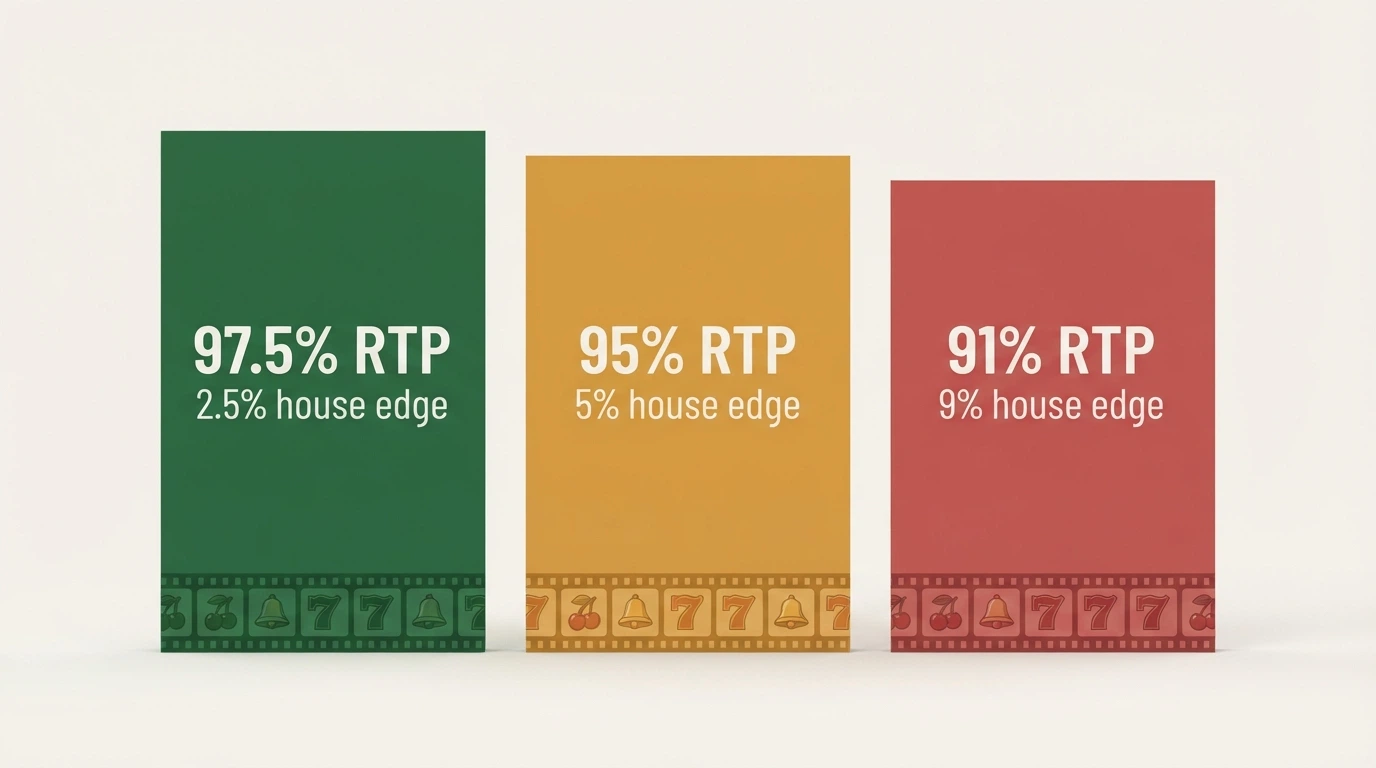
Realtime Gaming — RTG — is the platform provider behind the majority of AU-facing offshore casinos. The provider ships a catalogue of branded titles, a back-office system, a cashier module, and a bonus engine, and the operator configures the lot under its own brand name. RTG’s flexibility on game configuration is the reason the same pokie title can return different RTP percentages at different casinos. RTG offers a configurable RTP range, typically falling between 91% and 97%, and the operator chooses where on that range each title sits.
That configurability matters at the bonus level because the operator can target the high end of the range on its marquee titles and the low end on the bonus-eligible titles. A player who lands on a bonus-locked pokie running at 91% RTP is losing A$9 for every A$100 put through the game. A player who lands on the same title at a different operator running 97% RTP is losing only A$3 for every A$100. The pokie looks the same. The house edge is nearly three times larger.
Cash Bandits 2 is the clearest illustration of this configurability. The title ships with selectable RTP settings of 97.5%, 95% and 91%, and the operator chooses which one the player sees. Cash Bandits 3 sits at around 95.8%, classified as medium-to-high volatility. Fortunate Zeus is a 96.0% RTP, medium-volatility title with a max win of up to 50,000 times the stake and 50 fixed paylines. Fú Lóng Treasures runs 25 fixed paylines with bets from A$0.25 to A$25 per line and a maximum win of 50,000 times the bet per line. Oz Golden Trail, released in November 2025, sits at 95% RTP with medium volatility and a 50,000-times max win. Each of these is an RTG title running on an AU-facing offshore casino’s bonus-eligible list.
RTP and Volatility: The Numbers That Determine What You Keep
RTP — return to player — is the long-run percentage of turnover that a pokie returns to the player as winnings. A 95% RTP title returns A$95 for every A$100 put through it, on average, across enough spins for the percentage to mean something. A 97.5% RTP title returns A$97.50 for the same turnover. A 91% RTP title returns only A$91.
The arithmetic behind the no-deposit bonus uses this number directly. Required turnover times one minus RTP gives expected loss. At 50x wagering on a A$23 bonus, the turnover is A$1,150. At 97.5% RTP, the expected loss is A$28.75. At 95% RTP, it is A$57.50. At 91% RTP, it is A$103.50. The same bonus, the same wagering requirement, the same headline number — but the cost to the player varies by a factor of more than three depending on which end of RTG’s configurable range the operator has selected for the bonus-eligible pokie.
Volatility is the second number that determines what the player keeps. A high-volatility title pays out rarely and in larger chunks. A low-volatility title pays out often and in smaller chunks. The expected loss is the same in dollar terms if the RTP is the same, but the bankroll experience is wildly different — a high-volatility title will eat a small bankroll in long dry spells before paying, while a low-volatility title will keep the balance ticking over with small wins. For a no-deposit bonus with a short validity window, low volatility is generally the friendlier setting. For a player’s entertainment time on a deposit balance, the choice is a personal one.
Cash Bandits 2 at its high-volatility, 97.5% RTP setting is the friendliest RTG configuration. Oz Golden Trail at 95% RTP, medium volatility, is closer to the market average. Cash Bandits 3 at 95.8% sits between them. The player does not pick the configuration. The operator does. The bonus-eligible list is where the operator’s choice lives.
PayID Won’t Protect You: How Deposits Reach Offshore Casinos
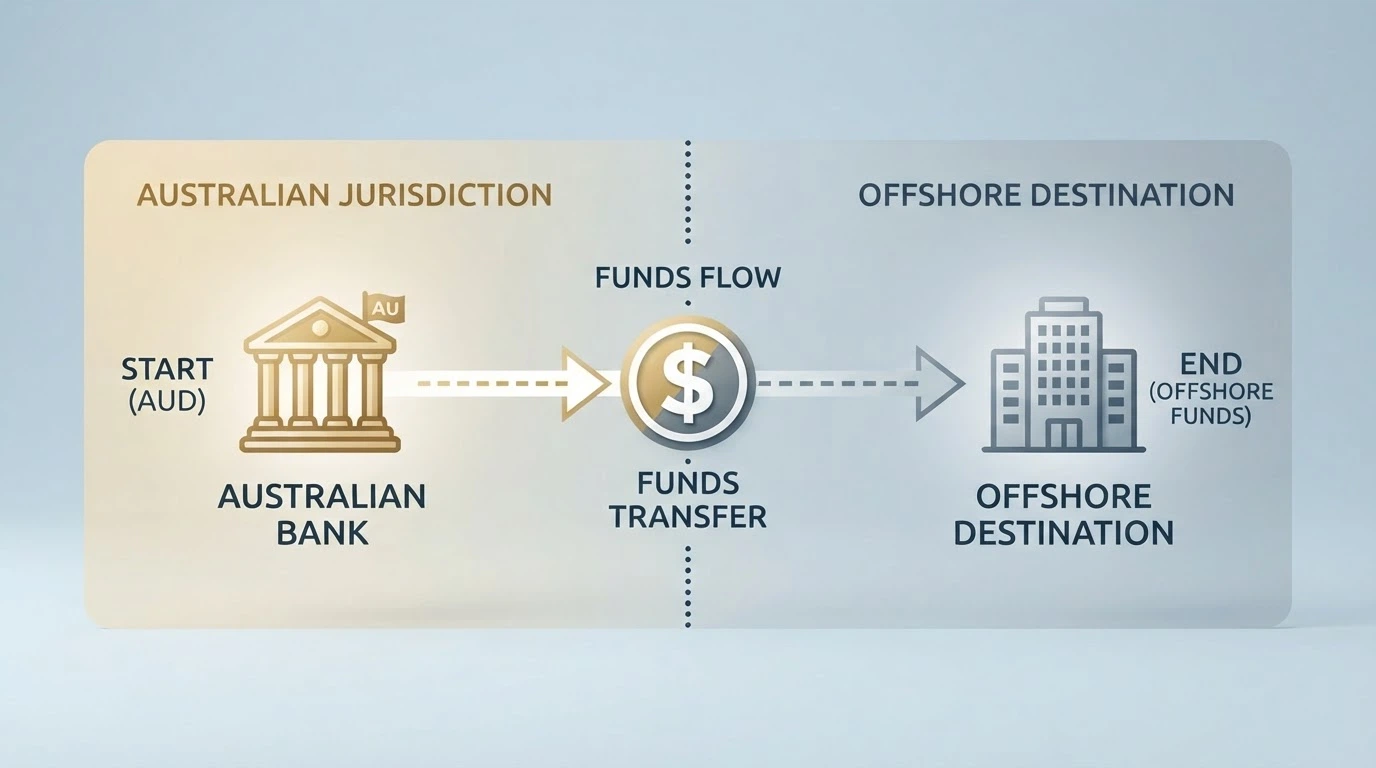
PayID is the deposit method that makes an offshore casino feel like an Australian product. It clears in seconds, the player sees AUD leaving their bank account and arriving in the casino’s cashier, and the whole experience reads as a domestic transaction. It is not. The money is leaving an Australian bank account and arriving at an offshore counterparty, and the protections that apply to a domestic transaction do not apply here.
PayID and Osko: Fast Deposits, Zero Protection
PayID and Osko are the New Payments Platform services that make near-instant bank transfers possible in Australia. They are listed as legal deposit routes for licensed Australian wagering, alongside debit card, bank transfer and BPAY. For an offshore casino, they are also the deposit method of choice — fast, familiar, low-friction for the player. From 11 June 2024, credit cards and crypto were banned as payment for online wagering in Australia, with an operator that fails to enforce the ban facing penalties of up to A$247,500. The ban targets the licensed wagering operator. An offshore casino does not enforce it; the player’s bank may or may not block a credit card transaction to a gambling merchant, and the player’s bank cannot block a PayID transfer once the recipient’s PayID is registered to a casino.
The transaction is irreversible. PayID credits the recipient’s account in seconds, and there is no chargeback mechanism for a transfer the player authorised. Australian banks cannot reverse a PayID transfer to an unlicensed offshore operator any more than they can reverse a bank transfer to a foreign payee — once the money has left the originating account, it is at the destination. The speed that makes PayID convenient for legitimate domestic payments is exactly what makes it irreversible for an offshore casino deposit.
What this means in practice: a player who deposits A$200 via PayID to an offshore casino has parted with that money. If the casino refuses the withdrawal, voids the bonus, blocks the account, or disappears, the player has no Australian recourse to recover the funds. The bank is not a party to the dispute. ACMA is not a party to the dispute. The only dispute resolution is the offshore operator’s own customer support, operating under the operator’s own terms.
Low-Deposit Casinos and Pay N Play: The AU Reality
A growing share of AU-facing offshore casinos have lowered their minimum deposit to A$10 and adopted a pay-n-play registration model where the player does not create an account in the conventional sense — the deposit is the account creation. The friction drop is real. The friction drop is also an acquisition tactic. A player who can deposit A$10, play, and decide whether to return has a lower barrier than a player who has to fill out a registration form, verify an email, and submit identification documents. The lower the entry barrier, the higher the conversion rate from “searcher” to “depositor.”
Pay-n-play has its own consequences. An account that exists only as a payment-method identifier is an account the operator can close at any time without an account-recovery process. A player who returns to find the account closed has no email to recover, no password to reset, and no identity document on file with which to argue the balance was theirs. The lower friction at entry is matched by lower friction at exit. Both directions favour the operator.
The A$10 minimum is a marketing floor, not a regulatory one. It signals to the searcher that the casino is approachable — “you don’t need to commit big to try us” — and the operator absorbs the small-deposit economics by relying on the bonus structure to convert the player into a higher-deposit returning customer. The expected-loss math works the same whether the player deposits A$10 or A$10,000. The house edge is a percentage of turnover, not a percentage of deposit.
Mobile Casinos: The Same Sites, Just in Your Pocket
The mobile experience at an AU-facing offshore casino is the desktop experience in a smaller browser window. There is no app to download, no App Store review to pass, no Google Play policy to navigate. The site loads in the phone’s browser, the cashier adapts to the screen, and the player plays. The friction is gone — but so is the friction that an app store’s review process would have added.
Apple and Google both enforce policies that prohibit real-money gambling apps from their stores in most jurisdictions, and Australia is one of them. The result is that AU-facing offshore casinos do not appear in the App Store or Google Play as downloadables. They run as browser-based instant-play sites that the phone treats like any other website. There is no install screen, no permission prompt, no store rating, no update cadence, no uninstall flow. The site sits in the browser history and the bookmark bar.
The absence of an app-store gate is not in itself a safety failure, but it removes a layer of friction that licensed products sometimes have. A licensed Australian wagering app has been through the operator’s compliance review, the platform’s compliance review, and the app store’s policy review. A browser-based offshore casino has been through none of them. The player is the only quality-control step, and the player is also the customer the casino is trying to convert. That is the gap the browser-based model leaves open.
The game performance is broadly comparable to desktop — RTG titles are HTML5, the cashier is mobile-friendly, the live-dealer lobbies that some operators carry adapt to the smaller screen. The player experience is the same; the regulatory framework is the same absence.
Real Money, Real Risk: Playing for AUD at Unlicensed Casinos
Depositing AUD and playing for real money at an offshore casino puts the player’s funds outside every Australian protection framework. ACMA does not adjudicate disputes for money recovery. The Australian Financial Complaints Authority does not have jurisdiction. The state and territory gambling regulators do not have jurisdiction. The player’s only recourse is the offshore operator’s own support, the operator’s own terms, and the operator’s own good faith.
The player is not criminally liable for using an offshore casino — the Interactive Gambling Act 2001 targets the provider, not the player — but the legal position is thin in the way that matters most. A player whose withdrawal is refused, whose bonus is voided after a review, whose account is closed with a balance on it, or whose self-exclusion is ignored by the offshore operator has no Australian body to complain to. The casino’s terms are the contract. The casino’s interpretation of those terms is the ruling.
The currency-conversion trap adds another small cost layer. Most AU-facing offshore casinos offer AUD natively in the cashier, which removes the worst of the conversion overhead. But when the player withdraws via a method that settles in a different currency — a crypto withdrawal, a bank wire to a non-AUD account — the conversion sits in the operator’s favour at the rate the operator quotes. The player does not see the spread, and the spread is small enough that most players do not look for it. It is the kind of cost that accumulates by basis points rather than by dollars.
What “real money” play actually risks, in plain terms, is the amount the player deposits plus the expected house edge on the play. The expected loss on a no-deposit bonus is calculated above. The expected loss on a deposit balance is the same arithmetic applied to the player’s turnover. A player who deposits A$200 and plays through A$2,000 on a 95% RTP pokie has an expected loss of A$100 across that turnover. The bonus structure, the cashout caps, and the offshore status do not change the house edge. They change who pays for it when something goes wrong, and they make sure the answer is the player.
The Law: Why No Licensed Online Casino Exists in Australia
The legal position is the frame for everything else on this page. The Interactive Gambling Act 2001, the 2017 amendment that closed the routing loopholes, ACMA’s enforcement powers, and the 2026 reform that will extend those powers to payment blocking — together, these explain why every operator an Australian can reach for casino play is offshore.
The Interactive Gambling Act: What It Actually Says
The Interactive Gambling Act 2001 makes it an offence to provide online casino games, online pokies, or in-play sports betting to a person physically in Australia. The offence sits with the provider — the offshore casino operator, the platform supplier, the affiliate that drives traffic — not with the player. Australians are not prosecuted for opening an account, depositing funds, or playing pokies at an offshore site. The Act does not create a player offence, and ACMA’s enforcement actions are directed at the provider end of the relationship.
That leaves a gap the player cannot paper over. The IGA was designed to choke off supply, not to protect individual consumers at offshore sites. The protection the player would normally expect — guaranteed withdrawals, dispute resolution, advertising standards, self-exclusion coverage, deposit limits, problem-gambling intervention — is a function of a licensed market, and there is no licensed market for online casino in Australia to provide it. The player is not prosecuted. The player is also not protected. Those two facts are not contradictions; they are the two sides of the same legal decision to prohibit the product.
ACMA Enforcement: Blocking, Fines and What It Cannot Do
ACMA — the Australian Communications and Media Authority — is the federal regulator with enforcement responsibility for the IGA. ACMA investigates complaints, issues formal warnings, refers matters for civil penalty proceedings, and since November 2019 has had the power to direct Australian internet service providers to block illegal gambling sites. The number stood at 1,564 blocked websites as of March 2026, with more than 225 illegal services having withdrawn from the Australian market since 2017.
The blocklist is large. It is also incomplete by design. ACMA blocks a specific URL, and the operator registers a new domain, re-uploads the site, and continues operating. The blocked-site figure is a measure of how many URLs have been shut down — it is not a count of how many operators have left the market, because most operators reappear under a different domain within weeks. The sluice gate is real but it is not a wall.
The 2026 reform changes the upstream picture. The Interactive Gambling Amendment (Gambling Reform) Bill 2026 passed Parliament on 19 August 2026, and its measures commence on 1 January 2027. From that date, banks and payment providers will gain express authority to block transactions to illegal gambling operators, giving ACMA and the financial sector a tool that addresses the operator’s funding rather than the operator’s URL. The reform also caps wagering advertising at no more than three ads per hour between 6:00 am and 8:30 pm, with a live-sport blackout from 15 minutes before until 5 minutes after a live sporting event, prohibits direct marketing of inducements for 14 days after sign-up and for three months after BetStop deregistration, bars athletes, celebrities and influencers from promoting wagering, and creates a national AdStop opt-out register administered by ACMA.
The reform does not legalise online casino. It does not create a licence. It adds upstream tools to the enforcement kit and tighter rules for the wagering products that are already licensed. The Australian player reading this in the second half of 2026 is looking at a January 2027 implementation date for those tools and an offshore casino market that will still be the only market for the casino product on that date.
What Australian Players Forfeit: The Protection Gap
A licensed Australian wagering customer sits inside a framework of protections the offshore customer does not have. Customer-set deposit limits are mandatory under state and territory conditions. Activity statements are issued regularly. A national self-exclusion register — BetStop — covers approximately 150 licensed wagering providers and excludes a registrant from all of them in a single registration. Dispute resolution is available through the operator and, failing that, through external schemes. Advertising is regulated, inducements are restricted, problem-gambling intervention is built into the operator’s licence conditions.
None of that framework reaches an offshore casino. The offshore casino is not on BetStop’s list of approximately 150 licensed wagering providers, so a BetStop registration does not exclude the player from the offshore site. The offshore casino is not bound by state and territory deposit-limit conditions, so the player cannot rely on the operator to enforce a limit the player sets for themselves. The offshore casino does not sit inside an Australian external dispute resolution scheme, so a withdrawal dispute cannot be escalated beyond the operator’s own support. The offshore casino’s advertising is not subject to ACMA’s wagering advertising rules.
The protection gap is the practical cost of the offshore choice. A player who has registered with BetStop, set a deposit limit, and activated a take-a-break period on a licensed Australian wagering account still has full access to every offshore casino account they have ever opened — and to every new offshore casino they choose to open next. The licensed protections stop at the licence line. The offshore product has no line to stop at.
Responsible Gambling When the Safety Net Has a Hole
Australia has world-class responsible-gambling infrastructure. BetStop, the National Gambling Helpline, Gambling Help Online, state and territory counselling services, the Australian Institute of Health and Welfare data series, the Department of Social Services policy framework. None of that infrastructure reaches an offshore casino. The infrastructure is built around the licensed wagering product, and the offshore casino is the product the licence does not cover.
The data is large. About 2.1% of Australian adults — roughly 430,000 people — experience problem gambling. In the 12 months to March 2026, Australians lost A$36.0 billion to gambling, an increase of close to A$1.3 billion on the A$34.3 billion lost in the 12 months to March 2025. Since COVID-19 in 2020, Australian gambling losses have increased 75%, or A$15.3 billion. The modelled national scenario estimates approximately 3.29 million Australians aged five and over are affected annually by their own or another person’s gambling, with an estimated 1,970,000 adults classified as having at-risk or problem gambling. Gambling participation slightly declined to 58.8% in 2025, but risky gambling increased from 13.7% in 2024 to 19.4% in 2025. Online gambling participation rose, with more than half (56.1%) of individuals who gambled mainly participating online in the past 12 months.
Those numbers describe the scale of gambling harm in Australia. They also describe why the offshore gap matters. The same AU$36.0 billion in losses funds a help infrastructure that is licensed-market-only, while a growing share of the online portion of that spend is happening offshore.
BetStop: What It Covers and What It Cannot Reach
BetStop — the National Self-Exclusion Register — launched on 21 August 2023 and excludes a person from every Australian-licensed online and phone wagering service in a single registration. To the end of Q3 of FY 2025–2026, 59,830 people had registered to self-exclude. As of 31 March 2026, 37,247 people had active exclusions. The minimum exclusion period is three months, with a lifetime option available — 38% of registrants choose the lifetime option. The register covers approximately 150 licensed wagering providers.
The ACMA-commissioned research on BetStop’s outcomes found that 77% of registrants experienced a better quality of life, 79% experienced improved mental health, and 96% had either completely stopped betting (81%) or decreased their betting (15%). Those are strong outcomes for the licensed market. They do not extend to offshore casinos.
BetStop binds licensed wagering providers. An offshore casino is not a licensed wagering provider. An offshore casino does not check BetStop before accepting a deposit, does not block a self-excluded player from creating a new account, and does not report back to BetStop on a registered player’s activity. A person who has registered with BetStop and self-excluded from the licensed wagering market still has full access to every offshore casino account they hold and every offshore casino they choose to open. The self-exclusion does not extend across the licensing line.
Help Is Available — Even If the Casino Is Offshore
The National Gambling Helpline — 1800 858 858 — is free, confidential, and staffed 24 hours a day, every day. Gambling Help Online — gamblinghelponline.org.au — provides online chat and counselling. Both services help regardless of where the gambling happened. A player who has been gambling at an offshore casino is not excluded from the help infrastructure the way the help infrastructure is excluded from the offshore casino. The helpline takes the call. The counsellors take the chat. The state and territory face-to-face counselling services take the appointment. The protection gap runs one way.
For a player who is reading this and recognising the shape of their own activity — the offshore accounts, the bonus chasing, the deposit limits that did not hold, the self-exclusion that did not reach the offshore product — the helpline is the place to start. For a player who is reading this on behalf of someone else — a partner, a family member, a friend — the helpline is also the place to start. The data on harm prevalence makes clear that the affected population is large and that the affected individuals are not all the people who placed the bets.
How We Evaluated These Casinos
This analysis is based on industry traffic data for the Australian market, established Australian gambling law, and documented offer terms from common offshore casino brands. The ranking of the ten operators reflects AU-market traffic data. The legal analysis draws on the Interactive Gambling Act 2001, the 2017 amendment, ACMA enforcement powers, the credit card and crypto ban, BetStop’s coverage, and the 2026 reform package. Bonus examples such as Caswino’s free spins, Slots Gallery’s wagering requirements, and Aus96’s free credit are included as illustrative examples of typical market offers.
Live web search was not available during the analysis window. Per-operator bonus terms, payout times, game provider lists, current RTP configurations, and current max-cashout figures could not be verified fresh against operator terms pages during this run. Where a specific number is stated at the brand level, it is stated from the offer-example research (Caswino, Slots Gallery, Aus96) rather than from a brand-level live read. The table of ten operators above is therefore written from market positioning only, and the column structure is limited to what can be honestly stated without a verified live read — operator name and licence status.
The criteria that ordered the ten operators are traffic data only. Licensing status is identical for all ten — offshore, no AU licence — so it does not differentiate. Bonus generosity, payout speed, game-library breadth, and complaint history could not be verified at the brand level on this run, so they do not appear in the ranking. The reader should treat the ranking as a snapshot of where AU traffic is currently flowing, not as an editorial ranking of which operator is the safer or more generous place to play — because no operator on this page is the safer or more generous place to play in a regulatory sense.
Your Move: What to Do About No-Deposit Casino Bonuses in Australia
Three realities, taken together, describe the choice facing an Australian reader who searched for the “newest online casinos no deposit bonus” in 2026.
First, every casino on the other side of that search is offshore. There is no licence for online casino anywhere in Australia, and the Interactive Gambling Act 2001 prohibits the product. The credit card and crypto ban that took effect on 11 June 2024 targets the licensed wagering operator, not the offshore casino. The 2026 reform that will give banks the power to block transactions to illegal gambling operators takes effect on 1 January 2027. In 2026, the offshore casino is the only game in town.
Second, the no-deposit bonus is a marketing cost, not a gift. A A$23 free-credit offer at 50x wagering carries an expected loss of about A$57.50 across the A$1,150 of turnover required to clear it. The cashout cap, typically A$50 to A$150 for no-deposit offers, ensures that any winnings above the cap are voided. The validity window, typically 24 to 72 hours, ensures that most players never reach the cap at all. The numbers are the numbers.
Third, no Australian protection applies. There is no ACMA complaint resolution for money recovery. There is no Australian external dispute resolution scheme. There is no BetStop coverage at an offshore casino. The helpline is free and confidential and 24/7, and it helps regardless of where the gambling happened — including the offshore product the rest of the page has described.
The decision is yours. If you choose to play at an offshore casino despite what is on this page, you do so knowing the bonus arithmetic works against you and the legal and consumer-protection framework is absent. If you choose not to play, the licensed Australian wagering market is the alternative for the products that are licensed — wagering on races and sport before the event starts, lotteries and keno, and the land-based casinos that are state-licensed. Online casino is not on that list, and the offshore sites are not a licensed substitute for it.
If a no-deposit bonus has already taken a deposit or a self-exclusion has not held, the National Gambling Helpline is 1800 858 858, free, confidential, and there at any hour. The helpline is the part of Australia’s responsible-gambling infrastructure that reaches the offshore product, even though nothing else on this page does.
Frequently Asked Questions
Are online casinos legal in Australia in 2026?
No. The Interactive Gambling Act 2001 prohibits the provision of online casino games, online pokies and in-play sports betting to a person in Australia, and no licence for online casino exists anywhere in the country. Every operator accepting Australian players is offshore and outside Australian law. The player is not prosecuted; the provider is.
What is BetStop and does it cover offshore casino sites?
BetStop is the National Self-Exclusion Register, launched on 21 August 2023. It excludes a person from every Australian-licensed online and phone wagering service in a single registration, across approximately 150 licensed providers. It does not cover offshore casinos. A self-excluded person can still open, deposit and play at any offshore casino.
Are my winnings from online casinos taxable in Australia?
Gambling winnings are not assessable income under section 6-5 of the ITAA 1997, and losses are not deductible under section 8-1 — unless the person is carrying on a business of betting. The typical recreational player neither owes tax on winnings nor can claim losses against other income. The legal status of the offshore casino does not change the tax treatment of a recreational player’s winnings.
What happens if an offshore casino refuses to pay out?
The player has no Australian recourse. ACMA does not adjudicate disputes for money recovery, the Australian Financial Complaints Authority does not have jurisdiction, and state and territory gambling regulators do not have jurisdiction over an offshore operator. The player’s only avenue is the operator’s own support, operating under the operator’s own terms. A BetStop registration does not help, because BetStop does not cover offshore casinos.
Can I use PayID to deposit at online casinos in Australia?
Yes — PayID and Osko transfers clear to an offshore casino in seconds, and most AU-facing operators offer PayID as a deposit method. The transaction is irreversible once it has cleared. Australian banks cannot reverse a PayID transfer to an unlicensed offshore operator, and there is no chargeback mechanism for an authorised PayID payment. From 11 June 2024, credit cards and crypto are banned for online wagering in Australia; PayID remains the common AU-facing offshore deposit route.
Which pokies have the highest RTP at Australian-facing casinos?
Cash Bandits 2 ships with an RTP of 97.5% at its highest setting — a figure configurable down to 95% or 91% depending on what the operator chooses. Fortunate Zeus sits at 96.0% RTP, Cash Bandits 3 at around 95.8%, and Oz Golden Trail at 95%. The RTP range across the dominant RTG catalogue in the AU-facing offshore market is 91% to 97%, and the operator selects where on that range each title runs. The high-RTP setting is not the default; the bonus-eligible list is where the operator’s configuration choice is most likely to put the player.
Australian-Targeted vs Worldwide: Does It Matter?
A casino that claims to target Australia — AUD currency in the cashier, PayID and Osko deposit options, a .com.au-looking domain, a footer that mentions responsible gambling, AEST customer support hours — is not safer than a casino that simply accepts Australians. Neither is licensed. The Australian-targeting is the casino’s marketing, not the casino’s compliance.
What it does signal is acquisition intent. An AU-facing casino is running ads and affiliate pages aimed at an Australian searcher, which means it expects enough AU players to be worth the spend. That is a business fact about the operator, not a regulatory fact about the product. The deposit methods are real — PayID does clear, AUD is not converted, support is in AEST — but those are customer-experience features, not regulatory protections. PayID is not a regulator. AUD is not a licence. Customer support cannot reverse a voided bonus.