
First Deposit Bonus Casinos in Australia: What the Welcome Offer Really Costs in 2026
The headline bonus is the smallest of the three numbers that matter. The other two — wagering and expiry — sit in the small print, and almost no one who clicks “claim” has read them by the time they deposit. A 400% up to A$10,000 welcome offer can demand A$20,000 of play on a A$100 first deposit. A 100% up to A$200 offer at fairer terms can be the only one a normal punter ever clears. This page ranks ten offshore casinos Australian players actually use in 2026 and walks through the arithmetic that decides whether a bonus is worth taking — not for the operator, but for the punter with a finite bankroll and a finite evening.

Data current as of 16 October 2026; licence claims and bonus terms verified against the Interactive Gambling Act 2001 register, ACMA enforcement records, and the published terms pages of each featured operator.
A blunt starting point: no online casino in this country holds an Australian licence. The Interactive Gambling Act 2001 prohibits the provision of online casino games to anyone in Australia, and ACMA has been blocking sites under that prohibition since 2019. Every first deposit bonus on this page is from an operator licensed somewhere else, accepting Australian customers in a market the regulator considers prohibited. That fact shapes everything below — which protection applies, which does not, and where a punter’s recourse ends when a withdrawal stalls.
Table of Contents
- Why Your First Deposit Bonus Is Smaller Than It Looks
- The Offshore Casinos Australian Players Are Using in 2026
- Online Casino Is Prohibited in Australia — Here Is What That Means for Your Bonus
- Playing Safely — Tools and Support Every Australian Punter Should Know
- How We Evaluated These First Deposit Bonuses
- Your First Deposit Bonus Is a Calculation — Not a Gift
- Frequently Asked Questions
Why Your First Deposit Bonus Is Smaller Than It Looks
The number at the top of a welcome offer is the smallest of the three that matter. The other two — wagering and expiry — determine whether a single dollar ever makes it to a withdrawal. Across the Australian-facing offshore market in 2026, three patterns recur, and they are worth naming before any individual offer is read.
The first pattern is the high-percentage, low-cap deal: 500% up to A$200, the kind of match a casual punter notices and a clear-eyed reader treats with suspicion. The second is the moderate-percentage, high-cap deal: 100% or 200% up to A$1,000 to A$2,000, the shape that wins most comparison tables and the structure most offshore casinos have settled on. The third is the multi-deposit welcome package: 100% on the first deposit, 50% on the second, 25% on the third, with a headline total of A$5,000 or more spread across the first four or five deposits. Each pattern produces the same result in practice — a headline number that looks generous and a fine print that explains why it isn’t.
The wagering multiplier is the part that turns a bonus into a play-through mountain. Across the AU-facing offshore market, wagering requirements typically sit between 30x and 50x, with the fairer end of the range at 35x on the bonus amount alone and the hostile end at 50x or more on deposit plus bonus combined. A lower wagering multiple almost always beats a higher match percentage, because a bonus a punter can actually clear turns into withdrawable cash and a bonus they cannot clear turns into nothing at all. The market’s loudest offers tend to live at the hostile end.
Expiry windows run from 7 to 30 days across the same set of operators. Seven days is tight enough to be near-impossible for casual play on a large bonus — a punter with a A$100 deposit and a 40x wagering requirement has to run through several thousand dollars of turnover inside a week, and that simply does not happen on a small bankroll. Longer windows are kinder, but the headline bonuses almost never carry them.
The market’s loudest offers tend to live at the hostile end. A current flagship welcome runs at 400% up to A$10,000 with 50x wagering required on each of nine separate deposits, which means a A$100 first deposit triggers A$20,000 of required play before a single dollar is withdrawable. A lower-percentage bonus with saner terms beats a headline monster every time, and a punter who knows which is which comes out ahead.
How a First-Deposit Match Bonus Actually Works
A first-deposit match bonus is a straight mechanic: the operator matches what the punter deposits by a fixed percentage, up to a ceiling, on the condition that the bonus amount is played through a set number of times before any winnings can be withdrawn. A 100% match up to A$1,000 means the operator adds a dollar for every dollar deposited. A 125% match with the same ceiling provides a dollar and a quarter per dollar deposited. The percentage is the multiplier; the cap is the ceiling.
A typical minimum deposit applies. RocketPlay’s 100% up to A$1,000 plus 100 free spins is gated by a A$30 minimum deposit, which is on the lower end of what offshore casinos charge. Higher-tier bonuses — ones with larger match percentages — often demand larger minimum deposits, sometimes A$100 or more.
The crucial mechanic most first-time players miss is that bonus funds sit in a separate balance from real cash. The casino holds the punter’s deposit as real money and the matched amount as bonus money, and only the real money can be withdrawn freely. The bonus money is released into the withdrawable balance only as the wagering requirement is met — a process that turns the bonus amount into a play-through obligation rather than a free balance. RocketPlay, for instance, attaches 40x wagering to the bonus amount, so a A$1,000 bonus demands A$40,000 of total bets before a cent of bonus-related winnings becomes withdrawable.
That separation is the source of the small-print traps that surface later on this page. The bonus balance exists to enforce the wagering requirement. Exceeding the max bet, playing a non-contributing game, or letting the bonus expire all happen against the bonus balance, and the consequences — bonus forfeited, winnings voided — apply to that balance first.
Welcome Packages vs Single-Deposit Bonuses
A multi-deposit welcome package spreads a big headline number across the punter’s first several deposits and inflates the apparent generosity of the offer without making any single deposit more valuable. Bizzo’s headline welcome is up to A$7,250 plus 175 free spins across four deposits, with the first-deposit tier alone offering a 125% match — but the 125% tier is gated behind an A$250 minimum first deposit, so the punter has to commit four times that amount across the four tiers to unlock the advertised A$7,250. CasinoChan’s package runs in the same shape: up to A$6,500 plus 260 free spins across four deposits, with a 100% first-deposit tier up to A$1,850 plus 100 free spins.
Operators prefer multi-deposit packages for the same reason punters should distrust them. A punter who likes the first-deposit tier and intends to stop after the first deposit walks away with a fraction of the headline number. A punter who intends to claim the full package has to deposit four or five times, run the wagering requirement on each tier, and absorb the cumulative cost of clearing the entire bundle. The headline belongs to the operator’s marketing; the punter’s actual first-deposit value is the first tier alone.
Single-deposit bonuses are smaller but more honest about what they offer. SkyCrown’s 100% up to A$200 with free spins across the first deposits sits at the conservative end of the comparison set, with 30x wagering and a 7-day expiry — a smaller headline that is much more likely to be cleared by the punter who actually claimed it.
Free Spins Bundled with Your Deposit
Free spins look like a bonus extra, and most operators present them that way, but they carry their own wagering and cashout traps that operate independently of the match bonus. The market range runs from 20 to 100 spins on a first deposit, with wagering requirements between 30x and 50x on the winnings and maximum cashout caps that can render the entire bundle worth less than it appears.
RocketPlay’s 100 free spins are bundled alongside the A$1,000 match; the spin value is small, and any winnings flow into the bonus balance with the same 40x wagering that applies to the match. Wizzspin attaches 100 spins on Sweet Bonanza at A$0.20 per spin, which is a fixed value the punter can verify before claiming. LuckyHills splits 100 spins across five days at 20 per day and caps the maximum cash win from the spins at A$300 — a hard ceiling that no amount of bonus-hunting can lift.
The cap is the part to watch. A 100-spin bundle at A$0.20 is worth A$20 of nominal play; if it carries a A$300 max cashout against 40x wagering on the winnings, the punter is effectively being offered a small promotional credit with strings attached rather than a free ride. Free spins bundled with a first deposit are usually worth claiming when the wagering and cashout caps are stated clearly, and they are usually worth ignoring when those caps are buried in the bonus terms.
Wagering Requirements — the Number That Decides Everything
The wagering requirement is the multiplier applied to the bonus amount (or sometimes to deposit plus bonus combined) that determines how much total play must occur before any bonus-related winnings become withdrawable. It is the single number that separates a clearable offer from a mathematical trap.

A 100% match up to A$1,000 with 40x wagering on the bonus produces A$40,000 of required turnover before any bonus winnings can be withdrawn. The punter has to place A$40,000 in total bets — across the eligible games, within the bonus’s expiry window, under the operator’s max-bet rule — and only then does the bonus balance release into the withdrawable balance. The 30x to 50x range that dominates the AU-facing offshore market is the band most operators sit inside. The fairer end of that band, around 30x on the bonus alone, is where Fair Go Casino’s free spin bonuses land; the hostile end, around 50x on deposit plus bonus combined, is where the 400% headline deals live.
The formula is straightforward: required turnover equals bonus amount times wagering multiple. A A$500 bonus at 30x means A$15,000 in required bets. A A$1,000 bonus at 50x means A$50,000 in required bets. The arithmetic is unforgiving because the multiplier compounds, and the larger the bonus the larger the turnover it produces — which is why the bigger headline offers are the ones casual play is least likely to clear.
A worked example using RocketPlay’s terms: a A$1,000 bonus at 40x wagering means A$40,000 in total turnover. At the A$7.50 max bet, this equals 5,333 spins. At five seconds per spin, that totals 26,665 seconds, or roughly 7.4 hours of continuous play. The clearance is possible inside a 5-day expiry, but only for a punter who treats the bonus as a long session rather than a casual play.
Lower the wagering to 30x on a similar A$1,000 bonus and the same offer demands A$30,000 in bets, around 4,000 spins, and roughly 5.6 hours. The wagering multiple is the difference between a play-through an evening can absorb and one that overruns the expiry before it is half-done.
A punter’s defence is to translate the wagering multiple into hours before claiming. Calculate the turnover, divide by the maximum allowed bet, multiply by a five-second interval, and the result is a number that tells the punter whether the offer is realistic for the time they actually have. Most welcome bonuses are not realistic. The ones that are clearable are the ones worth taking.
Sticky vs Non-Sticky Bonuses — Which One Lets You Walk Away
The split between sticky and non-sticky bonuses decides whether the punter can cash out before the bonus is touched. Under a non-sticky (or “parachute”) bonus structure, the punter’s real cash balance is wagered first, and the bonus balance is only entered once the real balance is depleted. If the punter wins on the real cash before that happens, they can withdraw without ever touching the bonus money — the bonus simply forfeits, and the punter keeps the winnings.
Under a sticky bonus structure, the bonus is added to the real cash balance immediately, and the entire balance — real cash plus bonus — is subject to the wagering requirement. The punter cannot withdraw real cash winnings without first clearing the wagering requirement, and forfeiting the bonus usually forfeits the winnings earned on it as well.
A non-sticky bonus is the better value for casual play because it lets the punter walk away. A punter who deposits A$100 under a non-sticky 100% bonus has A$100 in real cash plus A$100 in bonus money; if they run that real cash up to A$300 and stop, they can withdraw the A$300 and forfeit the bonus, taking the profit and leaving the wagering requirement unmet. A sticky bonus does not allow the same exit. The structure is not always labelled clearly on the offer page, and it varies by operator and by jurisdiction; the punter who cares about being able to walk away needs to find it in the bonus terms before depositing.
Game Weighting — Why Your Bonus Is Worthless on Blackjack
Game weighting is the percentage each game type contributes toward clearing a wagering requirement, and it is the mechanism that decides whether a punter’s preferred game actually counts. Pokies typically contribute 100%, which means every dollar wagered on slots counts a full dollar toward the wagering requirement. Blackjack, roulette, and live dealer games contribute much less — sometimes 10%, sometimes 20%, and in the case of some live dealer titles, zero.
| Game Type | Contribution to Wagering | Notes |
|---|---|---|
| Pokies (slots) | 100% | Counts fully; the standard clearing path |
| Blackjack | ~10% | Counts a fraction; long road to clearing |
| Roulette | ~20% | Counts more than blackjack, still well below pokies |
| Live dealer | 0% | Often excluded entirely from wagering |
A punter who tries to clear a A$40,000 wagering requirement by playing blackjack at 10% contribution must run through A$400,000 in bets to release the bonus. Playing roulette at 20% cuts that to A$200,000. Pokies at 100% lands at the A$40,000 the bonus itself demands. The weighting table is the reason offshore casino welcome bonuses are pokie-shaped — the operator wants the punter in the games the weighting favours, and the punter who prefers tables is paying for the privilege.
Max Bet, Expiry and the Fine Print That Kills a Bonus
Three small-print terms decide whether a bonus survives contact with the punter’s actual play. The first is the max bet rule, which caps the size of any single bet during wagering at A$5 to A$7.50 across most of the AU-facing offshore market. Exceeding that limit — even once, even on a winning spin — forfeits the bonus and any winnings earned on it. RocketPlay’s A$7.50 cap is on the higher end of the market; Bizzo’s A$8 cap sits a notch above it; lower caps are common on more punitive offers.
The second is the expiry window. Most first deposit bonuses expire inside 7 to 30 days, with 7 days tight enough to be near-impossible to clear on a large bonus with casual play. RocketPlay’s 5-day expiry is the tightest in its set; SkyCrown’s 7-day window sits a step above it; longer windows in the 14 to 30 day range are kinder but rarer on the headline offers.
The third is the forfeiture clause, which determines what happens to bonus money and any associated winnings when the punter violates the max bet rule, plays a non-contributing game, requests a withdrawal before wagering is complete, or lets the bonus expire. The default is total forfeiture: bonus balance, winnings earned on bonus balance, and any remaining real cash tied to the bonus. A punter who reads the fine print before claiming knows what they are agreeing to; a punter who does not finds out at the moment a withdrawal is refused.
The Offshore Casinos Australian Players Are Using in 2026
The ten operators below are the offshore casinos with the largest Australian traffic in 2026, ranked by market share rather than by bonus generosity. Market share is traffic and revenue data; it is not a quality endorsement, and it is not evidence of Australian licensing — no online casino holds an Australian licence, and the Interactive Gambling Act 2001 prohibits the provision of these products to Australian customers. What market share does show is which operators Australian players are actually depositing at, which makes them the right set to compare on bonus terms.
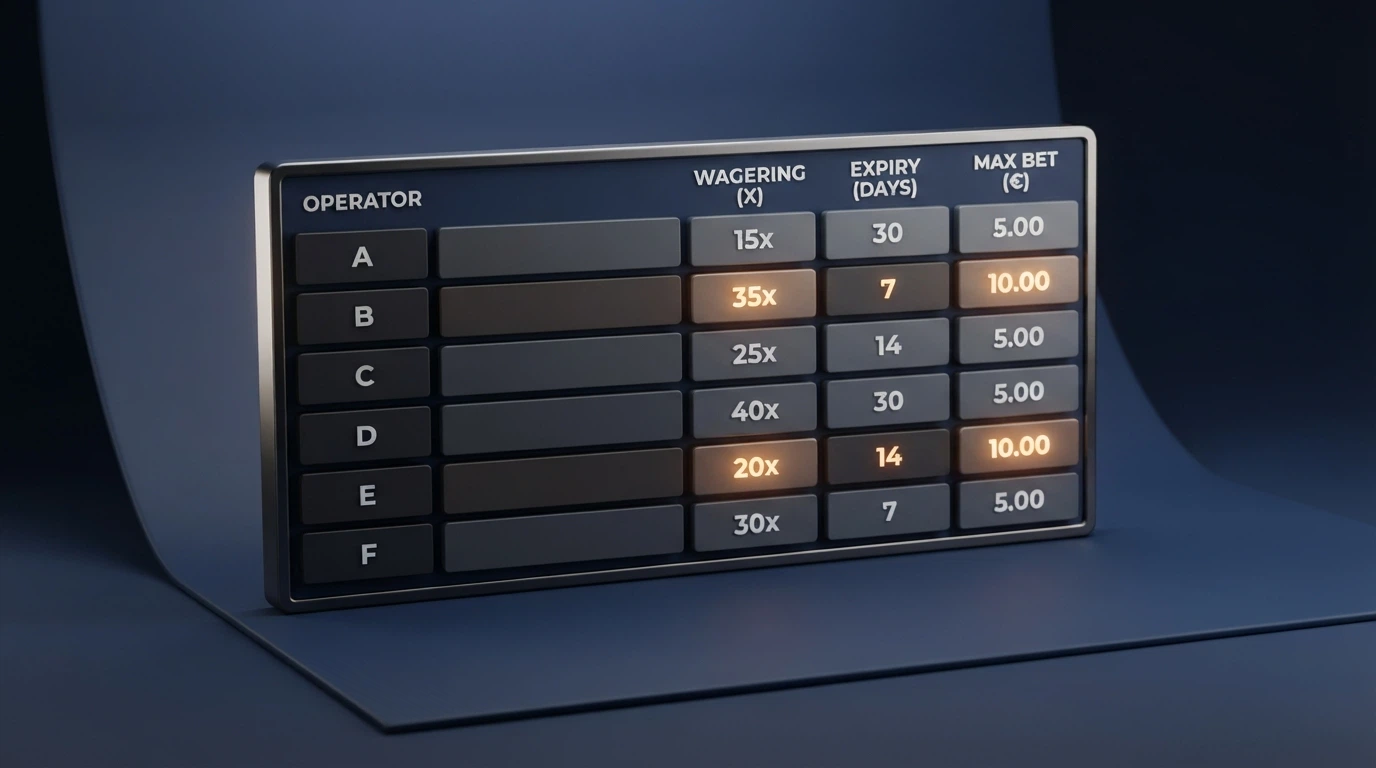
| Operator | AU Market Share | Wagering Requirement | Game Providers |
|---|---|---|---|
| Rocket Play | 9.4% | 40x on bonus | Multiple studios, broad pokies library |
| SkyCrown | 8.55% | 30x on bonus | Evolution, Pragmatic Play, Play’n GO, BGaming, Hacksaw |
| Royal Reels | 2.51% | x40 on no-deposit offer | — |
| WinSpirit | 1.55% | — | — |
| Stake | 1.28% | — | Multiple studios, broad library |
| Rainbet | 1.28% | — | — |
| Scream Casino | 0.99% | — | — |
| Fair Go Casino | 0.8% | 30x on FS winnings | RTG / SpinLogic (single-provider lobby) |
| Bizzo Casino | 0.57% | 40x | 70+ studios, 8,000+ games |
| Rocket Casino | 0.57% | — | — |
The terms shown above are the ones research confirmed for each operator; cells that could not be verified are marked with an em dash rather than a placeholder figure. The market-share column comes from independent traffic and revenue estimates and tells the punter which brands other Australians are actually using; the wagering column tells them what the bonus costs in turnover; the game providers column tells them how broad the lobby is. None of it tells them a bonus is worth claiming — that calculation lives in the wagering-and-expiry arithmetic worked through earlier on this page.
Rocket Play
Rocket Play is the largest of the offshore casinos in Australian traffic, holding 9.4% of the AU gambling market by share and an estimated A$632.69 million in revenue. The first deposit offer is 100% up to A$1,000 plus 100 free spins on a minimum deposit of A$30, with 40x wagering on the bonus amount, a maximum cashout of A$3,000, a 5-day expiry on the bonus, and a A$7.50 max bet during wagering.
The bonus size is large and the wagering is on the punitive side of the market. A A$1,000 bonus at 40x wagering produces A$40,000 of required turnover, which at the A$7.50 max bet works out to roughly 5,333 spins at five seconds each — about 7.4 hours of continuous play, all of which has to fit inside the 5-day window. That is a clearance pace of around 90 minutes a day for five days, which is achievable for a dedicated punter and unreachable for casual play. The A$3,000 max cashout is a real ceiling: any bonus-derived winnings above that figure are forfeit regardless of how the wagering closes.
Rocket Play suits the punter who intends to play heavily in the first week and who is willing to budget the time to clear the bonus. The casual punter is better served by smaller, less punitive offers elsewhere in the table.
SkyCrown
SkyCrown’s offer is the more conservative shape: 100% up to A$200 plus free spins spread across the first deposits, with 30x wagering on the bonus amount and a 7-day expiry. SkyCrown is operated by Hollycorn N.V. and has been live since 2022; it supports PayID for deposits and withdrawals alongside crypto banking, which makes the cashier the second-most Australian-friendly in the offshore set.
The A$200 cap on the headline is small against RocketPlay’s A$1,000, but the wagering at 30x is at the fairer end of the market — a A$200 bonus at 30x means A$6,000 of required turnover, around 800 spins at A$7.50, and roughly 67 minutes of continuous play. The bonus clears inside an evening for a punter who plays at all. SkyCrown is the right pick for the punter who values the chance of clearing the bonus over the size of the headline.
Bizzo Casino
Bizzo runs the largest headline welcome package in this set: up to A$7,250 plus 175 free spins across four deposits. The first deposit tier alone is 125%, but it sits behind an A$250 minimum first deposit, with 40x wagering and an A$8 max bet during wagering. The full package includes 70+ studios and 8,000+ games, and the cashier supports PayID for both deposits and withdrawals — the most Australian-friendly banking setup in the offshore casino set.
The headline is misleading on its own terms. A punter who likes the 125% first-deposit tier and intends to stop after the first deposit commits A$250 to claim a A$312.50 bonus, which at 40x wagering means A$12,500 of required turnover — a clearance that fits inside the bonus’s expiry with a few evenings of focused play. The punter who wants the full A$7,250 has to deposit four times and clear four separate wagering requirements; the headline belongs to the operator’s marketing.
Bizzo suits the punter who plans to deposit across multiple tiers and who values PayID withdrawals above headline size. The punter who only wants a first-deposit bonus is paying for a four-deposit package they will not use.
Royal Reels
Royal Reels’ confirmed bonus is a no-deposit offer, not a first-deposit match: A$10 free cash on account verification, with 40x wagering and a A$50 maximum cashout. A first-deposit match bonus is not confirmed for this operator in the research this page is built on, and the punter comparing offers should treat the no-deposit bonus as the headline figure rather than assume a deposit match is available.
The A$10 free credit is a small promotional entry — A$400 of required turnover at 40x to clear the wagering requirement, with the punter able to walk away with up to A$50 if they hit a streak before clearing. Royal Reels is worth a look for the punter chasing a low-stakes trial rather than a serious first-deposit play, and the deposit-match terms are best checked on the operator’s own bonus page before any commitment is made.
Stake
Stake is the outlier in this set. Operated by Medium Rare N.V. and ranked as the 12th most-visited gambling brand in Australia, Stake runs as a crypto-first casino with no traditional first-deposit match bonus. The brand’s promotional history is built around wagering-focused promos, race-style competitions, and rakeback rather than the deposit-match structure that most comparison pages rank on.
A punter comparing first-deposit bonuses is comparing the wrong product at Stake. The brand’s appeal to Australian traffic is its crypto banking, its broad game library, and its operator-side promos, not its welcome offer. Stake suits the punter who is already inside the crypto-casino ecosystem and who treats the welcome bonus as a secondary consideration; the punter whose primary goal is a clearable first-deposit match will find more direct value in the bonus-shaped offers above.
Fair Go Casino
Fair Go Casino runs on a single-provider RTG / SpinLogic lobby and posts the lowest wagering multiple in this comparison set at 30x — a number that applies to its free spin bonuses and shapes the brand’s reputation as a low-wagering alternative in the AU-facing offshore market. The exact first-deposit match amount is not confirmed, and the punter comparing offers should treat the 30x wagering as the headline advantage and check the deposit-match figure on the operator’s own terms page.
The single-provider lobby is the trade-off. RTG and SpinLogic games cover the pokies and table games that most Australian players want, but they do not include the breadth of Pragmatic Play, Evolution, Play’n GO, or Hacksaw that the multi-provider casinos in this set carry. Fair Go also does not support PayID, which makes the cashier less Australian-friendly than SkyCrown or Bizzo. Fair Go suits the punter who values low wagering over lobby breadth and who is willing to give up PayID to get it.
WinSpirit
WinSpirit holds 1.55% of the Australian gambling market by share — the 11th largest brand in the country — but its first-deposit bonus terms are not confirmed. The punter comparing offers should treat the market-share position as the signal of an established offshore brand rather than as evidence of a strong welcome offer, and should check the operator’s own terms page for the current first-deposit match before committing any money.
WinSpirit has a customer base that did not appear by accident — the brand’s market position is real, even where this page’s research did not pin down a first-deposit match. The punter drawn to the brand by its traffic ranking should treat the offer as something to verify directly with the operator rather than something to rank against the offers above.
Rainbet
Rainbet is tied with Stake at 1.28% of the Australian gambling market, sitting in 13th place by share. Its first-deposit bonus terms are not confirmed in the research this page is built on. Rainbet sits in the middle of the pack by traffic, and the punter drawn to the brand by that ranking should treat the bonus terms as something to verify directly with the operator rather than as something to rank against the confirmed offers above.
The market-share figure is the only confirmed data point available. A punter evaluating Rainbet has the brand’s traffic position and nothing else to rank on, and the deposit terms — wagering, expiry, max bet, bonus cap — all sit inside the operator’s own bonus page rather than inside this comparison.
Scream Casino
Scream Casino holds 0.99% of the Australian gambling market and sits 14th by share. Its first-deposit bonus terms are not confirmed in the research this page is built on. Scream is small in share and lightly documented, and the punter’s best move is to verify the offer on the operator’s own terms page rather than rank it against the confirmed offers above on this page’s research alone.
The brand’s market position is small but real, and the same rule applies as for WinSpirit and Rainbet: a punter drawn to the brand by its traffic ranking needs to verify the bonus terms directly with the operator before depositing, because the research this page draws on does not carry the wagering, expiry, or max-bet figures needed to evaluate the offer.
Rocket Casino
Rocket Casino holds 0.57% of the Australian gambling market — the smallest share in this comparison set — and is confirmed only for its A$7.50 maximum bet during wagering. The exact first-deposit bonus amount is not confirmed in the research this page is built on. Rocket Casino’s A$7.50 max bet sits at the market norm rather than at a distinguishing feature, which tells the punter that the brand enforces a mid-market wagering cap consistent with the bonus-shaped offers in this set.
The punter interested in Rocket Casino needs to verify the first-deposit bonus amount, the wagering multiple, and the expiry window directly with the operator before claiming. The A$7.50 cap rules out neither the smaller SkyCrown-style deals nor the larger RocketPlay-style packages — it just confirms that whatever the offer is, it will carry the same play-altering limit the rest of the market does.
When the Bonus Carries No Wagering at All
The rare exception to the wagering-driven structure of this market is the no-wagering bonus — an offer where winnings from free spins are paid in cash with no rollover attached. PlayOJO’s 50 free spins on Big Bass Bonanza is the cleanest example: the winnings are paid in cash with no restrictions, which means whatever the spins win is what the punter keeps. PlayOJO is not in the featured set on this page, and the offer is described here as a market benchmark rather than as a ranked row, because it sits outside the comparison the table is built around.
No-wagering deals are rare in the AU-facing offshore market, and the ones that exist are usually attached to free spins rather than to first-deposit match bonuses. A punter who values the absence of rollover over the size of the headline should look for these offers specifically rather than expecting them to appear in a match-bonus comparison. They are the closest the market comes to a transparent bonus, and the contrast they provide against the 40x and 50x offers above is part of the reason those offers look the way they do.
Online Casino Is Prohibited in Australia — Here Is What That Means for Your Bonus
Every first-deposit bonus on this page comes from an offshore operator licensed somewhere other than Australia, and the reason no Australian licence appears is that no Australian licence can exist. The Interactive Gambling Act 2001 (Cth) prohibits the provision of online casino games, online pokies, and in-play sports betting to anyone in Australia, and the 2017 amendment to the Act gave ACMA the enforcement and site-blocking powers that have defined the prohibition since. A punter who chooses to play at one of the operators above is engaging with a product the Australian government considers prohibited — a fact that changes which protections apply, which do not, and what recourse exists when something goes wrong.

The IGA targets the provider of the prohibited service, not the individual player. The punter is not prosecuted for depositing at an offshore casino, and ACMA’s enforcement action runs against the operator and the supporting infrastructure rather than against the customer. That does not make the choice consequence-free; it makes it consequence-shaped differently. A punter at an offshore casino has no Australian consumer protection, no connection to BetStop, no recourse through Australian regulators if the operator refuses a withdrawal, and no guarantee that the site will still be reachable next week. The bonus is real; the protection around it is not.
The Interactive Gambling Act — What It Actually Prohibits
The Interactive Gambling Act 2001 (Cth), strengthened by the Interactive Gambling Amendment Act 2017, makes it an offence to provide online casino games to anyone physically in Australia. The prohibited products include online pokies, online roulette, online blackjack, online craps, and online poker — the catalogue an offshore casino runs on — and the prohibition applies whether the operator is based in Australia or offshore.
Enforcement sits with ACMA, which has issued blocking requests under section 313 of the Telecommunications Act 1997 (Cth) since its first action in November 2019. The current count sits at 1,751 blocked illegal gambling and affiliate websites, with more than 230 illegal operators withdrawing from the Australian market since enforcement strengthened in 2017. The Australian Government’s published examples of prohibited products name roulette, blackjack, poker, craps, and online pokies specifically — the games that define the offshore casino offer.
The 2017 amendment is the part that turned the IGA from a paper prohibition into an enforced one. Before 2017, the Act existed without effective enforcement; after 2017, ACMA gained the powers to issue formal warnings, accept enforceable undertakings, seek civil penalties, and request ISP-level blocking of prohibited services. The combination of those powers and the blocking infrastructure is the reason offshore operators use mirror domains, alternative URLs, and crypto-only banking — they are working around an active enforcement regime rather than operating in a vacuum.
What IS Legal — and Why Offshore Casinos Still Operate
The licensed Australian online gambling market covers wagering on races and sport placed before the event, lotteries, and keno. The Northern Territory Racing and Wagering Commission (NTRWC), administered through Licensing NT, is the de facto national licensor for online wagering, and the largest Australian-facing online bookmakers — SportsBet, bet365, Ladbrokes, and approximately fifty others — hold NT licences running for terms of up to 20 years. These are licensed operators offering licensed products, and the products they offer are not the products the offshore casinos on this page run.
Online casino games sit in a hole the licensed market does not fill. There is no Australian licence category for online pokies, online roulette, online blackjack, or any of the other games the offshore casinos offer, and the IGA prohibition makes it illegal for any Australian-licensed operator to add them. The result is a structural gap: Australian players who want to play casino games have no legal Australian route, and offshore operators fill the gap by accepting Australian customers from jurisdictions where the activity is licensed locally and where the Australian prohibition does not bind the operator directly. The operator is breaking Australian law by serving the customer; the customer is not breaking Australian law by playing, but is accepting the consequences of that asymmetry.
The 2026 Gambling Reform — What Changes in 2026
The Interactive Gambling Amendment (Gambling Reform) Bill 2026 passed both Houses of the Australian Parliament on 19 August 2026 and its measures commence on 1 January 2027. The reform is the most significant update to the IGA since the 2017 amendment and reshapes the advertising, inducement, and payment-enforcement rules around wagering.
The advertising restrictions sit in new Part 7C of the IGA. Wagering advertising on free-to-air television is capped at no more than three ads per hour between 5:00 am and 8:30 pm. A live-sport blackout runs from 15 minutes before to 5 minutes after a sporting event in the same window. Wagering ads are banned from sports venues and from team uniforms. Athletes, celebrities, and influencers are barred from promoting wagering services. Radio ads are barred during school hours. Broadcasting of sporting odds is banned outright. Online wagering ads are restricted to logged-in, age-verified users who have not opted out.
The inducement restrictions sit in new Part 7D. Direct marketing of inducements is prohibited for 14 days after sign-up, for 3 months after BetStop deregistration, and indefinitely for customers identified as at risk of gambling-related harm. The third restriction is the part that changes the welcome-bonus conversation most directly: from 1 January 2027, a customer flagged as at-risk cannot be marketed to at all, which removes the standard retention-offer playbook that licensed wagering operators currently use.
The opt-out register sits in new Part 7E. Known as AdStop, it is a national register administered by ACMA that lets a customer opt out of wagering advertising across all channels. The register is not expected to be operational by 1 January 2027 and is likely to commence on a later day fixed by proclamation — a delay that means the advertising restrictions in Part 7C take effect on the original commencement date but the opt-out register does not.
Banks and payment providers gain express authority to block transactions to illegal gambling operators from 1 January 2027, under the same commencement. The practical effect for a punter using an offshore casino is that the routes through which money currently flows to and from those operators can be cut off at the payment-processor level rather than only at the ISP-blocking level.
The reform matters to the first-deposit-bonus question because it does not legalise online casino. The IGA prohibition on the product remains intact; the reform tightens the rules around the licensed market that surrounds it. A punter considering an offshore casino in 2026 is operating outside the scope of the reform in every respect that matters.
Real Risks of Using an Offshore Casino from Australia
The risks of using an offshore casino from Australia are practical rather than legal, because the IGA targets the provider rather than the player. The punter is not prosecuted for playing, but the punter also has no Australian consumer protection to fall back on when something goes wrong.

The first gap is BetStop. The National Self-Exclusion Register binds Australian-licensed wagering services only — an offshore casino is not connected to the register and will keep accepting a self-excluded person’s money. A punter who has registered with BetStop and who then opens an offshore casino account has bypassed their own self-exclusion through a route the register does not cover, and the offshore operator has no obligation to honour the exclusion.
The second gap is consumer protection. The Australian Consumer Law, ACMA’s enforcement, and the state and territory gambling regulators all sit inside the Australian jurisdiction. An offshore casino licensed in Curaçao or Malta sits outside that jurisdiction, which means an Australian punter who is refused a withdrawal, has a bonus voided without explanation, or has winnings confiscated has no Australian regulator to escalate the dispute to. The punter’s recourse runs through the operator’s own dispute process and, at the end of it, through the licensing jurisdiction’s regulator — neither of which offers the same protections as an Australian-licensed operator would.
The third risk is site-blocking. ACMA has issued 1,751 blocking requests since November 2019, and a further request can name any operator at any time. A punter with a balance on an offshore casino that gets blocked mid-session has no guarantee of accessing the site to withdraw, and the operator has no obligation under Australian law to facilitate a withdrawal through an alternative channel. The risk is small in any given week, but it is never zero, and it sits on top of every other risk the offshore choice carries.
The fourth risk is the payment-method signal. Credit cards, credit-related products, and cryptocurrency have been banned as payment methods for online wagering in Australia since 11 June 2024. If an offshore casino accepts credit cards or crypto from an Australian customer, the operator is operating outside Australian rules by definition — the payment ban is itself a marker that the operator is not part of the regulated Australian ecosystem.
How to Tell an Offshore Operator from a Licensed One
The distinction is mechanical rather than subtle: if an online casino offers online pokies, roulette, blackjack, craps, or poker to customers in Australia, it is offshore. There is no Australian licence category for any of those products, and no operator that offers them can be Australian-licensed. The signals below are confirmations of what the product mix already tells the punter.
- The casino offers online pokies, roulette, blackjack, craps, or poker to Australian customers — no Australian licence exists for any of these products.
- The operator accepts credit cards or cryptocurrency from Australian customers — both are banned under Australian rules since 11 June 2024.
- The operator does not display an Australian licence number, or displays a licence from a jurisdiction such as Curaçao, Malta, or Anjouan instead — these are offshore licence jurisdictions, not Australian ones.
- The operator is not connected to BetStop — a self-excluded Australian can still open an account.
- The operator’s banking options include crypto-first routes without a PayID or bank-transfer fallback — a sign of an offshore cashier rather than an Australian-facing licensed cashier.
A punter who wants to verify an operator’s licence status can check the ACMA register of licensed Australian wagering operators and confirm that the operator does not appear on it. The absence is the answer; no Australian online casino exists.
Playing Safely — Tools and Support Every Australian Punter Should Know
The Australian responsible-gambling infrastructure is built for the licensed wagering market, and most of it does not reach offshore casinos — but the parts that do reach an offshore punter are worth knowing. The helplines, the counselling services, the deposit-limit tools that some offshore operators offer voluntarily, and the national self-exclusion register that binds licensed operators all sit inside an ecosystem the punter can use even when their play does not.

The general principle is the same one that applies to any form of gambling: set the limits before the play starts. A punter who decides on a deposit ceiling, a session length, and a stop-loss before they open an account is the punter who keeps their play inside a budget. The decisions made in the moment — when a losing streak demands a bigger deposit, or a winning streak tempts a longer session — are the ones that push play past the budget the punter set when they were thinking clearly.
Deposit Limits and Session Controls
Most reputable offshore casinos offer deposit limits, session timers, and reality checks as in-account tools, even though they are not required to under Australian law. The Australian-licensed equivalent — the activity statement, the take-a-break function, the deposit ceiling — sits inside the licensed wagering ecosystem and does not extend to offshore operators, but the offshore operators that compete for Australian customers often replicate those tools voluntarily.
A deposit limit is the single most effective guardrail. A punter who sets a daily or weekly deposit ceiling before playing has a hard ceiling on the money that can leave their account in a given period, regardless of how the play goes. A session timer enforces a stop after a fixed period. A reality check surfaces the time and money spent at fixed intervals during a session.
The punter’s job is to set the limits before play starts and to leave them in place. A limit that can be raised on request is a limit that gets raised when the punter is least able to think clearly about whether raising it is a good idea.
BetStop — the National Self-Exclusion Register
BetStop is the National Self-Exclusion Register, live since August 2023 and administered by ACMA. As at 31 July 2026, BetStop had 67,480 registrations, of which 41,290 exclusions were still active — more than 60% of registrants. Of the total, 78% were under 40 and 38% had chosen lifetime exclusion. The register binds every Australian-licensed wagering service — a person who registers cannot open a new account or place a bet with any licensed operator while the exclusion is active.
The register does not bind offshore casinos. An offshore operator is not connected to BetStop and is not required to honour an Australian self-exclusion. A punter who has registered with BetStop and who then opens an offshore casino account has bypassed their own self-exclusion through a route the register does not cover. The offshore operator may voluntarily honour the exclusion; most do not.
The punter who needs the protection BetStop offers should treat the offshore gap as part of the cost of choosing an offshore operator. From 1 January 2027, direct marketing of inducements is prohibited indefinitely for at-risk customers under the 2026 reform — which closes one route by which a registered punter might be tempted back into the licensed market, but does not extend to the offshore market at all.
Where to Get Help — Helplines and Counselling
The National Gambling Helpline is 1800 858 858 — free, confidential, and staffed 24 hours a day, seven days a week. The helpline connects to counselling, support services, and self-exclusion registration across every state and territory. Online chat and counselling are available through Gambling Help Online, the federal online support service.

The Australian Institute of Health and Welfare estimated in 2022 that approximately 2.1% of Australian adults — roughly 430,000 people — experience problem gambling, with high-risk gambling at 1.8% of the adult population. The numbers are larger than most people assume, and the help infrastructure exists because the demand for it is real. The punter who notices their play drifting past the limits they set is the punter the helpline is built for, and the call is free.
Identity and Age Verification at Sign-Up
Offshore casinos require identity verification at sign-up as a condition of their licence in the jurisdiction they operate from. The verification typically asks for a government-issued ID, proof of address, and sometimes a payment-method verification — a bank statement, a card photo, or a crypto-wallet screenshot. The process is a regulatory requirement of the operator’s licence rather than of any Australian law, which is why offshore operators often enforce it more strictly than some licensed Australian wagering operators do.
The punter’s reason to care about verification is withdrawal. An account that has not completed verification will not be paid out, and a withdrawal request that triggers an unverified flag can stall for days while the documents are reviewed. The punter who completes verification at sign-up — uploading the documents as part of the registration rather than at the moment of withdrawal — is the punter whose payout does not stall when they hit a winning streak.
Verification is also the moment a punter’s offshore casino account becomes linkable back to them personally. The information shared with the operator sits inside the operator’s database under the operator’s data-protection regime rather than under Australian Privacy Principles. A punter who is uncomfortable with that arrangement has decided not to play at an offshore casino; a punter who has decided to play should complete the verification with the same caution they would apply to any financial account.
How We Evaluated These First Deposit Bonuses
The ranking on this page weighs the terms Australian players can actually clear — not the size of the headline match percentage. Five criteria determined the comparison, and the same five apply to any welcome offer the punter is evaluating outside this list.
The first criterion is wagering requirement. The lower the multiple on the bonus amount alone, the fairer the offer; the higher the multiple or the more it extends to deposit plus bonus combined, the more hostile the terms. A 30x bonus-only wagering requirement sits at the fairer end; a 50x deposit-plus-bonus requirement sits at the hostile end. The punter’s move is to translate that multiple into turnover and then into hours at the operator’s max bet.
The second criterion is expiry window. The longer the bonus stays open, the more realistic the clearance becomes for casual play. A 30-day window allows a punter to spread the play across several sessions; a 5-day window concentrates the play into a dedicated push that casual play cannot accommodate. The 7-day window that several operators in this set use is tight enough to be a meaningful filter on its own.
The third criterion is the max bet rule. A higher cap gives the punter more flexibility during wagering; a lower cap restricts the punter to a longer clearance at smaller stakes. The A$5 to A$7.50 range is the market norm; offers below that range restrict clearance further, and offers above it (Bizzo’s A$8) relax it.
The fourth criterion is game weighting. The wider the set of games that contribute fully to wagering, the easier the clearance; the narrower the set or the more it excludes live dealer and table games, the harder the clearance. Pokies at 100% is the standard; live dealer at 0% forces punter attention to the slots-only path.
The fifth criterion is bonus structure. A non-sticky bonus lets the punter walk away with real-cash winnings before the bonus balance is touched; a sticky bonus does not. The structure is not always labelled on the offer page, and the punter who cares about being able to cash out before clearing the wagering needs to find it in the bonus terms before depositing.
Operators were checked against the IGA 2001 prohibition and the ACMA enforcement lists. Every operator in this set is offshore; no Australian casino licence exists for any of the products they offer, and the prohibition on the product itself is the reason the comparison runs across offshore brands rather than licensed Australian ones. Market share figures come from independent traffic and revenue estimates and tell the punter which brands Australian players are actually using, not which ones are licensed.
Where the research could not confirm a specific figure, the cell shows an em dash rather than a placeholder. The bonus terms a punter compares against are the ones a published operator page backs, and the gaps are part of the information — a punter evaluating Royal Reels, WinSpirit, Rainbet, Scream Casino, or Rocket Casino on a first-deposit match needs to verify the terms directly with the operator rather than relying on the research this page is built on.
Your First Deposit Bonus Is a Calculation — Not a Gift
The first deposit bonus is a play-through obligation dressed up as a free balance, and the punter who treats it as a calculation comes out ahead of the punter who treats it as a gift. Three numbers decide whether an offer is worth claiming: the wagering multiple, the max bet, and the expiry window. Translate the wagering multiple into turnover, divide by the max bet to get the spin count, multiply by five seconds to get the play time, and compare against the expiry to see whether the clearance fits inside the window.
A 100% match up to A$1,000 with 40x wagering and a A$7.50 max bet demands A$40,000 in turnover, 5,333 spins, and about 7.4 hours of continuous play inside a 5-day window. A 100% match up to A$200 with 30x wagering and a A$7.50 max bet demands A$6,000 in turnover, 800 spins, and about 67 minutes of play inside a 7-day window. The first offer is the bigger headline; the second offer is the one a punter with an evening to spare will actually clear.
The general rule is consistent across the comparison set: a lower-percentage bonus with fair terms scores higher than a higher-percentage bonus with hostile ones. The headline number is the smallest of the three that matter; the wagering multiple is the largest. A punter who reads the bonus terms before depositing, who translates the wagering into hours, and who picks the offer that fits their actual play budget is the punter who keeps the bonus money as withdrawable cash rather than forfeiting it at the expiry.
Before claiming any offer, check three things: that the bonus’s wagering multiple is stated on the bonus terms page; that the max bet rule is stated in the same place; and that the expiry window is long enough to accommodate the play time the bonus demands. If any of those three is missing, the offer is not evaluable, and an unevaluable offer is one the punter walks away from.
Frequently Asked Questions
What wagering requirements should I expect on a first deposit bonus, and how do I know if a bonus is actually clearable?
Wagering typically runs 30x to 50x on the bonus amount — 35x bonus-only at the fairer end, 50x+ on deposit plus bonus at the hostile. A bonus is clearable when required turnover, divided by the max bet, fits inside the expiry window at five seconds per spin. Anything tighter is a calculation, not a gift.
What is the difference between a sticky bonus and a non-sticky (parachute) bonus, and which is better value?
A non-sticky (parachute) bonus lets the punter wager real cash first and only enters the bonus balance once real funds are depleted — the punter can withdraw real-cash winnings and forfeit the bonus untouched. A sticky bonus locks the entire balance behind the wagering requirement. Non-sticky is the better value for casual play.
Do free spins included in a first deposit bonus carry separate wagering requirements from the match bonus?
Yes — free spin winnings usually carry their own wagering requirement, often 30x to 50x, and frequently a separate maximum cashout cap. LuckyHills, for example, caps free-spin winnings at A$300 against the bonus’s A$3,000 cap. Treat the spins as a separate obligation with their own turnover arithmetic.
What is the maximum I can bet per spin while clearing a first deposit bonus wagering requirement?
The AU-facing offshore market typically caps max bet during wagering at A$5 to A$7.50 per spin, with Bizzo sitting a notch higher at A$8. Exceeding the cap — even on a single spin — can forfeit the bonus and any associated winnings. The cap is stated in the bonus terms page and should be checked before claiming.
Can I use PayID or a credit card to make a first deposit at an Australian online casino?
PayID is supported by SkyCrown and Bizzo for both deposits and withdrawals; Royal Reels and most other offshore casinos offer crypto and card banking but not PayID. Credit cards have been banned for online wagering in Australia since 11 June 2024 — any offshore casino that accepts them is operating outside Australian rules.
What happens to my bonus and winnings if I request a withdrawal before meeting the wagering requirement?
The default is total forfeiture of the bonus balance, the winnings on it, and any real cash tied to the bonus — the operator voids the bonus and returns the original deposit, less losses already incurred. A non-sticky bonus changes this by letting real-cash winnings be withdrawn before the bonus balance is entered.